

Tokyo. Tuesday, 14 July 2026
The global digital layout is undergoing a rapid architectural shift. Driven by an unprecedented artificial intelligence supercycle, access to advanced AI hardware has evolved from an ordinary commercial enterprise into a critical asset for economic competitiveness and national security. In response, Japan is executing one of its most assertive industrial policy pivots in modern history, injecting billions of dollars into reclaiming its position as a global semiconductor powerhouse.
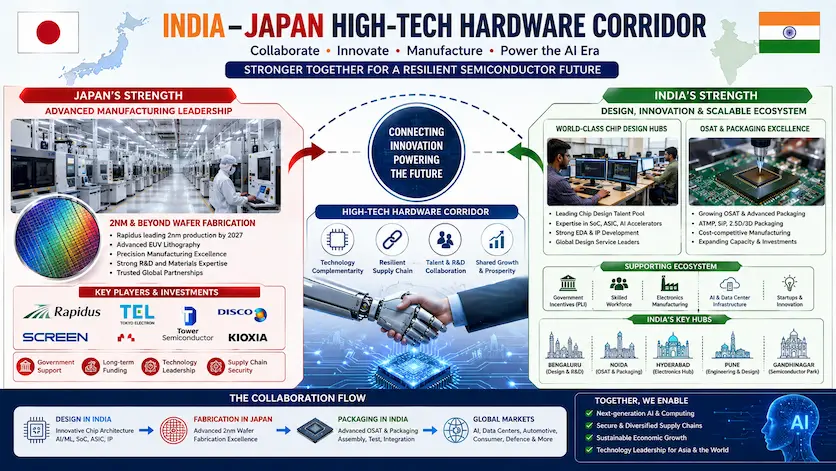
This renewed semiconductor push goes far beyond domestic boundaries. It establishes a complementary hardware corridor with India, which is simultaneously running its own ambitious electronics manufacturing and microchip development programs.
The Blueprint of Japan’s Advanced Fabrication Shift
At the very center of Tokyo’s industrial revival is Rapidus, a government-backed enterprise aiming to commercially manufacture next-generation 2-nanometer (2nm) logic chips within the next few years. These cutting-edge processors are engineered specifically for high-density environments, including AI data centers, autonomous mobility systems, advanced robotics, and defense technologies.
Rather than working in isolation, Japan is actively expanding its capabilities across the entire value chain:
Advanced Wafer Fabrication & EUV Technology: Accelerating deep collaborations with international technology pioneers for Extreme Ultraviolet (EUV) lithography.
Silicon Photonics: Integrating light-based communication into hardware architecture to bypass traditional electrical boundaries.
Advanced Materials and Equipment Manufacturing: Leveraging its historic core competency in critical semiconductor materials and precision factory tools.
India’s Complementary Infrastructure Leap
As Japan leads front-end fabrication, India is establishing itself as the region’s premier industrial accelerator, expanding rapidly from an intellectual design hub into a full-scale microchip ecosystem. Backed by structured government policies like the India Semiconductor Mission (ISM) and strategic midstream pushes like the Rare Earth Permanent Magnet (REPM) Scheme, India offers structural balance to the supply chain.
This partnership creates a natural alignment across several distinct industrial nodes:
1. Backend Assembly & OSAT Facilities
Advanced front-end fabrication requires specialized backend assembly. India is rapidly constructing Outsourced Semiconductor Assembly and Test (OSAT) facilities. By shifting final packaging, physical verification, and system testing to Indian manufacturing clusters, Japanese firms can build reliable end-to-end supply paths within a trusted Indo-Pacific framework.
2. The Design and Engineering Engine
India houses a massive percentage of the world’s chip design talent pool. Indian engineers frequently design the processor architectures, embedded software, and Electronic Design Automation (EDA) applications running modern technology. Fusing Japan’s advanced fabrication lines with India’s agile engineering capital drastically reduces development cycles and R&D expenditures.
3. Sovereign AI Infrastructure and Market Scaling
India’s domestic digital economy is scaling up at an incredible pace, driven by hyper-density data infrastructure and foundational frameworks like Digital Public Infrastructure (DPI). This creates a massive internal market for sovereign AI data centers, creating a natural consumer base for Japan’s high-performance AI logic processors.
Building Resiliency Across the Indo-Pacific
Recent global events have proven that high concentration in semiconductor manufacturing poses serious economic risks. Supply chain diversification has become essential.
By combining forces, the two nations reduce external vulnerabilities to sudden geopolitical shifts. This strategic partnership ensures that the future of artificial intelligence across Asia rests on a highly competitive, geographically diversified, and technologically robust foundation.
Frequently Asked Questions (FAQ)
Q1: What is the main objective of Japan’s Rapidus venture?
Rapidus is a government-backed enterprise aimed at restoring Japan’s leadership in front-end semiconductor manufacturing by achieving commercial production of cutting-edge 2-nanometer (2nm) logic chips for AI data centers, supercomputers, and autonomous technologies.
Q2: How does India complement Japan’s front-end manufacturing strengths?
While Japan focuses heavily on advanced fabrication and materials, India complements this through its massive pool of chip design engineers, rapidly expanding Outsourced Semiconductor Assembly and Test (OSAT) facilities, and a domestic market building high-density AI data center infrastructure.
Q3: Why have AI chips become a matter of national security?
Unlike traditional processors, AI chips execute billions of complex calculations simultaneously, serving as the backbone for critical infrastructure, defensive drones, smart manufacturing platforms, and sovereign cloud ecosystems.
Q4: Where can I read more about India’s high-tech manufacturing policies?
For comprehensive details on how India is handling midstream industrial security and technical gaps, explore the Rare Earth Permanent Magnet Scheme Policy Update and the evolving landscape of the India Semiconductor Mission and Tech Ecosystem on Matribhumi Samachar.
Disclaimer: This article is intended solely for informational, educational, and analytical purposes. The details regarding industrial investments, company goals, and bilateral frameworks are based on current macroeconomic updates and industrial reports available as of mid-2026.
