

Mumbai. Saturday, 18 July 2026
In a decisive move to secure its economic sovereignty and insulate domestic industries from volatile global shocks, India is preparing an aggressive, targeted push to localize approximately $51 billion worth of critical imports. Rather than deploying a broad, unguided approach across all imported goods, the Indian government has strategically isolated high-value industrial components, specialty raw materials, and advanced technology inputs that can be produced competitively within the country.
This massive initiative is designed to structurally transform India’s industrial base, transitioning the nation from an assembly-focused economy into an end-to-end global manufacturing powerhouse.
The Strategic Imperative: Why Localizing Critical Imports Matters
While the “Make in India” initiative has successfully catalysed the assembly of finished products—most notably smartphones and consumer electronics—deep-tier supply chains have remained heavily dependent on international suppliers for intermediate inputs. Recent global disruptions have made it clear that relying on foreign supply networks for foundational components presents a severe tactical and economic vulnerability.
By shifting its focus to domestic production capabilities for these crucial items, India aims to achieve several structural goals:
Elevated Industrial Self-Reliance: Ensuring domestic factories face minimal friction or dependency on external vendors for primary sub-components.
Insulated Supply Chains: Guarding vital industries against sudden border tensions, maritime logjams, and geopolitical export controls.
Job Creation in High-Tech Sectors: Moving beyond low-skill assembly lines to generate high-value engineering, chemistry, and technical positions.
Macroeconomic Stability: Drastically narrowing the trade deficit by substituting billions in recurring import expenditures with domestic value addition.
Fostering Local Deep-Tech Innovation: Encouraging real technology transfers, indigenous research, and domestic intellectual property (IP) creation.
Key High-Value Sectors Poised for Rapid Transformation
The localization framework specifically singles out advanced technological ecosystems and heavy capital goods industries where domestic manufacturing gaps are currently most pronounced.
1. Electronics and the Semiconductor Ecosystem
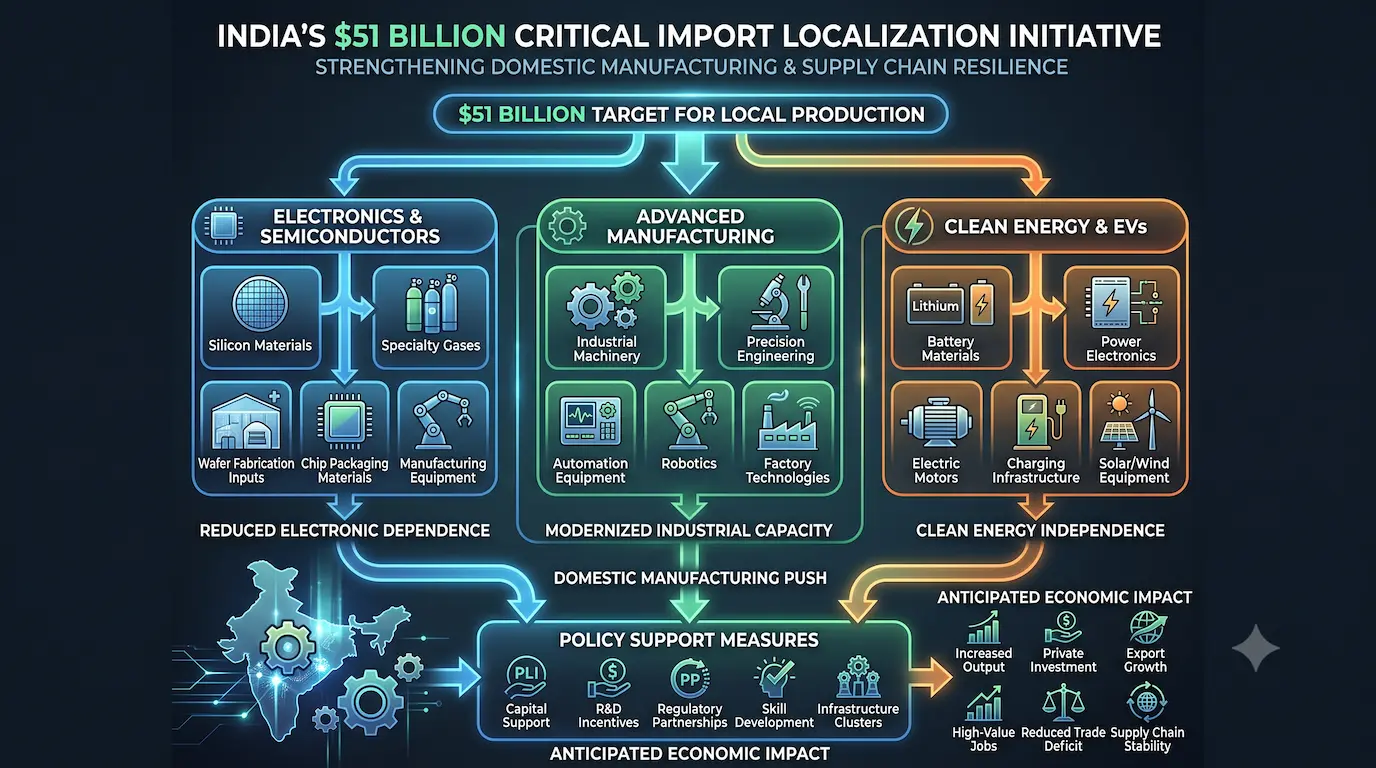
India is moving swiftly to build a comprehensive semiconductor supply chain. To complement the broader objectives of the India Semiconductor Mission 2.0, policy support will lean heavily toward upstream inputs. This includes accelerating the localization of silicon wafer materials, specialty electronics-grade gases, chip packaging substrates, and specialized components for fabrication equipment.
Furthermore, targeted assistance will bolster the domestic manufacturing of multi-layer Printed Circuit Boards (PCBs) and high-purity specialty chemicals required for precision electronics.
2. Advanced Manufacturing and Robotics
As Indian factories rapidly transition toward Industry 4.0, the requirement for heavy industrial machinery, precision engineering components, factory automation hardware, and robotics has scaled exponentially. The initiative aims to support local engineering firms in manufacturing high-performance CNC machines, automated tools, and advanced software layers to ensure the country builds its own production tools.
3. Electric Vehicles (EVs) and Clean Energy Infrastructure
Achieving true self-reliance in green mobility requires domestic control over the battery and powertrain ecosystem. The push focuses heavily on anchoring midstream capabilities, such as processing battery materials (Lithium, Cobalt, Nickel) and manufacturing power electronics, high-torque electric motors, and grid-scale energy storage components.
This directly complements existing high-tech initiatives, such as the government’s Rare Earth Permanent Magnet (REPM) Scheme, which targets the production of specialized magnets crucial for both EV traction motors and aerospace electronics.
┌─────────────────────────────────────────────────────────────┐
│             $51 BILLION CRITICAL IMPORTS TARGET             │
└──────────────────────────────┬──────────────────────────────┘
                               │
         ┌─────────────────────┼─────────────────────┐
         ▼                     ▼                     ▼
┌─────────────────┐   ┌─────────────────┐   ┌─────────────────┐
│   ELECTRONICS   │   │    ADVANCED     │   │  CLEAN ENERGY   │
│ & SEMICONDUCTORS│   │  MANUFACTURING  │   │     & EVs       │
├─────────────────┤   ├─────────────────┤   ├─────────────────┤
│ • Silicon Wafers│   │ • CNC Machinery │   │ • Battery Cells │
│ • Specialty Gas │   │ • Robotics      │   │ • REPM Magnets  │
│ • Advanced PCBs │   │ • Factory Auto. │   │ • Power Elect.  │
└─────────────────┘   └─────────────────┘   └─────────────────┘
The Execution Blueprint: Evolving Beyond Protective Tariffs
Unlike traditional import substitution models that relied strictly on defensive import tariffs—which can inadvertently inflate production costs for domestic manufacturers—this strategic push utilizes a proactive, modern policy toolkit:
Refined Production-Linked Incentives (PLI): Restructuring existing financial incentives to reward upstream component processing and raw material refinement rather than final-stage assembly.
Deep-Tier Joint Ventures: Actively incentivising cross-border technology transfers. By streamlining regulatory pathways, the government is prompting domestic industrial houses to form joint ventures with global technological pioneers from nations like Japan, Germany, Taiwan, and South Korea.
Targeted Bilateral Pacts: Strategically leveraging comprehensive trade deals, such as the India-Australia CECA, to guarantee seamless, tariff-free access to raw critical minerals like lithium and cobalt, ensuring domestic factories have the raw feedstocks required for processing.
Industrial Cluster Upgrades: Constructing plug-and-play manufacturing parks with common effluent treatment plants, shared testing laboratories, reliable power grids, and integrated multi-modal logistics links to lower structural overheads.
Addressing Structural Roadblocks to Ensure Success
While the economic potential is immense, transforming India’s deep-tier industrial capacity requires overcoming entrenched operational bottlenecks:
Bridging the Tech Gap: Cultivating advanced midstream metallurgical and chemical skills, such as turning raw rare earth oxides into high-performance permanent magnets.
Sustaining Global Price Competitiveness: Ensuring that locally manufactured sub-components can match the aggressive pricing and massive economies of scale enjoyed by dominant global exporters.
Talent Pipeline Development: Re-aligning academic curricula and technical vocational training to produce specialized engineers, semiconductor technicians, and automated systems operators at scale.
By directly resolving these foundational constraints through deep institutional collaboration, India is systematically laying down the tracks to transition into a robust, self-sustaining manufacturing superpower capable of anchoring global technology supply chains.
Frequently Asked Questions (FAQ)
Q1: What is the main objective of India’s $51 billion manufacturing push?
A: The initiative focuses on identifying and domestically producing high-value intermediate industrial components, raw materials, and advanced technology inputs that India currently imports. The goal is to reduce import dependence, enhance supply chain resilience, lower the trade deficit, and elevate the country into a global manufacturing hub.
Q2: How does this strategy differ from traditional “Make in India” programs?
A: Traditional programs often yielded high results in end-product assembly (e.g., putting smartphones together). This targeted push focuses strictly on the upstream and midstream sub-components—like silicon materials, electronics-grade specialty gases, and power electronics—ensuring that the foundational building blocks are made domestically.
Q3: Which sectors will see the most significant policy support under this push?
A: The primary beneficiary sectors include Semiconductor Ecosystems, Electronics Manufacturing, Advanced Capital Goods (Robotics and Factory Automation), Electric Vehicles (powertrains and battery chemistry), and Renewable Energy Infrastructure components.
Q4: How does this initiative link with international agreements like the India-Australia CECA?
A: To manufacture complex sub-components domestically, India requires a steady supply of raw critical materials. Trade frameworks like the India-Australia CECA help secure reliable, low-tariff access to vital base elements (like lithium, cobalt, and nickel), which are then processed inside India rather than imported as finished foreign components.
Related Coverage and Essential Links
For deeper analysis on India’s evolving economic, high-tech, and manufacturing frameworks, explore our comprehensive reporting on the Matribhumi Samachar English Portal:
To understand how India is securing the raw inputs needed for this high-tech manufacturing push, read our breakdown on the India Australia CECA Trade and Critical Mineral Framework.
Discover how the nation is expanding its downstream high-tech manufacturing capacities via the India Rare Earth Permanent Magnet (REPM) Manufacturing Initiative.
Learn how the expansion of factory outputs is driving record revenues in our special report on India’s Manufacturing Expansion and Economic Performance.
Disclaimer: This article is intended solely for informational, educational, and journalistic purposes. The analysis regarding India’s industrial strategies, critical import targets, and policy frameworks is synthesized from recent industrial publications, economic trends, and public ministerial outlines available as of July 2026.
