

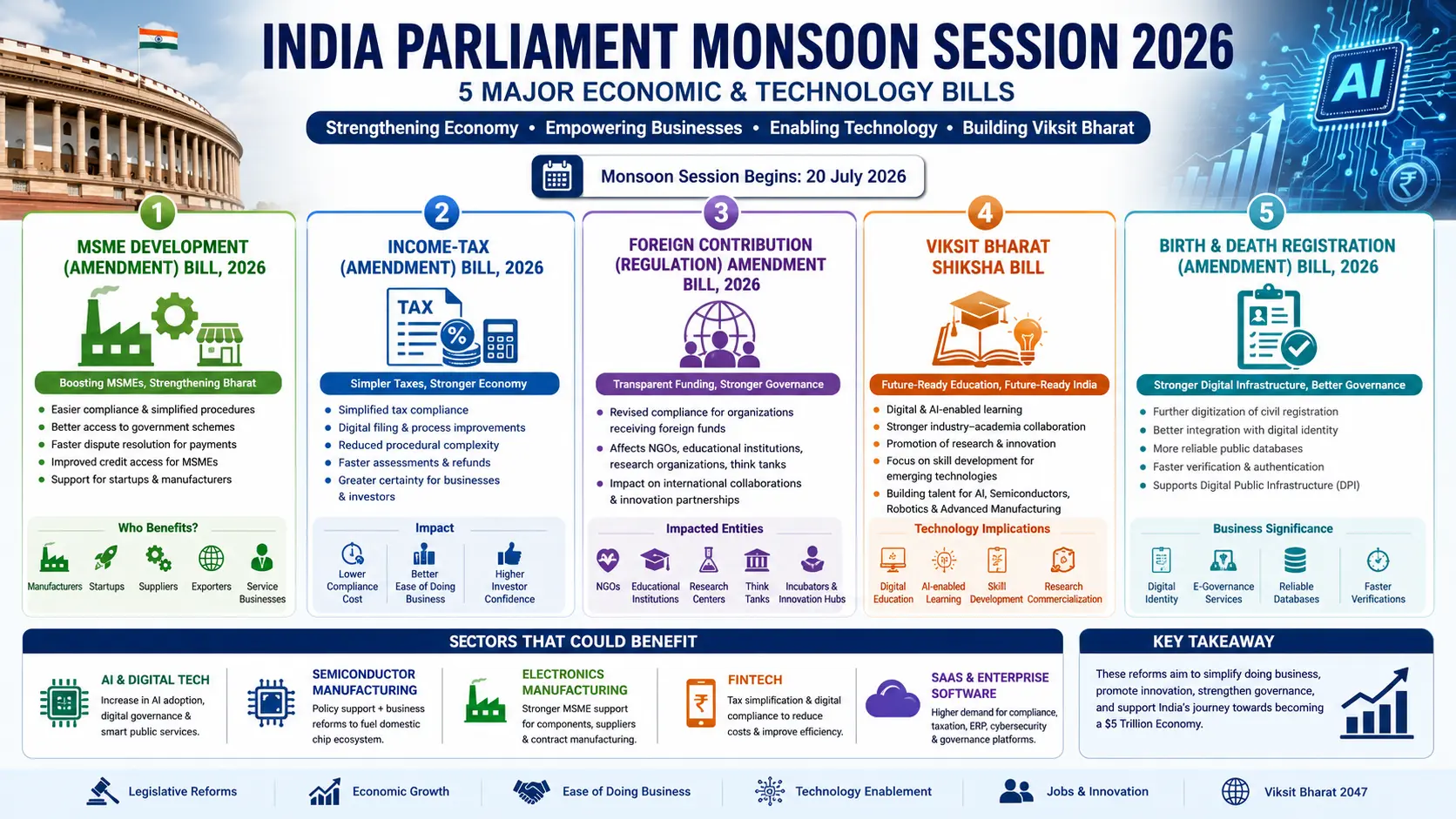
New Delhi. Saturday, 18 July 2026
India’s digital economy, startup ecosystem, and industrial sectors are bracing for a highly significant legislative roadmap as the Monsoon Session of Parliament prepares to commence on July 20, 2026. Beyond the usual political headlines, this session’s core legislative agenda features five critical bills that could fundamentally lower compliance friction, unlock credit pathways, and secure long-term investments for businesses, tech startups, and micro, small, and medium enterprises (MSMEs).
For absolute clarity on how these upcoming reforms will restructure the landscape for founders, institutional investors, and digital service providers, here is a detailed, breakdown of the central legislative proposals.
1. MSME Development (Amendment) Bill, 2026
Designed to shift the oversight of small businesses from heavy-handed compliance to trust-based governance, this bill directly attacks the systemic bottlenecks that choke operational liquidity for smaller vendors.
Key Operational Shifts: The amendment focuses on faster dispute resolution for delayed payments, granting micro and small enterprises robust enforcement options to recover locked capital from larger corporate or state buyers.
Primary Beneficiaries: Tech startups, electronics manufacturers, and domestic component suppliers.
The Tech Edge: Streamlined transaction reporting will create a major demand spike for automated compliance SaaS, while transaction-history credit models will help alternative digital lenders assess risk for tech manufacturers without requiring traditional physical collateral.
2. Income-tax (Amendment) Bill, 2026
Aiming to build clear tax predictability, this piece of legislation focuses on simplifying filing frameworks and eliminating historical friction points for incoming institutional capital.
Key Operational Shifts: Expect highly digitized assessment flows, faster processing timelines, and definitive rules on digital transaction treatments.
The Investment Catalyst: By offering a more structured tax framework, the bill signals a highly stable, predictable environment for global venture capital and late-stage growth funds looking to increase exposure to the Indian digital economy.
3. Foreign Contribution (Regulation) Amendment Bill, 2026
This proposal introduces tighter administrative check-and-balance parameters over organizations utilizing overseas capital injections.
Key Operational Shifts: The amendments introduce clear legal pathways regarding how foreign-funded assets are monitored, closing existing compliance gaps for entities that receive international monetary inputs.
Incubator Impact: High-tech research hubs, universities, and incubator setups managing cross-border innovation partnerships must audit their internal structures to ensure absolute alignment with evolving foreign-funding regulations.
4. Viksit Bharat Shiksha Bill
Bridging the historic talent-mismatch gap in highly technical domains, this bill modernizes institutional learning and prioritizes the commercial translation of deep-tech research.
Key Operational Shifts: The bill introduces strong frameworks for direct industry-academia collaboration, making it simpler for university-born intellectual property (IP) to spin off into commercial, venture-backed tech startups.
Talent Pipeline: The statutory upgrades focus heavily on scaling up skilled professionals in critical fields such as artificial intelligence, semiconductor chip design, advanced robotics, and industrial automation.
5. Birth & Death Registration (Amendment) Bill, 2026
While administrative on the surface, this bill operates as a primary structural expansion for India’s Digital Public Infrastructure (DPI) model.
Key Operational Shifts: Deepening the accuracy and integration of real-time public verification databases.
FinTech and Enterprise Utility: For insurance tech platforms, digital banks, and SaaS onboarding teams, an instantaneous digital identity grid means drastically reduced drop-off rates and fully secure, remote user authentication (Know Your Customer/KYC) cycles.
Tactical Action Items for Business Leadership
Verify Compliance Structures: Companies operating with heavy international partnerships should proactively check capital structures before updated foreign-contribution rules take full effect.
Optimize Accounts Payable: Enterprise buyers must check vendor payment terms to stay ahead of the stricter timelines set by the incoming MSME changes.
Monitor Implementation Dates: Track passing timelines and subsequent rule notifications from committees to properly phase in technology upgrades.
For complete day-to-day updates and deep-dive analysis on parliamentary bills affecting regional businesses, keep track of real-time legislative reporting at Matribhumi Samachar English.
Frequently Asked Questions (FAQs)
Q1: When does the Monsoon Session of Parliament begin?
The session officially begins on 20 July 2026.
Q2: How does the MSME Amendment Bill solve delayed payments?
It updates enforcement frameworks, enabling smaller businesses to quickly settle disputes and legally recover outstanding payments from large corporate buyers.
Q3: Will the Viksit Bharat Shiksha Bill immediately help deep-tech startups?
Yes, by legally simplifying university research commercialization, it allows founders to spin proprietary technological discoveries out of lab environments into companies faster.
Q4: Which technology sectors will experience the highest immediate impact?
Enterprise SaaS providers, automated compliance tech, alternative FinTech lenders, and AI-enabled education platforms are expected to see the fastest regulatory tailwinds.
Disclaimer: The information provided in this article is for informational purposes only, based on current legislative agendas and public policy drafts as of July 2026. It does not constitute formal legal or financial advice. The final operational impact depends entirely on the versions of the bills passed by Parliament and the subsequent rules notified by the respective ministries.
