

Mumbai. Wednesday, 22 July 2026
India’s industrial narrative is undergoing a monumental shift. Backed by strategic government mandates—such as the Production Linked Incentive (PLI) schemes, rapid expansions in electronics manufacturing clusters, and massive semiconductor investments—the country has firmly established itself as one of the world’s fastest-growing manufacturing destinations.
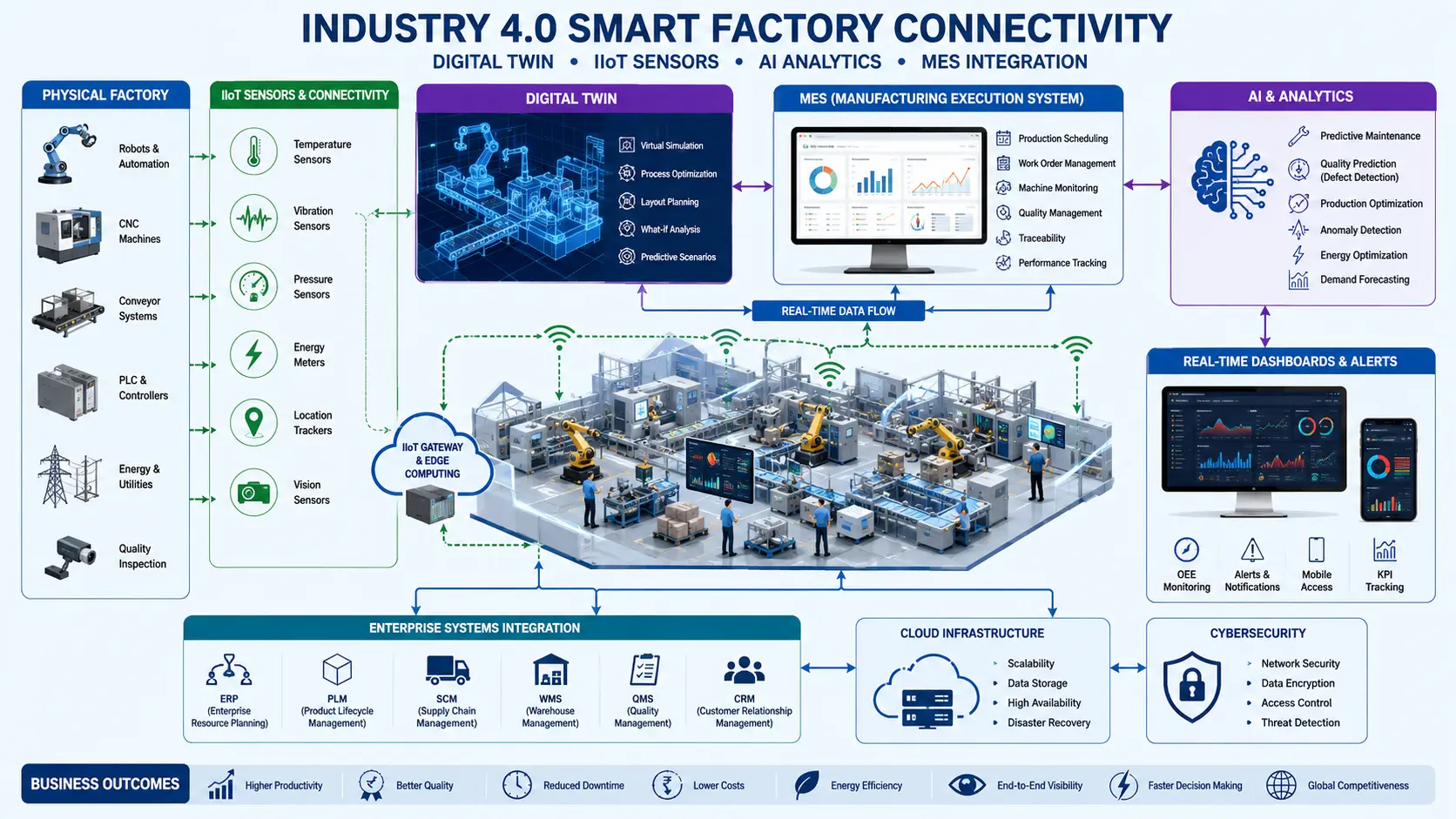
However, building physical factory floors and deploying heavy machinery is only half the battle. India’s next phase of economic expansion depends heavily on smart manufacturing software. Software tools like Manufacturing Execution Systems (MES), Digital Twins, Industrial Internet of Things (IIoT), and Artificial Intelligence are serving as the core digital backbone of Industry 4.0.
┌─────────────────────────────────────────────────────────────────┐
│                 THE MODERN SMART FACTORY STACK                  │
├───────────────────────────────┬─────────────────────────────────┤
│ ERP (Enterprise Planning)     │ Business Strategy & Finance     │
│ MES (Execution Engine)        │ OEE, Scheduling, Traceability   │
│ Digital Twins & AI Analytics  │ Virtual Simulation & Prediction │
│ IIoT & SCADA / PLCs           │ Sensors, Edge Data & Telemetry  │
└───────────────────────────────┴─────────────────────────────────┘
Manufacturing Is Becoming Software-Driven
Modern shop floors generate immense volumes of operational data across robots, quality control stations, and inventory belts. Without intelligent software to process these streams, valuable insights remain trapped inside static spreadsheets.
Smart software replaces manual reporting with real-time visibility, helping manufacturers:
Increase overall equipment effectiveness (OEE) and boost production output.
Reduce unplanned downtime through automated predictive maintenance.
Optimize energy consumption and minimize waste along assembly lines.
Elevate product quality and lower defect ratios.
The Digital Architecture of Industry 4.0
1. Manufacturing Execution Systems (MES)
Consider the MES as the factory’s central nervous system. It bridges high-level enterprise resource planning (ERP) systems with low-level shop-floor operations. An MES tracks production scheduling, machine utilization, operator throughput, and material consumption in real time.
2. Digital Twins
A Digital Twin creates a high-fidelity virtual replica of a physical machine or an entire facility. Fueled by real-time sensor data, manufacturers can virtually simulate floor plan adjustments, stress-test new product lines, and eliminate production bottlenecks before making capital-heavy physical changes.
3. Industrial Internet of Things (IIoT)
IIoT platforms connect physical sensors across the plant. By continuously monitoring variables such as temperature, vibration, power draw, and motor speeds, IIoT systems funnel raw operational telemetry into predictive AI analytics engines.
4. AI-Assisted Manufacturing
AI moves factory operations from reactive repair to proactive prevention. Using computer vision models for rapid surface defect detection and machine-learning algorithms to forecast component failures, AI optimizes inventory cycles and fine-tunes automated scheduling dynamically.
The Integrated Factory Software Stack
To build a fully connected, self-optimizing factory, industrial leaders integrate multiple software layers into a unified ecosystem:
| Software Platform | Primary Function |
| ERP | Business planning and resource allocation |
| MES | Production execution, work orders, and tracking |
| SCADA / PLC | Supervisory control, data acquisition, and hardware execution |
| Digital Twin | Virtual simulation and layout optimization |
| IIoT Platform | Edge sensor connectivity and telemetry gathering |
| AI Analytics | Predictive maintenance and decision support |
| WMS / QMS | Inventory tracking and regulatory compliance |
Why India Needs Digital Manufacturing Now
As India scales up high-precision sectors—including semiconductor fabrication, electric vehicles (EVs), defense, aerospace, pharmaceuticals, and green hydrogen equipment—the margin for error shrinks to near zero. Global supply chain buyers demand complete product traceability, standardized quality parameters, and high-speed delivery.
Addressing Adoption Barriers
While the opportunity is vast, challenges such as high upfront setup costs for Small and Medium Enterprises (SMEs), legacy machinery integration, digital skill gaps, and industrial cybersecurity must be addressed. The rising adoption of cloud-based industrial platforms and government-supported automation initiatives is helping bridge this divide.
Frequently Asked Questions (FAQ)
Q1: What is the main difference between ERP and MES in smart manufacturing?
Answer: ERP (Enterprise Resource Planning) focuses on high-level business operations like finance, supply chain purchasing, and human resources. MES (Manufacturing Execution System) operates on the shop floor, tracking real-time production processes, machine performance, and quality control.
Q2: How do Digital Twins help reduce manufacturing costs?
Answer: Digital Twins allow engineers to virtually test equipment layout changes, simulate workflow modifications, and predict machine breakdowns before they occur. This prevents costly physical downtime and unnecessary capital expenditure.
Q3: Why is IIoT important for predictive maintenance?
Answer: IIoT devices attach sensors to critical machinery to record operational parameters like temperature and vibration. AI algorithms analyze these streams to detect early wear and tear, alerting maintenance teams before a cataclysmic equipment failure occurs.
Related Coverage & Links
Smarter, Faster, Safer: How Artificial Intelligence is Transforming the Factory Floor
India’s Silicon Boom: Top Semiconductor Opportunities and Ecosystem Growth
Disclaimer
The information provided in this article is for general informational and educational purposes only. While every effort has been made to present accurate and current data regarding smart manufacturing technologies, Industrial IoT frameworks, and national industrial policies, market conditions, technology specifications, and government guidelines are subject to change. Readers should consult qualified industrial software consultants and enterprise tech specialists before making capital-intensive software deployment decisions.
