

Mumbai. Wednesday, 22 July 2026
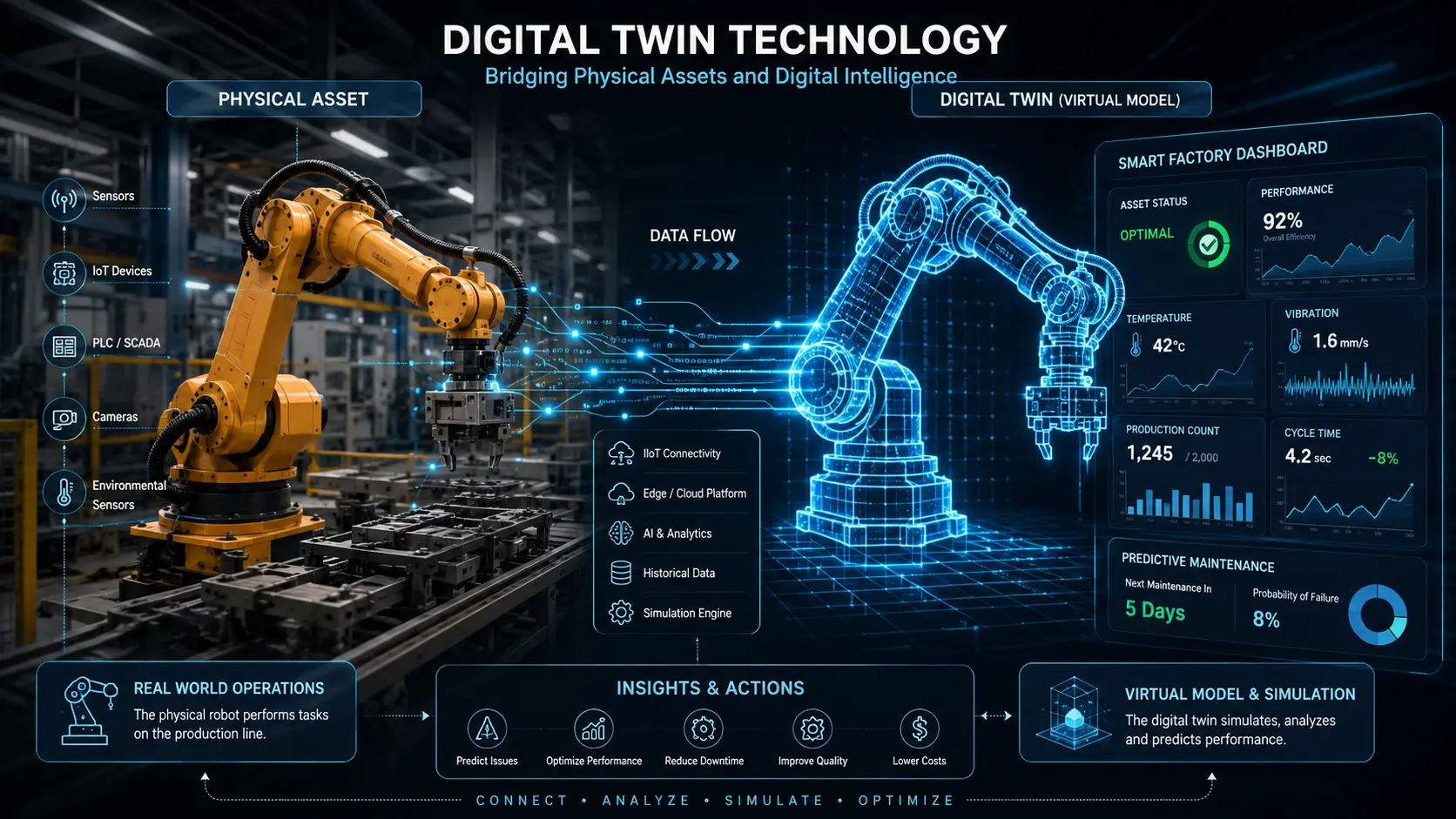
As global manufacturing rapidly transitions into the hyper-connected era of Industry 4.0, Digital Twin technology has emerged as one of the most critical structural innovations for modern industrial ecosystems. By mapping dynamic, real-time physical assets into intelligent digital replicas, industrial enterprises can monitor operations, predict machinery failures, optimize throughput, and reduce capital expenditures—all without interrupting live production lines.
For emerging global manufacturing powerhouses like India, the widespread adoption of Digital Twins is fundamentally reshaping productivity, quality assurance, and international competitiveness across electronics, automotive, defense, and heavy engineering sectors.
What Is Digital Twin Technology?
A Digital Twin is a real-time, dynamic virtual model of a physical asset, operational process, or complete production facility. Unlike static 3D CAD renders or passive architectural blueprints, a Digital Twin continuously ingests telemetry data from physical sensors, Industrial Internet of Things (IIoT) end-nodes, and enterprise software platforms.
┌────────────────────────────────────────────────────────────────────────┐
│                        DIGITAL TWIN ECOSYSTEM                          │
├───────────────────┬────────────────────────────┬───────────────────────┤
│    IIoT & 5G      │     Artificial Intelligence│   Enterprise Systems  │
│  Sensor Streams   │     & Machine Learning     │     (MES & ERP)       │
└─────────┬─────────┴──────────────┬─────────────┴───────────┬───────────┘
          │                        │                         │
          ▼                        ▼                         ▼
┌────────────────────────────────────────────────────────────────────────┐
│               CONTINUOUS REAL-TIME VIRTUAL REPLICATION                 │
└────────────────────────────────────────────────────────────────────────┘
The technology merges key deep-tech pillars into a unified intelligence layer:
Industrial IoT (IIoT) & 5G Edge Arrays: Capturing vibration, acoustic, thermal, and pressure signals.
Artificial Intelligence & Machine Learning: Processing telemetry to predict anomalies and run optimization algorithms.
Cloud & Edge Computing: Providing scalable memory and real-time operational feedback.
Manufacturing Execution Systems (MES) & ERP: Syncing factory-floor execution directly with enterprise resource planning.
The Bi-Directional Digital Twin Workflow
Digital Twin operations rely on a closed-loop feedback pipeline:
Sensor Ingestion: Physical sensors attached to CNCs, robotics, and conveyers capture operational metrics continuously.
High-Speed Transmission: Data routes securely via 5G networks or edge nodes to processing backbones.
AI Evaluation: Deep learning models analyze real-time asset health, efficiency bottlenecks, and performance degradation patterns.
Virtual Mirroring: The digital replica updates instantaneously, mirroring physical state changes on administrative dashboards.
Scenario Simulation: Engineers run “what-if” stresses, line recalibrations, or workload shifts in the virtual model.
Physical Execution: Automated actuators or engineers deploy optimized configurations back to the shop floor.
Core Operational Benefits
1. Predictive Maintenance Over Reactive Repair
Rather than waiting for high-value components to break down or servicing equipment on arbitrary schedules, Digital Twins forecast mechanical failures before they occur. This drastically cuts unplanned downtime, reduces spare-part overhead, and prolongs capital equipment lifespan.
2. Throughput & Workflow Optimization
Engineers identify micro-bottlenecks and machine idling in real time. By testing alternative workflow routing virtually, factories maximize throughput without risking physical crashes or line stoppages.
3. Early Defect Detection & Quality Control
By continuously tracking environmental and operational parameters (e.g., thermal fluctuations during semiconductor precision welding), Digital Twins flag defect risks early. This minimizes material waste, rework expenses, and customer warranty claims.
4. Zero-Risk Virtual Testing
Before deploying capital for new assembly lines, robotic programming updates, or plant layouts, manufacturers test everything in the simulation. Potential line collisions or ergonomic faults are resolved digitally prior to hardware procurement.
5. Energy Management & ESG Sustainability
Digital Twins track energy utilization per unit produced, highlighting power-hogging machinery, idle-time power drain, and peak-demand strain. This actionable data directly supports corporate carbon reduction targets.
Cross-Industry Applications
| Sector | Primary Digital Twin Use Cases | Key Outcome |
| Automotive | Assembly line simulation, paint shop airflow optimization, robotic weld monitoring. | Reduced cycle times and zero-defect body coating. |
| Electronics & Semiconductors | PCB assembly tracing, cleanroom thermal control, precision quality inspection. | Yield maximization on micron-level manufacturing. |
| Aerospace & Defense | Jet engine stress simulations, structural fatigue tracking, predictive maintenance. | Extended fleet readiness and zero critical-failure margins. |
| Pharmaceuticals | Bioreactor process validation, sterile room climate control, regulatory compliance automation. | Strict batch consistency and seamless audit trails. |
| Heavy Engineering | Large turbine state monitoring, foundry heat profiling, shop-floor schedule optimization. | Operational risk mitigation and lower downtime costs. |
The Strategic Imperative for India’s Manufacturing Ecosystem
As India positions itself as a competitive global manufacturing hub—fueled by national initiatives like Make in India, domestic semiconductor incentive programs, and regional AI policies—Digital Twin adoption is transitioning from a luxury to a baseline requirement.
By integrating IIoT, localized cloud data centers, and advanced AI models, Indian manufacturers can leapfrog traditional operational inefficiencies, lower production costs, and meet stringent international quality benchmarks required by global supply chains.
Recommended Contextual Reading
For broader insights into shop-floor automation, explore Smarter, Faster, Safer: How Artificial Intelligence is Transforming the Factory Floor on Matribhumi Samachar.
To understand supply chain integration, read The Blueprint of Modern Tech: Mapping the Complete Electronics Manufacturing Supply Chain.
Discover how policy frameworks are shaping deep tech via Haryana Digital Transformation: Capitalizing on the 2026 AI and Data Centre Policies.
For workforce trends in deep tech, check The Silicon and AI Revolution: High-Value Engineering Careers Exploding in India.
Frequently Asked Questions (FAQs)
What is the main difference between a traditional 3D CAD model and a Digital Twin?
A static 3D CAD model represents physical geometry at a fixed moment in design. A Digital Twin is dynamic and continuously connected to the real asset through IIoT sensors, updating in real time to reflect live operational states, temperature, wear, and throughput.
How does Artificial Intelligence enhance Digital Twin platforms?
AI introduces predictive and prescriptive capabilities to Digital Twins. Instead of merely displaying data, AI models analyze historical and real-time streams to forecast equipment failure, execute automated root-cause analyses, and optimize production schedules autonomously.
What are the main challenges companies face when adopting Digital Twins?
Key hurdles include high initial deployment costs, retrofitting sensor arrays on legacy non-digital machinery, cybersecurity risks associated with network-connected industrial assets, software interoperability issues, and a shortage of skilled deep-tech engineers.
Disclaimer
The technical and economic information contained in this article is intended solely for educational and informational purposes. Manufacturing strategies, technological implementations, and software deployments should be evaluated on an individual basis with certified Industry 4.0 systems integrators and enterprise security specialists.
