

Mumbai. Friday, 24 July 2026
Generative AI has fundamentally reshaped digital creative workflows, software development, and automated text creation over recent years. However, the next monumental frontier in artificial intelligence is taking shape on factory floors, inside supply chains, and across agricultural fields: Physical AI.
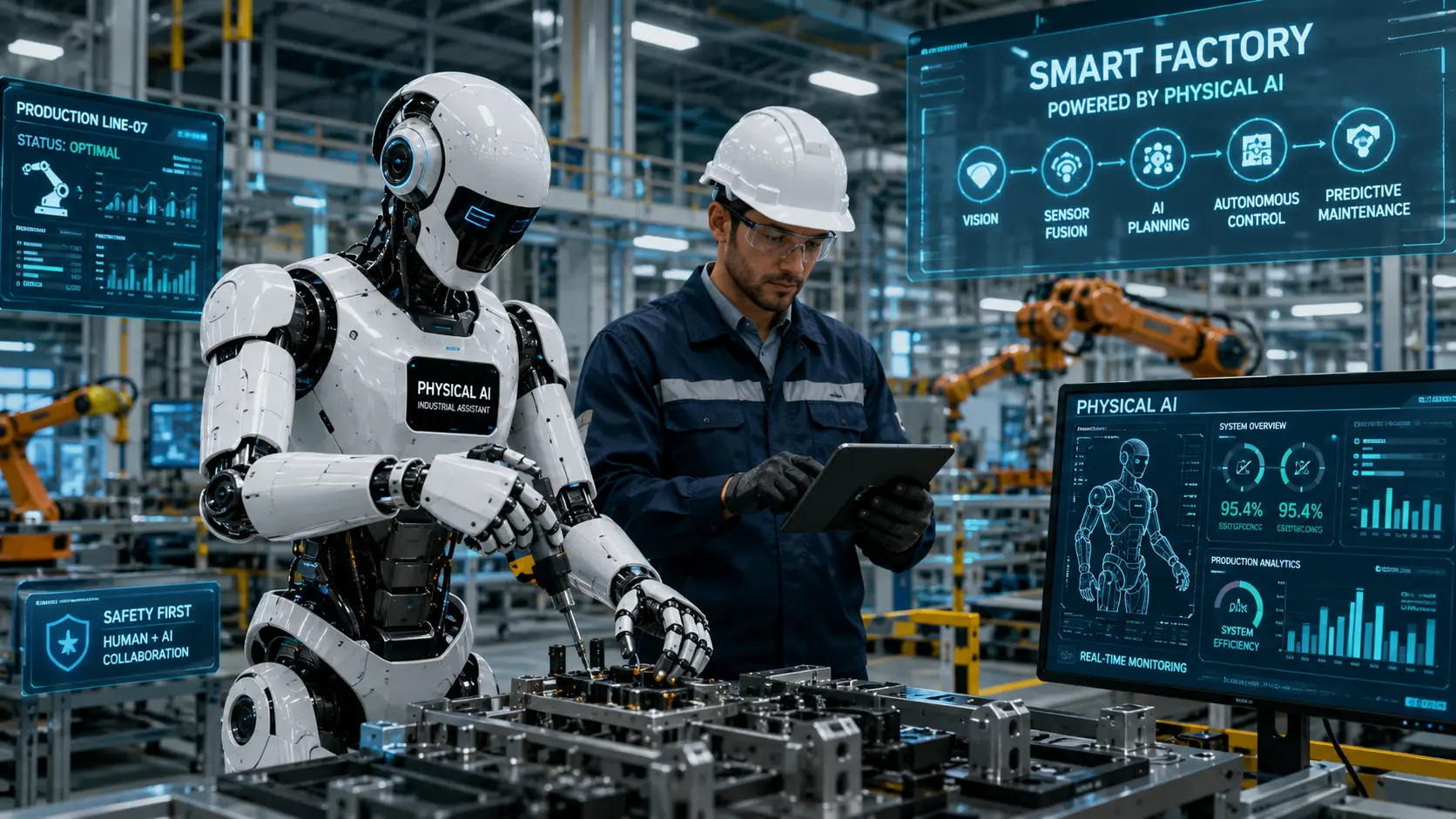
Unlike Generative AI, which operates primarily within software and digital canvases, Physical AI enables machines to perceive, reason about, and physically act within the real world. From self-driving mining trucks and warehouse pickers to surgical robots and precision agricultural drones, Physical AI represents the backbone of Industry 5.0.
       Digital Intelligence                     Physical Action
[ Generative AI Models ]  ---> (Sensors + Edge) ---> [ Physical AI Robotics ]
 (LLMs, Text, Code, Media)                            (Actuators, Motion, Fleet)
What Is Physical AI?
Physical AI refers to artificial intelligence architectures capable of sensing, modeling, planning, and executing actions in physical space. Rather than generating a document or rendered picture, a Physical AI engine processes multi-sensor data streams (cameras, Lidar, radar, force sensors, and microphones) to make split-second real-world navigational and operational decisions.
                  ┌────────────────────────┐
                  │     Sensory Input      │
                  │ (Lidar, Radar, Vision) │
                  └───────────┬────────────┘
                              │
                              ▼
                  ┌────────────────────────┐
                  │  World Modeling & AI   │
                  │   Foundation Models    │
                  └───────────┬────────────┘
                              │
                              ▼
                  ┌────────────────────────┐
                  │ Continuous Planning &  │
                  │    Actuator Motion     │
                  └────────────────────────┘
These systems unify multiple advanced technological domains:
Computer Vision & Sensor Fusion: Real-time spatial mapping and obstacle detection.
Spatial Foundation Models: Neural models trained on 3D geometry and physical mechanics.
Reinforcement Learning: Adaptive control policies for dynamic locomotion and force manipulation.
Edge Computing: Low-latency onboard inference hardware running directly on mobile robots.
Generative AI vs. Physical AI: Core Differences
While both domains rely on advanced machine learning algorithms, their objectives, operating environments, and structural constraints differ drastically.
| Operational Feature | Generative AI | Physical AI |
| Primary Domain | Digital environments & software | Physical environments & hardware |
| Output Type | Text, code, audio, and images | Kinetic movement, assembly, navigation |
| Compute Location | Cloud-centric datacenters | Onboard Edge hardware + Cloud hybrid |
| Primary Function | Knowledge work & content creation | Industrial execution & physical tasks |
| Safety Thresholds | Tolerates text hallucination or retry | Zero-tolerance for physical collisions/accidents |
Generative AI provides answers and generates ideas; Physical AI moves physical objects, navigates volatile environments, assembles intricate machinery, and monitors critical infrastructure autonomously.
Why Physical AI Is Surging in 2026
The rapid acceleration of Physical AI from research labs into commercial deployment is driven by several converging technology shifts:
Multimodal Spatial Foundation Models: Modern models now perceive physical spatial dynamics, 3D geometry, and object resistance rather than just 2D pixel grids.
High-Performance Edge AI Chips: Onboard neural processing units (NPUs) handle real-time spatial calculations at the microsecond level.
Digital Twins & High-Fidelity Simulation: Hyper-realistic physics engines allow thousands of robotic fleets to train safely in virtual factory replicas prior to physical deployment.
Resilient Industrial Private Networks: Private 5G and low-latency Wi-Mesh networks allow real-time telemetry sharing across enterprise fleets.
Key Industry Applications
1. Smart Manufacturing & Assembly
Automated production floors deploy collaborative robots (cobots) that learn worker movements, conduct real-time AI optical quality checks, and adjust assembly forces on the fly.
2. Autonomous Warehousing & Logistics
Modern fulfillment centers utilize autonomous forklifts, picking arms, and inventory-scanning drones to optimize supply chain throughput without human intervention.
3. Precision Agriculture
AI-enabled tractors and field sensors evaluate soil moisture, identify crop diseases, and conduct micro-precision spraying to increase yield while reducing chemical usage.
4. Healthcare & Surgical Robotics
Surgical assistance systems precise down to sub-millimeter scales work alongside clinical staff, while autonomous service units handle hospital logistics and pharmacy distribution.
India’s Strategic Position in Physical AI
India stands at a pivotal juncture to leverage Physical AI across its expanding manufacturing, electronics assembly, and defense infrastructure. Initiatives supporting semiconductor packaging, domestic electronics manufacturing, and agricultural digitalization (such as AgriStack) create a fertile foundation for widespread adoption.
Related Reads on Matribhumi Samachar
Aether AI Raises $20 Million Seed Round to Build Causal World Models for Robotics
Smarter, Faster, Safer: How Artificial Intelligence is Transforming the Factory Floor
Complete Guide to eNAM Portal 2026: Mandatory Digital ID & AI Crop Quality Testing
Beyond Chatbots: How Artificial Intelligence is Rewriting the Rules of Operations
Frequently Asked Questions (FAQ)
What is the main difference between Generative AI and Physical AI?
Generative AI creates digital assets like text, images, and code in software environments. Physical AI interacts with the physical world using sensors and actuators to navigate spaces, move objects, and operate physical machinery.
Is Physical AI going to replace Generative AI?
No. Physical AI complements Generative AI. In a modern automated ecosystem, Generative AI handles documentation, product design, and strategic data analysis, while Physical AI executes physical manufacturing, assembly, and logistics.
What technology powers Physical AI systems?
Physical AI relies on a full-stack integration of sensor fusion (Lidar, radar, vision), spatial foundation models, reinforcement learning, edge compute hardware, and digital twin simulation environments.
Disclaimer
Disclaimer: The information provided in this article regarding Physical AI, robotics, industrial automation trends, and technological policies is intended for educational and general informational purposes only. Industrial implementation schedules, regulatory frameworks, and tech capabilities are subject to rapid updates by respective technology providers and regulatory bodies.
