

Mumbai. Friday, 24 July 2026
India’s clean energy ambitions are taking center stage in the global energy transition. With an ambitious target of installing 500 gigawatts (GW) of non-fossil fuel electricity capacity by 2030, the nation is racing ahead to harness the power of the sun. From sprawling utility-scale solar parks across desert terrains to rooftop panels atop urban homes through the PM Surya Ghar programme, solar energy is driving India’s green growth.
However, beneath this impressive surge lies a critical structural puzzle: the solar cell and wafer manufacturing bottleneck. While India has built world-class capacity in assembling finished solar modules (panels), it still relies heavily on imported solar cells and silicon wafers to power them. Closing this supply chain gap is now the defining challenge for India’s clean energy ecosystem.
The Missing Link: Modules vs. Solar Cells
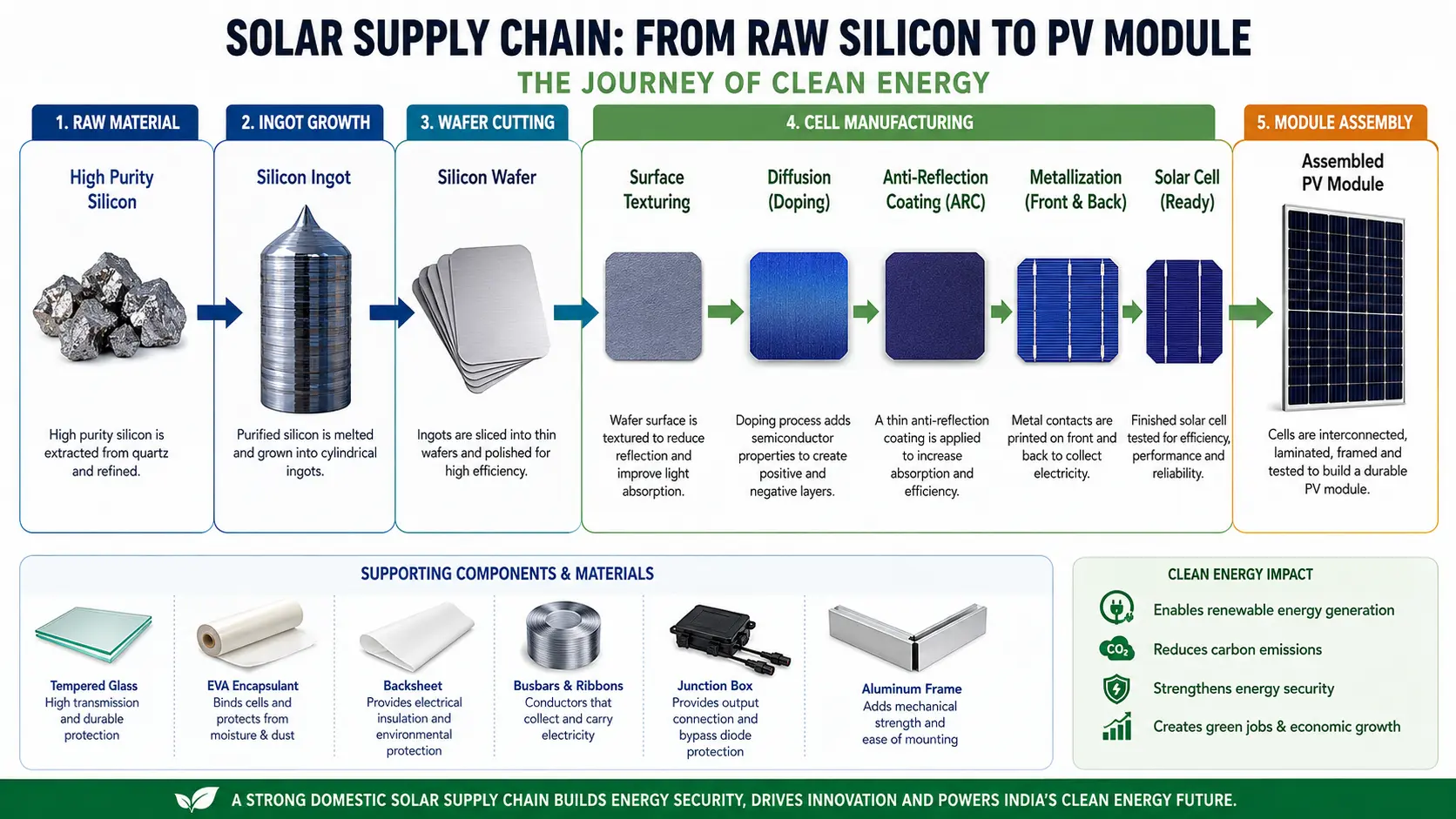
To understand the challenge, it helps to look at how solar panels are made:
Polysilicon Raw Material  ➔  Silicon Ingot & Wafer  ➔  Solar Cell  ➔  Solar Module (Panel)
                               [The Missing Link]                 [High Domestic Capacity]
A solar panel (module) is essentially an assembly of multiple interconnected photovoltaic solar cells. Over recent years, India has expanded its module assembly capacity significantly. However, because domestic production of high-efficiency solar cells has not kept pace, module manufacturers often face a dilemma:
Import cells at higher costs subject to international price swings and freight tariffs.
Operate factory lines below capacity when global cell shipments experience delays.
When supply chain disruptions occur, module factories end up underutilized despite soaring domestic demand for clean electricity.
Why Is Solar Cell Manufacturing Harder Than Module Assembly?
Assembling solar modules is largely a mechanical and automated process involving soldering, glass lamination, and framing. In contrast, manufacturing solar cells is an intricate semiconductor science requiring far greater technical sophistication and financial investment.
Key components of cell manufacturing include:
High-Purity Silicon Wafers: Ultra-thin wafers that serve as the foundational substrate for electrical charge generation.
Precision Diffusion Furnaces: Advanced thermal processing equipment to introduce electrical impurities (doping) into silicon.
Chemical Treatment & Etching Facilities: Cleanrooms and chemical lines to build precise anti-reflective coatings and contact points.
Continuous Tech Upgrades: Transitioning from older Mono-PERC technology to cutting-edge TOPCon (Tunnel Oxide Passivated Contact) and HJT (Heterojunction) architectures.
Setting up an integrated cell and wafer plant requires thousands of crores in capital, long regulatory approval cycles, specialized engineering expertise, and secure access to critical raw materials.
Policy Push: Building a Self-Reliant Clean Energy Hub
To reduce import reliance and foster domestic backward integration, the Indian government has rolled out a comprehensive set of policy measures:
Production Linked Incentive (PLI) Scheme: Multi-billion-dollar incentives encouraging manufacturers to establish fully integrated facilities spanning polysilicon, wafers, cells, and modules.
Approved List of Models and Manufacturers (ALMM): Regulatory frameworks ensuring government-backed projects source components from verified domestic suppliers.
Basic Customs Duty (BCD): Strategic tariffs applied to imported solar cells and modules to create a level playing field for domestic producers.
These domestic initiatives mirror broader international partnerships aimed at securing critical green technologies and raw materials, such as the strategic minerals and clean energy frameworks highlighted under the India Australia CECA 2026 Trade Blueprint. Furthermore, a strong domestic solar base is vital to power next-generation sustainability goals, including India’s Green Hydrogen Mission which relies heavily on low-cost renewable power for electrolyser operations.
The Strategic Path Ahead
Solving the cell and wafer deficit isn’t just an industrial goal—it is a cornerstone of national energy security. By establishing end-to-end manufacturing capabilities within its borders, India will protect project developers from international price volatility, shorten commissioning schedules, create thousands of high-tech manufacturing jobs, and solidify its standing as a competitive global clean energy exporter.
As major industrial groups expand their giga-factories across the country, the next few years will mark a crucial turning point in making India’s solar supply chain as resilient as its clean energy ambitions.
Frequently Asked Questions (FAQ)
Q1: What is the primary difference between a solar cell and a solar module?
A solar cell is an individual semiconductor device that converts sunlight directly into electricity. A solar module (or panel) is an assembly of multiple solar cells connected together inside a protective frame.
Q2: Why is India currently importing a large volume of solar cells?
While India has built extensive capacity to assemble finished solar modules, domestic production of silicon wafers and solar cells has historically been limited due to high capital investment requirements, technological complexity, and long gestation periods.
Q3: How does the PLI scheme assist domestic solar manufacturing?
The Production Linked Incentive (PLI) scheme provides financial rewards based on domestic sales performance to companies setting up integrated giga-factories that produce polysilicon, ingots, wafers, cells, and modules within India.
Q4: What solar cell technologies are replacing older Mono-PERC cells?
The global solar industry is transitioning toward higher-efficiency technologies such as TOPCon (Tunnel Oxide Passivated Contact), HJT (Heterojunction), Back Contact (BC) cells, and emerging Tandem Perovskite-Silicon architectures.
Disclaimer
This article is provided for informational and educational purposes only. Market projections, policy descriptions, and technical metrics are subject to change based on official government updates, regulatory shifts, and evolving industry conditions. Readers and investors should consult relevant industry authorities and financial advisors prior to making commercial commitments.
