

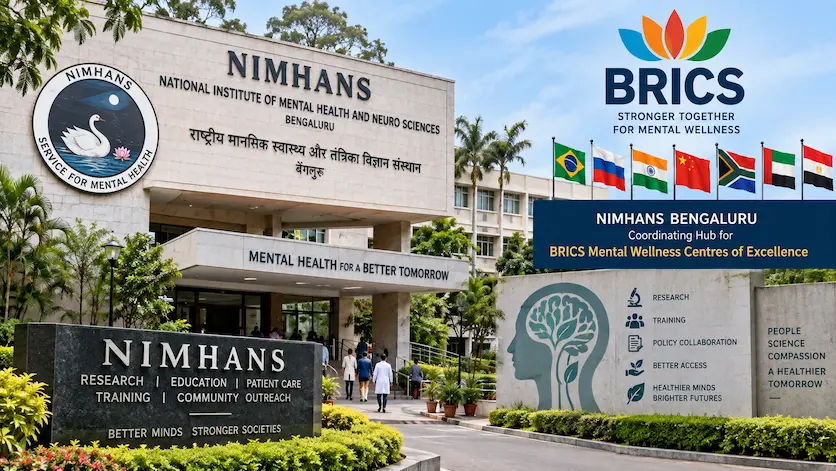
New Delhi. 13 September 2026
In a pivotal landmark for global public health collaboration, India has taken center stage during its 2026 BRICS Chairship to advance international cooperation in psychiatric care and mental health infrastructure. Under the newly adopted New Delhi Declaration at the 18th BRICS Summit, the National Institute of Mental Health and Neuro Sciences (NIMHANS) in Bengaluru has officially been designated as the coordinating hub for the newly formed BRICS Network of Centres of Excellence on Mental Wellness.
This strategic multilateral alliance aims to bring together premier institutions across BRICS member countries—including Brazil, Russia, India, China, South Africa, Egypt, Ethiopia, Indonesia, Iran, Saudi Arabia, and the United Arab Emirates—to address the escalating global burden of mental health conditions through cross-border research, shared evidence-based policies, and workforce expansion.
Core Pillars of the BRICS Mental Health Framework
The cooperation framework establishes structured scientific collaboration, policy dialogues, and capacity-building programs across all participating nations.
| Pillar | Strategic Operational Objective | Impact Horizon |
| Collaborative Research & Policy | Joint multi-country clinical trials, data pooling, and evidence-based policy formulation. | Establishes unified public health benchmarks across member nations. |
| Workforce Development | Rollout of the BRICS Training Hub Network focused on task-sharing and upskilling. | Directly counters shortages of clinical psychologists and psychiatrists. |
| Primary Healthcare Integration | Embedding psychiatric screening and early clinical intervention within primary health infrastructure. | Minimizes global treatment gaps and improves local access to care. |
| Child & Adolescent Support | Establishing dedicated psychosocial support models during emergencies and crises. | Provides timely care for vulnerable populations during humanitarian situations. |
Why NIMHANS Bengaluru Was Selected as the Nodal Hub
NIMHANS brings decades of institutional excellence, clinical research, and groundbreaking public health implementation to the global network. Recognized as an Institute of National Importance by the Parliament of India, NIMHANS treats over half a million patients annually while serving as the operational backbone for major initiatives such as India’s National Mental Health Survey (NMHS) and the Tele-MANAS digital health service.
Through India’s proven models in community-based psychiatry, task-sharing with grassroots health workers, and tele-psychiatry, NIMHANS provides a scalable, field-tested template for low- and middle-income nations facing comparable healthcare resource constraints.
                 +---------------------------------------------+
                 |    BRICS Summit New Delhi Declaration       |
                 +----------------------+----------------------+
                                        |
                                        v
                 +---------------------------------------------+
                 |    NIMHANS Bengaluru Nodal Hub             |
                 +----------------------+----------------------+
                                        |
       +--------------------------------+--------------------------------+
       |                                |                                |
       v                                v                                v
+--------------+               +------------------+             +-----------------+
|  Joint Research |             | BRICS Training Hub|             | Primary Care    |
|  & Policy Hub |               | Network          |             | Integration     |
+--------------+               +------------------+             +-----------------+
Frequently Asked Questions (FAQ)
What is the primary role of NIMHANS in the BRICS mental health network?
NIMHANS Bengaluru acts as the central coordinating body for the BRICS Network of Centres of Excellence on Mental Wellness. It facilitates cross-border knowledge exchanges, coordinates clinical research projects, standardizes training modules, and helps synthesize policy recommendations for all member states.
Will patients from other BRICS countries be treated directly at NIMHANS?
No. The initiative does not create a single centralized treatment hospital in Bengaluru. Instead, it establishes an institutional network where participating research centers and health agencies in each BRICS country collaborate on research, workforce upskilling, and policymaking to strengthen their respective domestic healthcare systems.
How does the initiative plan to solve shortages in mental health professionals?
Through the establishment of the BRICS Training Hub Network, member nations will implement task-sharing techniques, cross-border clinical observerships, and structured upskilling programs. This enables primary care doctors, nurses, and community health workers to identify and manage common mental conditions effectively.
External References & Further Reading
- For comprehensive updates on healthcare initiatives and regional reporting, visit Matribhumi Samachar English Edition.
Disclaimer
This article is for informational, educational, and reporting purposes only and does not constitute formal medical advice, diagnosis, or clinical treatment recommendations. Individuals experiencing mental health challenges or distress should consult a licensed medical professional or contact local health authorities.
