

New Delhi. 14 September 2026
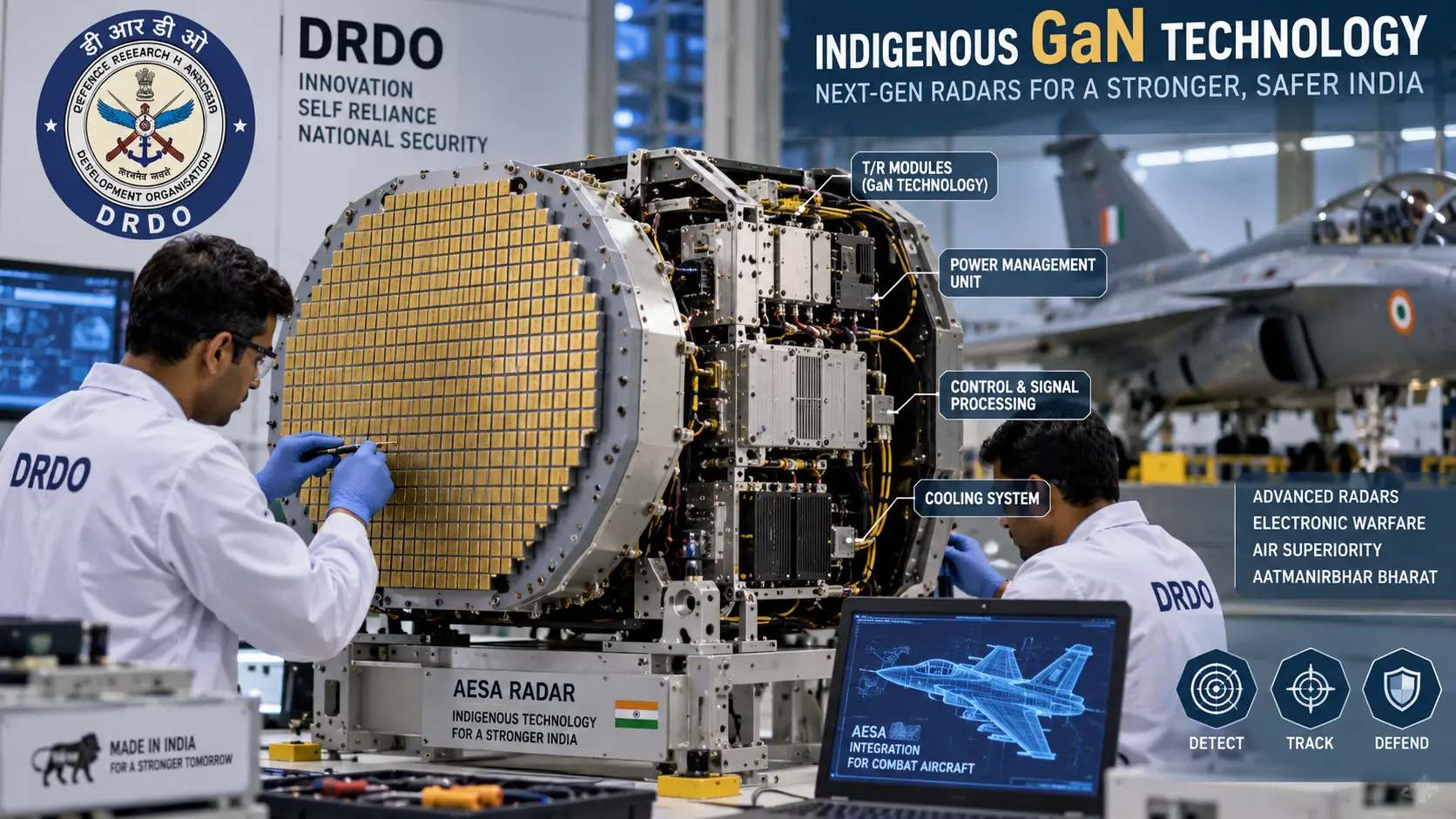
In a major leap toward self-reliance in critical military hardware, India’s Defence Research and Development Organisation (DRDO) has developed indigenous Gallium Nitride (GaN) semiconductor technology. This development strengthens India’s sovereign defence-electronics capabilities, enhancing high-power radar networks and electronic warfare (EW) systems across air, sea, and land battlefields.
Why Semiconductor Material Choice Matters in Modern Radar
Traditional defence electronics rely heavily on Silicon (Si) or Gallium Arsenide (GaAs). While effective for standard radio-frequency (RF) applications, these legacy materials face physical limits in thermal management, power density, and voltage breakdown.
+------------------------+-----------------------+-----------------------+
| Feature / Material     | Silicon (Si)          | Gallium Arsenide (GaAs)| Gallium Nitride (GaN) |
+------------------------+-----------------------+-----------------------+
| Energy Bandgap         | 1.1 eV                | 1.4 eV                | ~3.4 eV (Wideband)    |
| Relative Power Density | Baseline (1x)         | Moderate (~2x)        | High (5x - 10x)       |
| Thermal Tolerance      | Moderate              | Limited               | High Heat Conductive  |
| Primary Application    | Standard Electronics  | Legacy Fighter Radars | Next-Gen EW & AESA    |
+------------------------+-----------------------+-----------------------+
Technical Advantages of GaN in Strategic Systems
- Superior Power Density: GaN components yield up to ten times the power output of legacy GaAs devices. This enables smaller, lighter, yet significantly more powerful Transmit/Receive Modules (TRMs).
- Extended Operational Range: Higher signal output directly translates into longer target detection ranges without requiring larger physical radar antennas.
- Thermal Resilience: Wide bandgap properties allow components to operate efficiently at higher voltages and temperatures, reducing complex cooling requirements on fighter jets, warships, and mobile missile units.
Transforming India’s Radar & Electronic Warfare Operations
1. Active Electronically Scanned Array (AESA) Radars
AESA radars electronically steer radio beams to track multiple airborne, surface, and low-observable targets simultaneously. GaN-powered TRMs provide higher signal fidelity and improved detection of low Radar Cross-Section (RCS) targets like stealth fighters, cruise missiles, and micro-drones.
2. High-Power Electronic Warfare (EW)
In modern electronically contested environments, winning the spectrum battle requires massive RF output. GaN technology empowers electronic countermeasures to jam enemy radars, disrupt incoming missile guidance systems, and safeguard friendly assets over longer distances.
Boosting Aatmanirbhar Bharat & Strategic Autonomy
High-end RF semiconductor technologies are heavily restricted under global export control regimes (such as ITAR). By establishing an indigenous GaN ecosystem, DRDO helps protect India’s key platforms—including the LCA Tejas Mk2, AMCA, surface combatants, and air-defence shields—from international supply chain dependencies.
For ongoing coverage of Indian technology initiatives, defence developments, and innovation, read more on Matribhumi Samachar.
Frequently Asked Questions (FAQ)
What is Gallium Nitride (GaN) technology?
Gallium Nitride is a wide-bandgap semiconductor material that handles much higher voltages, power densities, and thermal stress than traditional Silicon or Gallium Arsenide materials.
Why is GaN important for Indian defence systems?
It enables higher-range AESA radars, stronger Electronic Warfare (EW) transmitters, and lighter cooling systems across military aircraft, naval destroyers, and air defence networks.
How does indigenous GaN support Aatmanirbhar Bharat?
Mastering domestic GaN fabrication reduces India’s dependence on restricted high-end semiconductor imports, securing supply chains for future military platforms.
Disclaimer
This article is for informational and educational purposes based on publicly available defence and technology releases. Visual depictions, platform designations, and specifications represent non-classified information.
