
Mumbai. 15 September 2026
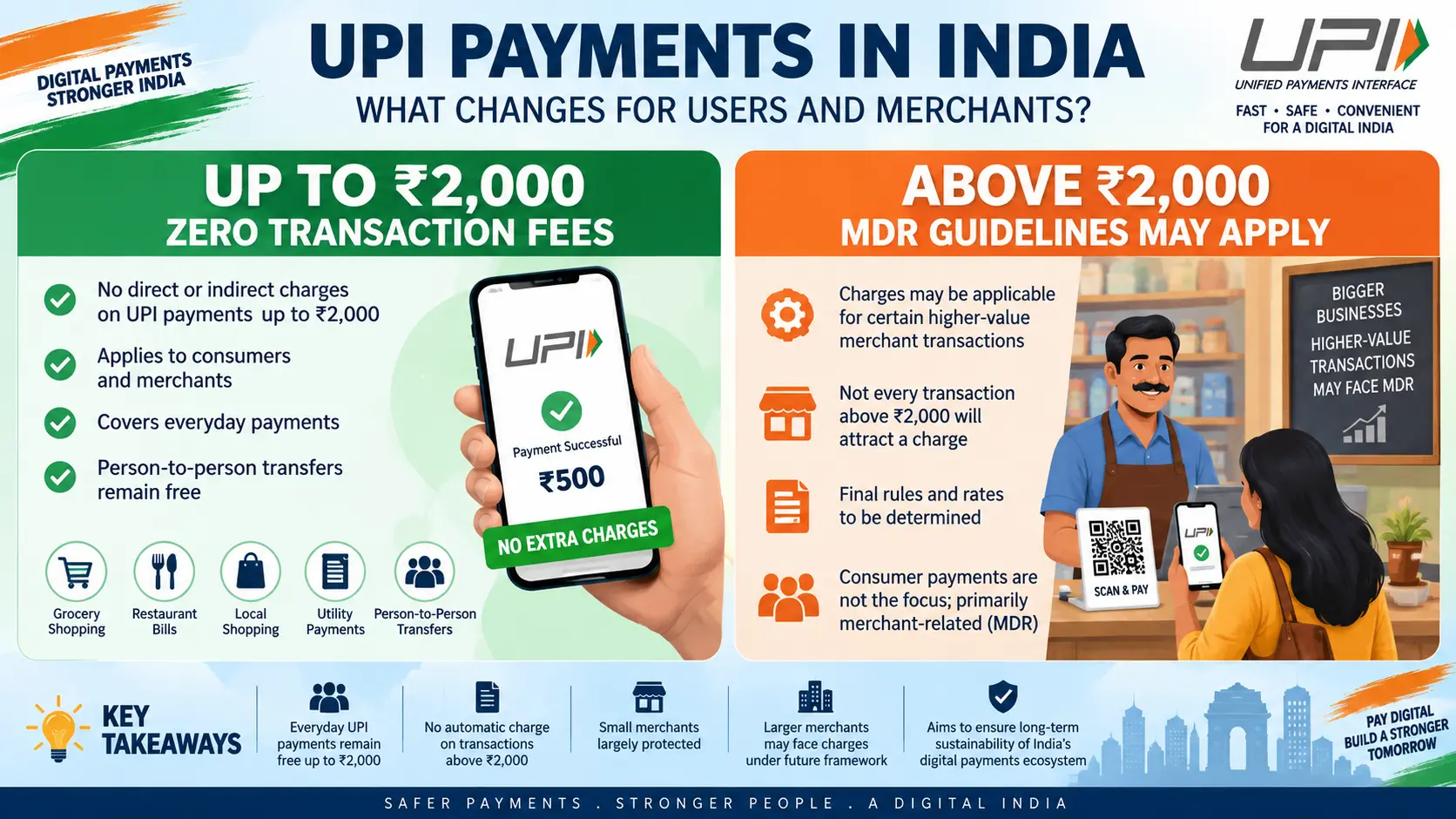
India’s digital payments landscape has reached a crucial regulatory milestone. The Ministry of Finance, exercising powers under Section 10A of the Payment and Settlement Systems Act, 2007, has officially notified that Unified Payments Interface (UPI) transactions up to ₹2,000 and payments via RuPay debit cards are protected from any direct or indirect charges.
The official direction clarifies that no bank, fintech entity, or payment service provider (PSP) can levy fees on qualifying transactions within the ₹2,000 threshold. The policy provides legal certainty for hundreds of millions of daily UPI users while enabling regulators to design a sustainable economic model for higher-value merchant transactions.
1. Zero Direct or Indirect Charges for Everyday Payments
Under the updated framework, small-value payments remain completely free for both the payer and the receiver. This statutory protection directly shields everyday economic activities:
- Retail Groceries & Neighbourhood Kirana Shopping
- Local Dining, Street Vendors, & Restaurant Bills
- Routine Utility Payments & Mobile Recharges
- Small Online Purchases & E-Commerce Orders
- All Person-to-Person (P2P) Direct Transfers
2. Decoupling Consumer Fees from Merchant Discount Rate (MDR)
A primary objective of the new notification is eliminating public confusion regarding potential transaction fees. Union Finance Minister Nirmala Sitharaman clarified that any future Merchant Discount Rate (MDR) structure will apply exclusively to merchants—never to end-line consumers.
                     +---------------------------------------+
                     |        UPI PAYMENT FRAMEWORK          |
                     +---------------------------------------+
                                         |
            +----------------------------+----------------------------+
            |                                                         |
            v                                                         v
 +----------------------+                                  +----------------------+
 |  Transactions <= 2,000 |                                 |  Transactions > 2,000  |
 +----------------------+                                  +----------------------+
            |                                                         |
            |-- Direct/Indirect Charges: ZERO                 |-- P2P Payments: 100% Free
            |-- Applies to: P2P & P2M                 |-- Merchant Payments (P2M):
            |-- Statutory Protection: Sec 10A           |   Potential MDR under NPCI rules
Key Differences in Payment Treatment
| Feature / Scenario | Transactions ≤ ₹2,000 | Transactions > ₹2,000 (Merchant/P2M) | Person-to-Person (P2P) |
| Consumer Transaction Fee | ₹0 (Prohibited by Law) | ₹0 (Free for users) | ₹0 (Always Free) |
| Merchant Discount Rate (MDR) | 0% (Prohibited) | Subject to future NPCI/Govt framework | Not Applicable |
| Target Merchants | Kirana stores, street vendors, small retail | Large enterprise retail, electronics, travel | N/A (Individual to Individual) |
3. Why the ₹2,000 Threshold Matters for Ecosystem Growth
Processing tens of billions of real-time transactions annually demands massive technological infrastructure, fraud prevention mechanisms, and server redundancy.
- Infrastructure Funding: Over half of India’s UPI volume consists of transactions below ₹2,000. Protecting low-value payments keeps the mass adoption engine running smoothly without financial friction for common citizens.
- Fintech Sustainability: Allowing a calibrated MDR framework for higher-value commercial transactions (e.g., consumer electronics, airline bookings, luxury retail) provides acquiring banks and fintech PSPs the capital necessary to continuously upgrade system capacity and security.
Frequently Asked Questions (FAQ)
Will I be charged extra if I send ₹2,500 to a friend via UPI?
No. All Person-to-Person (P2P) transfers remain entirely free of charge regardless of the payment amount.
Does a merchant transaction above ₹2,000 automatically incur a fee for consumers?
No. Consumers will not pay a surcharge for scanning QR codes or paying via UPI. Any future MDR framework strictly applies to merchants, not individual customers.
Does this policy apply to RuPay Debit Cards?
Yes. The notification under Section 10A explicitly covers both UPI transactions up to ₹2,000 and all RuPay-powered debit card transactions.
Disclaimer:
This article is published for informational purposes based on official regulatory notifications issued by the Ministry of Finance under the Payment and Settlement Systems Act, 2007. Future MDR rates and operational guidelines for merchants are subject to final notifications by the National Payments Corporation of India (NPCI) and the Reserve Bank of India (RBI).
For further news and financial updates, visit Matribhumisamachar or explore tech updates at Mathrubhumi English.
