

Bengaluru.
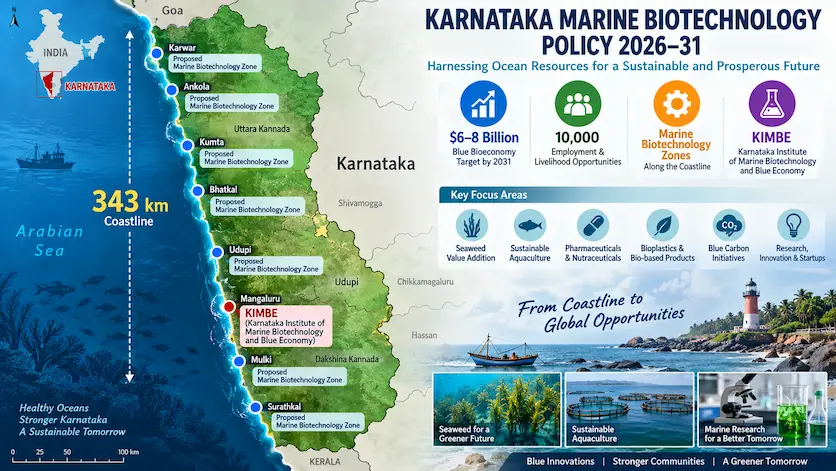
In a landmark policy push aimed at converting its 343.3-kilometer coastline into an economic powerhouse, the Government of Karnataka has officially approved the Karnataka Marine Biotechnology Policy 2026–31. This ambitious five-year roadmap seeks to merge the state’s deep scientific expertise in biotechnology with rich ocean resources, unlocking a high-value Blue Bioeconomy.
The policy sets a clear target: quadrupling the state’s current marine bioeconomy from $2 billion to between $6–8 billion by 2031, backed by a dedicated state financial outlay of ₹120 crore.
Key Highlights & Strategic Targets
                               KARNATAKA BLUE BIOECONOMY (2026–31)

   FINANCIAL OUTLAY                 TARGET GROWTH                    JOB CREATION
      ₹120 Crore                  $2B  --->  $6–8B                   10,000 Roles
 (5-Year State Budget)            (Current)  (By 2031)          (2.5k Tech | 7.5k Coastal)
| Parameter | Policy Target / Specification |
| Policy Duration | 2026 – 2031 (5 Years) |
| Coastline Scope | ~343.3 km across coastal Karnataka |
| Economic Target | Expand Blue Bioeconomy from $2B to $6–8B |
| Financial Outlay | ₹120 Crore |
| Employment Created | 10,000 Opportunities (2,500 High-Tech + 7,500 Coastal Livelihoods) |
| Key Anchor Hub | Karnataka Institute of Marine Biotechnology and Blue Economy (KIMBE) |
1. Establishing KIMBE: The Apex Marine Biotech Hub
To bridge the gap between benchtop laboratory research and commercial scale-up, Karnataka is establishing the Karnataka Institute of Marine Biotechnology and Blue Economy (KIMBE).
KIMBE will serve as an institutional anchor for:
- Advanced bioprospecting of marine microorganisms and organisms.
- Technology translation, IP transfer, and commercialization.
- Joint R&D collaborations between global marine institutes and local bio-clusters.
2. Infrastructure: Marine Biotechnology Zones & Incubation
To lower capital entry barriers for emerging entrepreneurs, the state government—in coordination with the Department of Fisheries—is setting up dedicated Marine Biotechnology Zones.
These hubs will offer plug-and-play laboratories, shared pilot manufacturing lines, cold-chain logistics, and quality-testing infrastructure. Complementing these zones, the Marine Bioinnovation and Startup Incubation Centre will nurture bioventures through a structured pipeline:
Research → Prototype → Pilot Validation → Technology Translation → Commercial Production
3. Seaweed Value Addition Incentive (SVA-PLI)
Seaweed cultivation is framed as a double win—offering sustainable coastal employment while feeding high-value industrial manufacturing. To foster an integrated supply chain, Karnataka has introduced the Seaweed Value Addition–Production Linked Incentive (SVA-PLI).
       Seaweed Cultivation ──> Processing ──> Industrial Applications
                                                      │
                                                      ├── Hydrocolloids & Nutraceuticals
                                                      ├── Biofertilisers & Biostimulants
                                                      ├── Marine Biomaterials & Bioplastics
                                                      └── Biofuels & Bio-based Chemicals
4. Blue Carbon Certification & Environmental Sustainability
The policy explicitly addresses climate resilience through a Pilot Blue Carbon Certification Programme. By measuring and scientifically verifying carbon sequestered by marine vegetation, mangrove conservation, and seaweed farms, Karnataka plans to integrate coastal ecosystem management into carbon credit mechanisms.
Downstream Industrial Sectors Benefiting from the Policy
- Pharmaceuticals & Nutraceuticals: Bioactive compounds for drugs, functional foods, and cosmetics.
- Agriculture & Aquaculture: Algal biostimulants, bio-organic fertilizers, and sustainable aquaculture feeds.
- Green Materials: Biodegradable marine plastics and bio-based industrial platform chemicals.
- Clean Energy: Algal biofuels and marine biomass conversion.
Coverage and Insights from Matribhumi Samachar
To read more on regional governance, industrial infrastructure, and technological developments across Karnataka and South India, explore these relevant articles from Matribhumi Samachar English:
- Technology & Innovation Infrastructure: Learn about Karnataka’s tech sovereignty initiatives and government-led AI roadmap at Karnataka Pioneers Tech Sovereignty.
- Bioenergy & Bio-economy Alignments: Understand India’s larger national bio-based policy landscape through Union Minister Nitin Gadkari Addresses 12th CII Bioenergy Summit.
- Regional Industrial Growth: Read more about state-level development projects and regional coverage via Matribhumi Samachar English Homepage.
Frequently Asked Questions (FAQ)
What is the Karnataka Marine Biotechnology Policy 2026–31?
It is a comprehensive five-year framework launched by the Karnataka government to leverage its 343.3 km coastline for marine biotechnology research, startup acceleration, seaweed manufacturing, and sustainable coastal livelihoods.
How many jobs will the Blue Bioeconomy Policy generate?
The policy targets approximately 10,000 employment and livelihood opportunities over five years, comprising 2,500 high-value technical R&D jobs and 7,500 coastal enterprise and farming roles.
What is the SVA-PLI framework in Karnataka?
The Seaweed Value Addition–Production Linked Incentive (SVA-PLI) is a scheme offering financial and operational incentives to businesses converting harvested seaweed into high-value commercial goods like bioplastics, nutraceuticals, biostimulants, and biofuels.
What role will KIMBE play?
The Karnataka Institute of Marine Biotechnology and Blue Economy (KIMBE) acts as the state’s central research hub, bridging academic marine science with industrial commercialization and startup incubation.
Disclaimer
This article is provided for informational and educational purposes based on government policy announcements and public domain releases regarding the Karnataka Marine Biotechnology Policy 2026–31. Financial projections, employment targets, and operational frameworks represent official government estimates and are subject to administrative guidelines issued by the Government of Karnataka.
