

New Delhi.
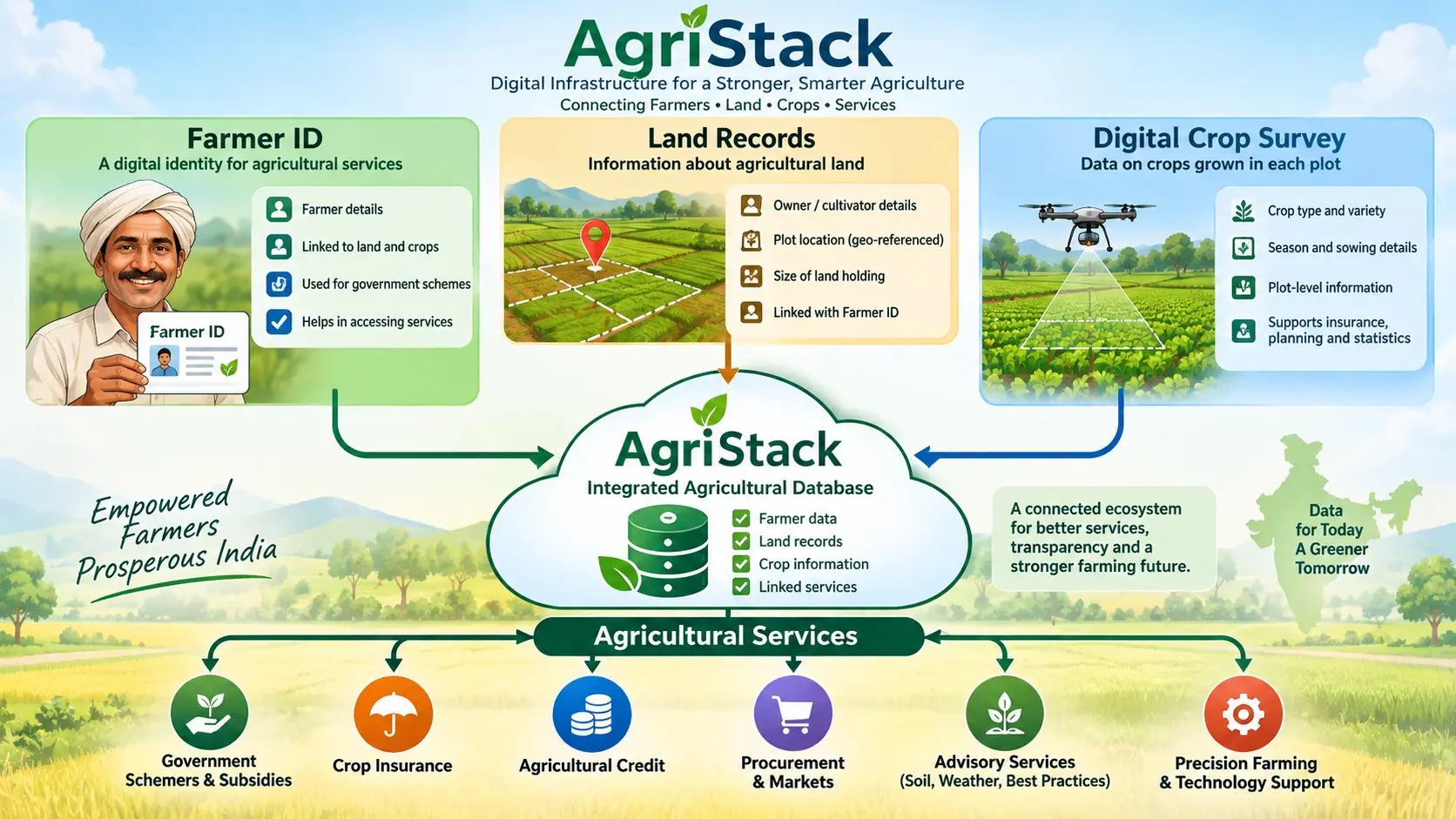
India is undergoing a profound digital transformation across its rural landscape. At the center of this modern agrarian shift is AgriStack, a Digital Public Infrastructure (DPI) framework created specifically for the agricultural sector. Developed under the umbrella of the Digital Agriculture Mission, AgriStack connects isolated farm records, satellite monitoring, and administrative services into a unified network.
The core goal of AgriStack is to bring transparency, efficiency, and speed to how farmers interact with government bodies, financial institutions, and agricultural markets. By bridging the gap between land-registry data, crop analytics, and direct-benefit schemes, AgriStack reduces red tape and speeds up rural credit delivery.
What is a Farmer ID and How Does It Function?
A Farmer ID is a unique, persistent digital identity assigned to an individual farmer within the agricultural ecosystem. It serves as a single reference key that links a cultivator to their land records, crop data, and eligible benefits.
Key Distinction: A Farmer ID is not an alternative to Aadhaar. While Aadhaar provides general citizenship-level identity verification, a Farmer ID is domain-specific—tailored exclusively to agricultural services, land parcels, and farming schemes.
                  ┌─────────────────────────────────┐
                  │            Farmer ID            │
                  └────────────────┬────────────────┘
                                   │
       ┌───────────────────────────┼───────────────────────────┐
       ▼                           ▼                           ▼
┌──────────────┐            ┌──────────────┐            ┌──────────────┐
│ Land Records │            │ Crop Survey  │            │  Government  │
│  & Plots     │            │  Data (DCS)  │            │  Subsidies   │
└──────────────┘            └──────────────┘            └──────────────┘
Depending on state-level implementation, a Farmer ID connects:
- Registered land plot boundaries (survey numbers).
- Real-time seasonal crop data via Digital Crop Surveys (DCS).
- Active enrollment in welfare schemes, insurance policies, and agricultural credit lines.
Core Pillars of AgriStack & The Digital Agriculture Mission
The Digital Agriculture Mission relies on several interconnected technological components:
| Component | Functionality | Primary Impact |
| Farmer Registry | Main database maintaining verified profiles of agricultural landholders and cultivators. | Reduces identity fraud and duplicate applications. |
| Geo-Referenced Maps | Spatial mapping of village plots tied to land record databases. | Enables plot-level verification from satellite imagery. |
| Digital Crop Survey (DCS) | Ground-level and remote-sensed digital verification of crops sown each season. | Accelerates insurance claims and disaster relief. |
| Decision Support Systems | AI-driven integration of weather, soil health, and satellite telemetry. | Delivers localized farm advisories directly to mobile phones. |
Major Benefits of the Digital Agriculture Ecosystem
1. Accelerated Direct Benefit Transfers (DBTs) & Subsidies
By linking digital records directly to a farmer’s verified profile, government departments can instantly cross-verify eligibility. This eliminates repetitive paper submissions every farming season.
2. Streamlined Crop Insurance (PMFBY)
With Digital Crop Surveys recording actual cultivation data per plot, insurance claims during flood or drought conditions can be processed rapidly, minimizing lengthy field inspections.
3. Faster Access to Formal Credit
Financial institutions can quickly assess landholdings and cropping history, making it easier to evaluate applications for Kisan Credit Cards (KCC) and short-term agricultural loans.
4. Direct Market Linkages and Integration with e-NAM
While AgriStack focuses on identity and farm data, its integration with platforms like the National Agriculture Market (e-NAM) simplifies seller registration and price discovery.
Farmer Identity (AgriStack) ──► Crop Verification (DCS) ──► Online Market Access (e-NAM) ──► Direct Payment
Comparing Key Agricultural Systems
It is common to confuse new digital initiatives with existing income-support programs. The table below highlights the differences:
| Feature | Farmer ID / AgriStack | PM-Kisan Scheme | e-NAM Platform |
| Primary Category | Digital Infrastructure Framework | Financial Income Support Scheme | Electronic Trading Marketplace |
| Core Objective | Data integration across farm services | Cash transfer of ₹6,000/year to eligible farmers | Transparent price discovery & crop sales |
| Role of Land Data | Maps plots to digital identity | Used to confirm scheme eligibility | Optional verification for trade limits |
| Monetary Payout | None (It is an administrative ID layer) | Direct cash transfer to bank account | Direct seller payment upon trade |
Practical Steps for Farmers: Status Checks and Data Accuracy
Because agricultural land administration is governed by individual States and Union Territories, registration and status-check procedures vary across regional portals.
How to Verify Your Farmer ID Status
- Visit the Official State Portal: Access your respective state’s official Farmer Registry or Agriculture Department website.
- Access the Farmer Login Section: Select the AgriStack / Farmer Registry dashboard.
- Authenticate Securely: Complete verification via standard state-approved login methods.
- Review Linked Land & Crop Records: Ensure plot numbers, landholding sizes, and mobile numbers are correct.
- Report Discrepancies: If land record details are wrong, contact the regional Revenue/Land Records Department. If the land record is correct but missing in the registry, use the State Farmer Registry grievance mechanism.
Frequently Asked Questions (FAQs)
Is obtaining a Farmer ID mandatory for all farmers?
Mandatory status depends on specific central or state scheme guidelines. While many government subsidies, crop insurance schemes, and procurement portals are progressively mandating Farmer ID linkage for seamless verification, farmers should consult local agriculture office updates for specific requirements.
Does getting a Farmer ID guarantee PM-Kisan payments?
No. Farmer ID is a digital public infrastructure layer, whereas PM-Kisan is a specific financial support scheme with its own distinct eligibility criteria and verification protocols.
How does AgriStack handle land transfers or inheritance?
AgriStack relies on official state revenue records. If land is sold, partitioned, or inherited, the primary land mutation must first be updated with the state revenue authority before the digital Farmer Registry reflects the change.
External Resources & Regional News
For further regional news, policy updates, and state-by-state agricultural announcements in English, visit Matribhumi Samachar English.
Disclaimer
This article is for informational and educational purposes only. Government policies, registration procedures, and scheme guidelines regarding AgriStack, Farmer IDs, and state land records are subject to updates by central and state authorities. Farmers and readers are advised to consult official government portals or visit their local District Agriculture Office for official instructions.
