

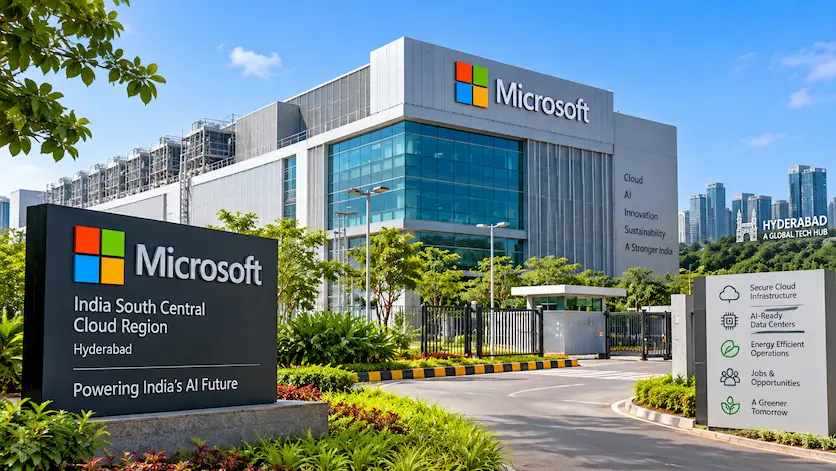
Hyderabad.
Microsoft has expanded its cloud computing and artificial intelligence infrastructure in India with the formal launch of its India South Central data-centre region in Hyderabad, Telangana. Launched on September 24, 2026, the facility reinforces Hyderabad’s standing as a prominent technology epicenter for cloud services, AI development, and enterprise infrastructure across South Asia.
The launch forms part of Microsoft’s long-term digital infrastructure roadmap in India, addressing surging demand for low-latency cloud computing, high-density AI workloads, and sovereign data storage.
Microsoft’s Fourth Cloud Region in India
The India South Central region marks Microsoft’s fourth cloud infrastructure region in the country, joining established nodes in Pune, Chennai, and Mumbai. The Hyderabad site is engineered to bring cloud resources closer to domestic enterprises, public sector agencies, and regional startups.
- Architecture: Built with a three-zone availability design to ensure high availability, fault tolerance, and seamless business continuity.
- Service Roadmap: Microsoft plans a phased rollout of advanced Azure capabilities, high-performance computing (HPC) nodes, and specialized enterprise AI tools.
- Global Strategy: The region will serve as a regional cloud hub for India and neighbouring Global South markets.
A Major Push into India’s AI Infrastructure
The Hyderabad deployment is anchored by Microsoft’s multi-year US$20.5 billion capital commitment to India. This investment was pledged across two distinct tranches:
- US$3 billion in January 2025
- US$17.5 billion in December 2025
The high-density computing clusters in the new facility are optimized for running generative AI models, enterprise-scale analytics, and deep learning pipelines. Early corporate adopters already leveraging or onboarding onto the region include Adani Group, Bajaj Finserv, HDFC Bank, and PB Pay.
Data Security, Compliance, and Data Residency
With data sovereignty becoming a primary mandate for Indian enterprises, the India South Central region offers localized storage options to simplify regulatory compliance.
The infrastructure’s governance capabilities assist organizations in aligning with national mandates, such as the Digital Personal Data Protection (DPDP) framework and sector-specific rules from financial regulators. However, localized infrastructure serves as an enabler rather than an automatic guarantee; enterprises must continue to configure appropriate identity controls, encryption, and operational practices for their workloads.
Sustainability and Zero-Water Cooling
Addressing the environmental footprint of AI-scale processing, Microsoft has implemented zero-water cooling architecture in the Hyderabad facility.
+———————————–+
| Hyperscale Cloud & AI Workloads |
+———————————–+
|
v
+———————————–+
| Closed-Loop Air Cooling System |
| (Effectively Zero Water Used) |
+———————————–+
|
v
+———————————————————————–+
| Community Water Initiatives |
| – Elikatta Groundwater Program: 5M+ Liters Capacity Added (June 2026)|
| – Rainwater Harvesting & Local Watershed Restoration Projects |
+———————————————————————–+
Beyond facility-level efficiency, Microsoft collaborates with local partners on ecological restoration. Its Elikatta groundwater-recharge initiative successfully added over five million liters of water replenishment capacity to local aquifers by June 2026.
Telangana’s Data-Centre Ambitions & Skill Development
Telangana continues to position itself as a premier destination for hyperscale investments. The state government has set a target to build 5 GW of data-centre capacity by 2029, alongside attracting US$30 billion in investments across AI, cloud, and digital infrastructure.
To address the growing need for specialized talent, Microsoft has partnered with government agencies and academic institutions to deploy its Data Center Academy. The initiative provides a 600-hour specialized curriculum focused on:
- Data centre physical and virtual operations
- Cloud infrastructure management
- Network operations and hardware diagnostics
- Advanced AI workload maintenance
Economic and Technological Impact Overview
| Focus Sector | Strategic Impact |
| Enterprise IT | Lower latency, redundant active-active deployments, and high-density compute options. |
| Financial Services | In-country data hosting for regulated banking, insurance, and fintech transactions. |
| AI Development | Direct access to localized GPU capacity for training and running production models. |
| Regional Workforce | New career opportunities in cloud architecture, site reliability engineering, and data center operations. |
Related Coverage from Matribhumi Samachar
To explore further context on tech infrastructure investments and regional growth in India, visit these related reports from Matribhumi Samachar:
Frequently Asked Questions (FAQ)
What is the name of Microsoft’s new cloud region in Hyderabad?
It is officially designated as the India South Central region, representing Microsoft’s fourth cloud region in India alongside Mumbai, Pune, and Chennai.
How much is Microsoft investing in India’s AI and cloud infrastructure?
Microsoft committed a total of US$20.5 billion, announced in two stages: US17.5 billion in December 2025.
What environmental measures were taken for the Hyderabad data center?
The facility relies on zero-water cooling design and supports regional aquifer restoration through groundwater recharge programs like the Elikatta project.
How does this launch benefit data compliance for Indian businesses?
It provides in-country data residency, helping organizations in regulated sectors comply with local privacy regulations like the Digital Personal Data Protection (DPDP) framework.
Disclaimer
This article is provided for informational purposes only. Information regarding cloud services, compliance standards, and investment targets reflects public announcements made up to September 2026. Readers and businesses should perform independent legal and technical assessments regarding data protection policies and regulatory compliance.
