

New York.
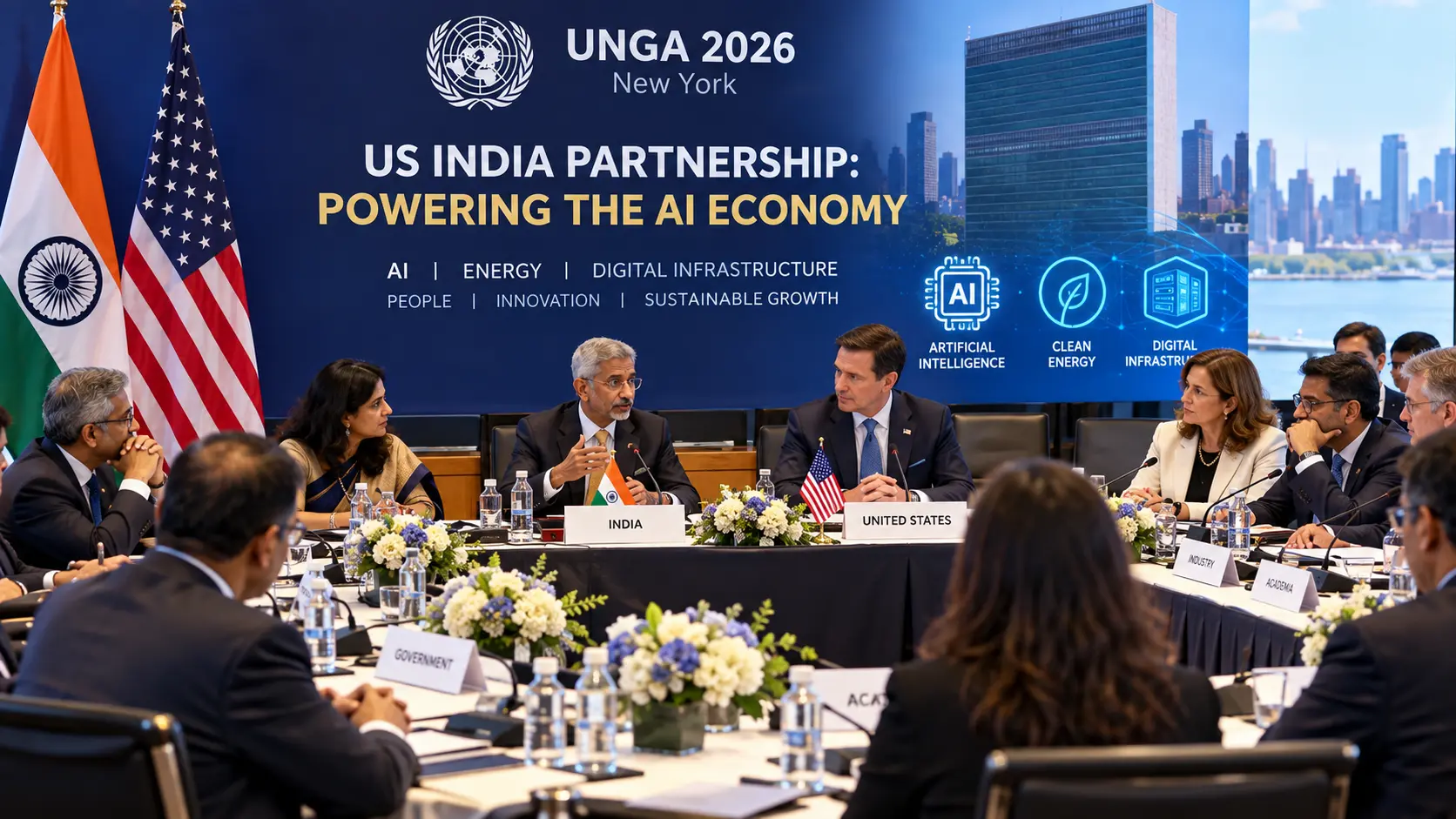
During the 81st United Nations General Assembly (UNGA) week in New York, government leaders, industry titans, investors, and academic experts gathered for a roundtable titled “US India Partnership: Powering the AI Economy.”
The high-level discussions centered on the physical infrastructure, massive capital deployment, and energy resilient systems required to sustain the rapid expansion of global artificial intelligence.
Scaling Up the US-India Data Centre & Compute Corridor
As artificial intelligence integration deepens across economic sectors, the demand for high-performance computing capacity and hyperscale data centres has reached an unprecedented peak.
Key roundtable takeaways included:
- Cross-Border Compute Ecosystems: Bridging cutting-edge American semiconductor architectures with India’s rapidly expanding data centre ecosystem.
- Capital Mobilization: Accelerating private-sector participation alongside institutional investment to finance large-scale hardware and facility rollouts.
- Technological Convergence: Linking frontier AI development directly to physical data infrastructure and local grid capacities.
Energy Security: The Power Backbone of the AI Economy
Advanced AI clusters require uninterrupted, high-density power. Attendees emphasized that power grid readiness and energy security are no longer secondary concerns—they are the primary bottleneck for future AI scaling.
[ Global AI Compute Demand ]
│
▼
[ Hyperscale Data Infrastructure ]
│
▼
[ Resilient Grid Readiness & Clean Energy Integration ]
│
▼
[ Public, Private & Blended Cross-Border Financing ]
Participants explored dynamic financing structures—combining public, private, and blended funds—to construct cross-border energy infrastructure capable of sustaining next-generation data facilities without straining regional electricity supplies.
Report Launch: India’s Next Energy Export Opportunity
A strategic highlight of the event was the launch of the report: “Powering the AI Age: India’s Next Energy Export Opportunity.”
The report highlights India’s dual advantage: massive renewable energy potential and rapid grid modernization. Rather than exporting raw power alone, India is positioned to “export” energy by hosting processing capacity locally—offering foreign enterprises reliable, cost-effective, and green compute resources.
Strategic Policy and Regulatory Frameworks
The roundtable underscored the need for harmonized regulatory and trade environments between the two nations. Building on bilateral frameworks like the Initiative on Critical and Emerging Technology (iCET), both countries aim to align policy on:
- Cross-border capital flows for technology infrastructure.
- Responsible AI governance, data security, and digital inclusion.
- Semiconductor supply chain resilience and hardware manufacturing.
Related Coverage & Further Reading
- For coverage on regional data center policy shifts, read the Karnataka Sustainable Data Centre Policy 2026–31.
- Learn more about digital public ecosystems on Matribhumi Samachar Business News.
- Explore international energy transition reports via Matribhumi Samachar English Main Portal.
Frequently Asked Questions (FAQ)
What was the main objective of the UNGA 2026 US-India AI roundtable?
The roundtable, titled “US India Partnership: Powering the AI Economy,” aimed to address the investment, digital infrastructure, and energy grid requirements necessary to sustain global AI growth.
What report was launched during the event?
The report titled “Powering the AI Age: India’s Next Energy Export Opportunity” was officially launched during the roundtable session.
Why is energy infrastructure critical for artificial intelligence?
AI computing systems require continuous, high-density power. Without resilient grids and scalable electricity generation, data centre capacity cannot expand to meet future AI demand.
Disclaimer
This article is prepared for informational and news analytical purposes based on press releases and public domain updates from the UNGA 2026 sidelines. The views and policy interpretations expressed herein do not necessarily constitute formal state policy endorsements by either government.
