

Mumbai.
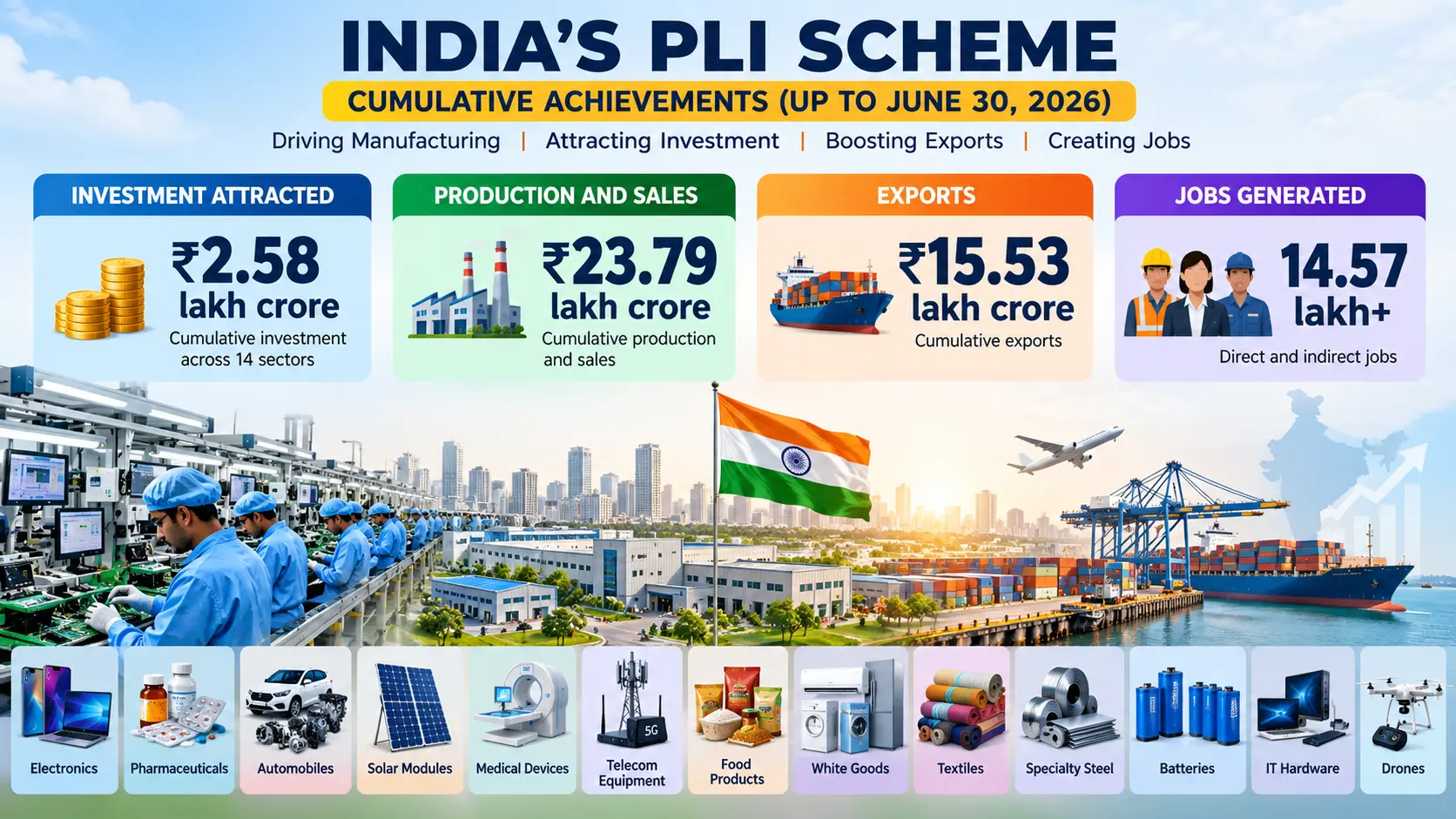
India’s flagship industrial manufacturing initiative, the Production Linked Incentive (PLI) Scheme, has crossed key milestones in driving domestic manufacturing, expanding export capabilities, and attracting investments. According to the latest official performance figures updated as of June 30, 2026, the programme has recorded cumulative incentive disbursements of ₹36,754 crore, backed by ₹2.58 lakh crore in total investments drawn across 14 target sectors.
The initiative—launched in 2020 under the Atmanirbhar Bharat vision—was allocated a total financial outlay of ₹1.91 lakh crore. It links financial incentives directly to incremental sales and output, encouraging domestic production while reducing reliance on imported goods.
Key Performance Metrics (Cumulative as of June 30, 2026)
- Approved Incentive Outlay: ₹1.91 lakh crore
- Cumulative Incentive Disbursed: ₹36,754 crore (~19.2% of total outlay)
- Cumulative Investments Attracted: ₹2.58 lakh crore
- Production and Sales Generated: ₹23.79 lakh crore
- Exports Generated: ₹15.53 lakh crore
- Direct and Indirect Employment: Over 14.57 lakh jobs created
- Sectors Covered: 14 strategic manufacturing industries
Note: These figures reflect total cumulative achievements under the scheme since launch, not single-year outcomes for 2026.
Detailed Sector-Wise Analysis
1. Sector-Wise Investments
Capital deployment has seen strong momentum in green energy, healthcare, and industrial auto manufacturing. High-Efficiency Solar PV Modules lead capital investment figures, driven by long-term capacity building.
| Sector | Cumulative Investment Reported |
| High-Efficiency Solar PV Modules | ₹73,437 crore |
| Pharmaceuticals | ₹46,744 crore |
| Automobiles & Auto Components | ₹45,477 crore |
| Specialty Steel | ₹27,368 crore |
| Large-Scale Electronics Manufacturing | ₹20,580 crore |
| Textiles | ₹9,510 crore |
| Food Products | ₹9,207 crore |
| White Goods (ACs & LEDs) | ₹7,670 crore |
2. Cumulative Disbursements
Incentive disbursements are performance-linked and released after verified production and sales threshold achievements. The Large-Scale Electronics Manufacturing sector has secured the largest portion of total payments made.
| Sector | Cumulative Incentive Disbursed |
| Large-Scale Electronics Manufacturing | ₹19,090.98 crore |
| Pharmaceuticals | ₹6,662.00 crore |
| Food Products | ₹3,271.44 crore |
| Automobiles & Auto Components | ₹3,174.15 crore |
| Telecom & Networking Products | ₹2,796.00 crore |
| White Goods (ACs & LEDs) | ₹593.00 crore |
| Textiles | ₹386.00 crore |
| Specialty Steel | ₹236.00 crore |
| IT Hardware | ₹98.00 crore |
| Drones & Drone Components | ₹93.00 crore |
| Bulk Drugs | ₹88.00 crore |
(Note: Advanced Chemistry Cell (ACC) Batteries registered zero payouts as of June 2026 due to extended commissioning timelines and pending operational milestones).
Sectoral Highlights: Electronics & Healthcare
Large-Scale Electronics Manufacturing
Large-scale electronics—particularly mobile phone assembly and sub-assembly manufacturing—serves as the flagship component of the PLI scheme. With ₹19,090.98 crore disbursed, it accounts for over 51% of total cumulative payouts under the framework. The focus is shifting toward deeper localized component supply chains to substitute imported intermediate parts.
Pharmaceuticals and Medical Devices
- Pharmaceuticals: Cumulative sales reached over ₹3.64 lakh crore. Support spans 1,931 drug products, including 191 active pharmaceutical ingredients (APIs) and bulk drugs manufactured locally in India for the first time.
- Medical Devices: Domestic manufacturing now covers high-end diagnostic equipment like CT/MRI scanners, cath-labs, and ultrasound systems with participation from global entities like Siemens, Wipro GE, and Philips. Beneficiaries achieved ₹6,475 crore in domestic sales and ₹560 crore in export revenue.
Frequently Asked Questions (FAQ)
What is the primary goal of India’s PLI scheme?
The Production Linked Incentive (PLI) scheme aims to boost domestic manufacturing capacity, attract foreign and domestic investments, expand exports, generate jobs, and lower import dependence in critical industrial sectors.
Which 14 sectors are covered under the PLI scheme?
The 14 sectors are:
- Large-Scale Electronics Manufacturing
- IT Hardware
- Pharmaceuticals
- Bulk Drugs
- Medical Devices
- Telecom & Networking Products
- Automobiles & Auto Components
- Advanced Chemistry Cell (ACC) Batteries
- Textiles
- Food Products
- White Goods (ACs & LEDs)
- High-Efficiency Solar PV Modules
- Specialty Steel
- Drones & Drone Components
Does the ₹36,754 crore payout mean the scheme budget is nearly spent?
No. The total approved budget is ₹1.91 lakh crore. Disbursed funds (₹36,754 crore) represent roughly 19.2% of the budget. Remaining funds are paid out in subsequent phases as participating companies achieve defined production, sales, and investment milestones.
Are exports counted separately from total production and sales?
No. Cumulative exports (₹15.53 lakh crore) form a subset of the total production and sales figure (₹23.79 lakh crore). They should not be added together.
Relevant Sources & Related Reading
- For complete coverage of national policy and economic updates, visit Matribhumi Samachar English Edition.
Disclaimer
This article is provided for informational and analytical purposes based on official government reports and data released up to June 30, 2026. Scheme performance, allocations, and sectoral disbursements are subject to updates, policy revisions, and audit verifications by respective line ministries.
