

Mumbai.
- The 6 Pillars of India’s Strategic Industrial Transformation
- 1. Semiconductors: Building the Core Technology Foundation
- 2. Data Centres: Fueling the AI and Digital Economy
- 3. Space Technology: Commercializing Space Capabilities
- 4. Electronics Manufacturing: Moving Beyond Assembly
- 5. Solar Manufacturing: Strengthening Clean Energy Supply Chains
- 6. Aerospace: Scaling Up as a Global Supplier
- Interconnectivity Across the Ecosystem
- Economic Impact and Macro Outlook
- Key Challenges to Address
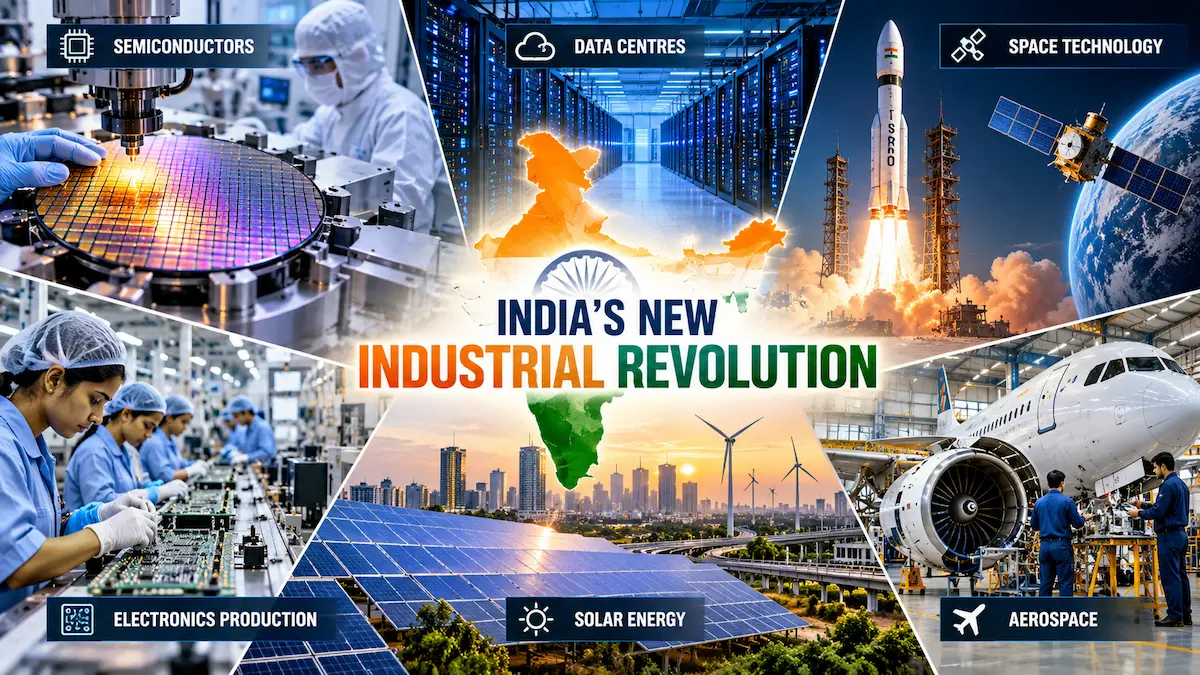
India is entering a transformative phase of industrial development, driven by high-tech manufacturing, clean energy expansion, digital infrastructure, and frontier technologies. Emerging as core pillars in this transition are six sectors: semiconductors, data centres, space technology, electronics manufacturing, solar manufacturing, and aerospace.
A September 2026 investment assessment by global financial firm Jefferies highlights these six sectors as potential catalysts for India’s next capital expenditure (capex) and industrial investment cycle. Rather than focusing merely on factory assembly lines, this shift aims to establish deep domestic technology capabilities, localize supply chains, attract private capital, create skilled jobs, and integrate Indian companies into global supply networks.
The 6 Pillars of India’s Strategic Industrial Transformation
1. Semiconductors: Building the Core Technology Foundation
Developing a domestic semiconductor ecosystem is essential for reducing import reliance and mitigating global supply chain disruptions.
In July 2026, the Union Cabinet approved Semicon 2.0 with a reported outlay of ₹1,27,500 crore, expanding focus beyond basic assembly to R&D, advanced packaging, materials, machinery, and talent development.
- Import Reduction: Local fabrication minimizes reliance on foreign chips.
- Industrial Synergy: Fabs stimulate downstream supply chains in specialized chemicals, gases, and precision engineering.
- Skill Demand: High-value employment opportunities for engineers and technical researchers.
2. Data Centres: Fueling the AI and Digital Economy
The surge in artificial intelligence adoption and cloud services requires massive data processing capacity and secure storage.
- AI & Cloud Demand: Generative models demand scalable high-performance computing (HPC).
- Data Sovereignty: Local infrastructure facilitates compliance with data residency and security frameworks.
- Ecosystem Impact: Generates continuous demand for electrical hardware, liquid cooling systems, backup energy, and cybersecurity services.
3. Space Technology: Commercializing Space Capabilities
India is transitioning from government-led space missions toward a commercialized space industry supported by private enterprise.
- Satellite Manufacturing & Launches: Commercial launch vehicles and small satellites serve global satellite operators.
- Geospatial & Connectivity: Space applications power agricultural monitoring, urban planning, disaster response, and remote internet access.
4. Electronics Manufacturing: Moving Beyond Assembly
While India has achieved high assembly volumes, deepening the component supply chain remains a key priority.
- Local Value Addition: Expanding domestic production of PCBs, sensors, displays, and passives keeps a higher share of added value within the country.
- Export Expansion: Strengthens India’s position as global firms implement supply chain diversification strategies.
5. Solar Manufacturing: Strengthening Clean Energy Supply Chains
Expanding clean energy requires vertical integration across the solar value chain—from silicon to operational modules.
- Upstream Integration: Establishing capabilities in polysilicon, ingots, wafers, solar cells, and specialized glass protects against international price spikes and supply bottlenecks.
- Energy Security: Supports India’s decarbonization goals while building export capacity for global renewable markets.
6. Aerospace: Scaling Up as a Global Supplier
Stringent quality and safety standards make aerospace a high-value sector for Indian precision engineering firms.
- Tier-1/2 Integration: Opportunities span precision machining, structural components, engine parts, and maintenance, repair, and overhaul (MRO) services.
- Advanced Materials: Drives innovation in lightweight alloys and carbon composites.
Interconnectivity Across the Ecosystem
These six sectors function as an interconnected industrial network:
┌──────────────────────────────┐
│ Semiconductors & Design │
└──────────────┬───────────────┘
│
┌───────────────────────┼───────────────────────┐
▼ ▼ ▼
┌──────────────────┐ ┌──────────────────┐ ┌──────────────────┐
│ Electronics Mfg. │ │ Data Centres │ │ Space & Aviation │
└──────────────────┘ └─────────┬────────┘ └──────────────────┘
▲
│
┌─────────┴────────┐
│ Solar Clean Power│
└──────────────────┘
- Semiconductors supply specialized microcontrollers and chips for Electronics, Data Centres, and Aerospace.
- Solar Manufacturing provides reliable, clean electricity required by power-intensive Data Centres.
- Aerospace and Space Tech share advanced materials science, precision engineering, and specialized testing facilities.
Economic Impact and Macro Outlook
| Focus Area | Core Potential Impact |
| Manufacturing | Transition from low-cost assembly to deep-tech fabrication |
| Employment | Creation of high-skilled engineering, operational, and research roles |
| Exports | Growth in technology-intensive products and international service delivery |
| Supply Chains | Reduced import vulnerability via localized component production |
Key Challenges to Address
- Capital & Execution: Long gestation periods require steady financing and streamlined project execution.
- Infrastructure Requirements: Uninterrupted power, water efficiency, and specialized logistics are necessary for fabs and data centers.
- Global Competition: Indian companies compete with mature manufacturing hubs holding decades of vendor integration.
- Talent Pipeline: Demands rapid upskilling in advanced automation, chip design, and aerospace certifications.
Frequently Asked Questions (FAQ)
What is the significance of the September 2026 Jefferies report on India?
The assessment identified semiconductors, data centers, space tech, electronics, solar manufacturing, and aerospace as the key structural growth drivers for India’s upcoming industrial capital expenditure cycle.
What is the financial outlay for India’s Semicon 2.0 scheme?
In July 2026, the Union Cabinet approved Semicon 2.0 with a reported financial outlay of ₹1,27,500 crore to build end-to-end capabilities across chip design, fabrication, packaging, and supply chain materials.
Why is component localization critical for India’s electronics sector?
Assembling imported parts keeps local value addition low. Manufacturing core inputs like printed circuit boards, sensors, and displays domestically deepens the industrial base, increases export value, and creates specialized jobs.
Disclaimer
This article is prepared for informational and educational purposes only. The information contained herein does not constitute financial, investment, or legal advice. Readers and prospective investors are encouraged to conduct independent research and consult certified professionals before making investment decisions.
Relevant Link
Read more about India’s economic growth and industrial policy updates at Matribhumi Samachar English.
