

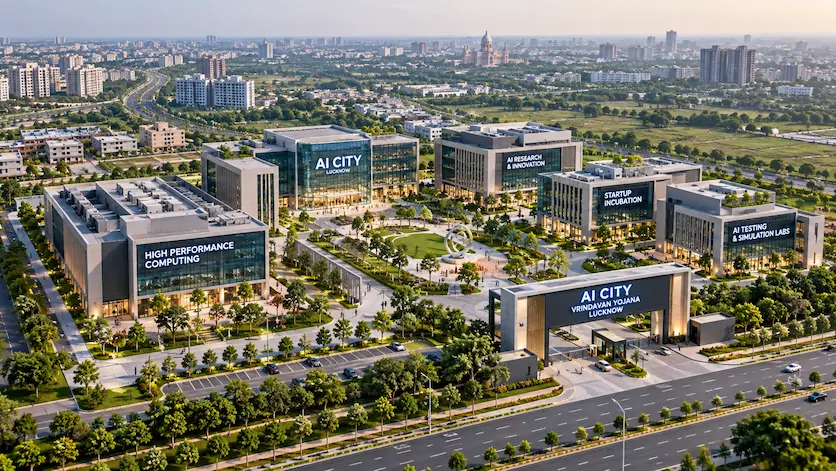
Lucknow.
- Uttar Pradesh’s Tech Ambition: Four Core Growth Engines
- Lucknow: The AI Engine and Regional Innovation Hub
- Kanpur: Deep-Tech Research and Chip Design
- Semiconductor Manufacturing: The Jewar Anchor
- Regional Division of Roles across Uttar Pradesh
- GCC & Data Infrastructure Policy Enablers
- Execution Requirements and Key Metrics to Watch
- What to Track Over the Next 36 Months:
Uttar Pradesh is undergoing an unprecedented industrial overhaul, rapidly shifting from its traditional heartland roots to establish itself as India’s premier innovation engine. As of 2026, the state government has accelerated its vision to build a interconnected tech corridor that extends far beyond the established technology hubs of Noida and Greater Noida.
By linking world-class research institutions, high-tech manufacturing, skilled engineering graduates, and targeted policy incentives, Uttar Pradesh is laying the infrastructure for an ecosystem capable of sustaining advanced manufacturing and high-value digital services.
UTTAR PRADESH MULTI-CITY TECH CORRIDOR
┌────────────────────────────────────────────────────────────────────┐
│ │
│ JEWAR & GREATER NOIDA ───► Semiconductor Fabs & Electronics │
│ LUCKNOW ───► Proposed AI City & Enterprise GCCs │
│ KANPUR ───► Deep-Tech R&D, Design & Robotics │
│ NOIDA ───► Established IT Services & Operations │
│ │
└────────────────────────────────────────────────────────────────────┘
Uttar Pradesh’s Tech Ambition: Four Core Growth Engines
The state’s technology roadmap revolves around four mutually reinforcing growth verticals:
- Artificial Intelligence & Data Infrastructure: Anchor projects like Lucknow’s AI City provide high-performance computing, simulation labs, and testing infrastructure tailored for machine learning startups and enterprise scale-ups.
- Semiconductors & Electronics: Centered in the Yamuna Expressway Industrial Development Authority (YEIDA) region near Jewar, this vertical focuses on wafer fabrication, display-driver chip manufacturing, and electronics assembly.
- Global Capability Centres (GCCs): Strategic policy frameworks encourage global enterprises to set up operational nodes handling cyber resilience, business analytics, and product engineering.
- Deep-Tech & Startups: University-backed research initiatives in robotics, quantum engineering, industrial AI, and advanced defense tech provide a direct link between campus IP and market deployment.
Lucknow: The AI Engine and Regional Innovation Hub
Lucknow is designed to serve as the software intelligence heart of the state. The proposed AI City at Vrindavan Yojana IT City—with Phase I spanning over 20 acres—aims to establish an integrated environment for AI research, software testing, and startup incubation.
- Employment Generation: Expanding software engineering roles in machine learning, cloud architecture, data pipelines, and full-stack AI dev.
- Incubation Infrastructure: Dedicated testing environments designed to accelerate time-to-market for early-stage software companies.
- University Collaboration: Direct pipelines connecting regional universities with private enterprise teams for skill development and technology transfer.
Kanpur: Deep-Tech Research and Chip Design
Kanpur supplies the foundational engineering, R&D, and deep-tech muscle for the corridor. Built around the academic ecosystem of IIT Kanpur, the city focuses on high-precision engineering rather than traditional IT campuses:
- Semiconductor Design & Embedded Systems: Specializing in chip verification, VLSI circuit layout, and microarchitecture development.
- Deep-Tech U-Hub: The Uttar Pradesh Startup Mission’s U-Hub initiative leverages IIT Kanpur’s facilities to incubate robotics, industrial automation, defense technology, and quantum computing ventures.
- Tier-II Satellite GCCs: Acting as a key spoke under the state’s GCC framework to house specialized research and engineering teams.
Semiconductor Manufacturing: The Jewar Anchor
The semiconductor landscape is grounded in the YEIDA region near the Noida International Airport at Jewar:
- HCL-Foxconn Semiconductor Facility: Approved by the Central Government with an estimated investment of ₹3,706 crore, this project is configured to manufacture display-driver chips for smartphones, laptops, and automotive electronics. The unit targets a production output of 20,000 wafers per month alongside a design capacity of 36 million units monthly.
- Electronics Manufacturing Cluster: Backed by foundational investments worth over ₹6,750 crore announced in June 2026, the cluster complements chip production with component manufacturing and supply chain integration.
Regional Division of Roles across Uttar Pradesh
| Region / City | Primary Strategic Role | Focus Domain / Ecosystem Contribution |
| Jewar & Greater Noida | Semiconductor & Electronics Fab | Semiconductor manufacturing, display-driver packaging, supply chain logistics |
| Lucknow | AI Hub & Enterprise GCCs | Machine learning models, enterprise software, global capability operational nodes |
| Kanpur | Deep-Tech R&D & Engineering | Chip design, VLSI verification, robotics, industrial AI, defense tech |
| Noida | IT Services & Product Engineering | Established corporate operations, software engineering, enterprise IT delivery |
GCC & Data Infrastructure Policy Enablers
Two key state policies provide the framework for sustainable scaling:
- UP GCC Policy 2024: Uses a hub-and-spoke delivery model to expand multinational operations beyond Tier-I markets into Lucknow and Kanpur, offering capital, operational, and payroll incentives.
- UP Data Centre Policy 2026: Targets the mobilization of more than ₹2 lakh crore in digital infrastructure investments. It covers hyper-scale data parks, edge computing units, and AI computing clusters powered by renewable energy incentives.
Execution Requirements and Key Metrics to Watch
Translating policy into a thriving tech belt requires steady execution across core operational pillars:
- Digital & Energy Infrastructure: Securing uninterrupted power delivery and high-bandwidth fiber backbones for data-heavy AI and chip production.
- Talent Retention & Pipeline: Building skilled workforces trained in specialized semiconductor engineering, cybersecurity, and deep-tech development.
- MOU Translation: Converting signed MoUs into operational facilities and real hiring.
What to Track Over the Next 36 Months:
- On-ground progress at Lucknow’s AI City development site.
- Milestone completion of the HCL-Foxconn facility in Jewar.
- Net hiring metrics across newly operational satellite GCCs.
- Active commissioning of data centre megawatt capacity across the state.
Frequently Asked Questions (FAQ)
Q1: What is the main objective of Lucknow’s proposed AI City?
A: Lucknow’s AI City (Vrindavan Yojana) is designed to bring together high-performance computing infrastructure, AI simulation/testing facilities, incubators, and corporate technology teams into a unified innovation hub.
Q2: How does Kanpur contribute to Uttar Pradesh’s technology corridor?
A: Kanpur contributes through deep-tech R&D, leveraging IIT Kanpur for semiconductor design, chip verification, robotics, industrial AI, defense tech, and satellite GCC operations.
Q3: What capacity is planned for the HCL-Foxconn semiconductor project near Jewar?
A: The ₹3,706 crore facility is designed with a planned manufacturing capacity of 20,000 wafers per month and a design output capacity of 36 million units monthly for display-driver chips.
Q4: How do the UP GCC and Data Centre policies support this multi-city strategy?
A: The UP GCC Policy 2024 provides incentives for companies expanding into Lucknow and Kanpur, while the UP Data Centre Policy 2026 offers land, energy, and capital subsidies to expand computing capacity for high-density tech workloads.
Disclaimer
This article is provided for educational and informational purposes only. Information regarding state schemes, investment targets, infrastructure timelines, and policy guidelines is based on public announcements and subject to revisions by the relevant government departments and corporate stakeholders.
Relevant Links
- Kanpur–Lucknow Corridor: North India’s New Real Estate “Power Belt” Set for 2026 Surge
- UP Startup Policy 2026: Financial Grants, U-Hub Infrastructure, and ₹1000 Crore Fund
- Silicon, Skills, and Sovereignty: Inside the Massive Uttar Pradesh AI Revolution of 2026
- 73rd Meeting of Network Planning Group Under PM GatiShakti Evaluates Key Infrastructure Projects
