

Mumbai.
In a decisive move to expand beyond silicon and challenge market leader Nvidia in full-stack artificial intelligence, Advanced Micro Devices (AMD) announced an agreement to acquire World Labs. The spatial-intelligence startup was co-founded by renowned computer scientist Dr. Fei-Fei Li. The all-stock transaction values World Labs at approximately $8.2 billion and marks AMD’s largest software and model research acquisition to date.
Under the terms of the agreement, Dr. Fei-Fei Li will join AMD as Executive Vice President and Chief Scientist, reporting directly to AMD Chair and CEO Dr. Lisa Su once the transaction closes toward the end of 2026.
What Is World Labs and Why Is AMD Acquiring It?
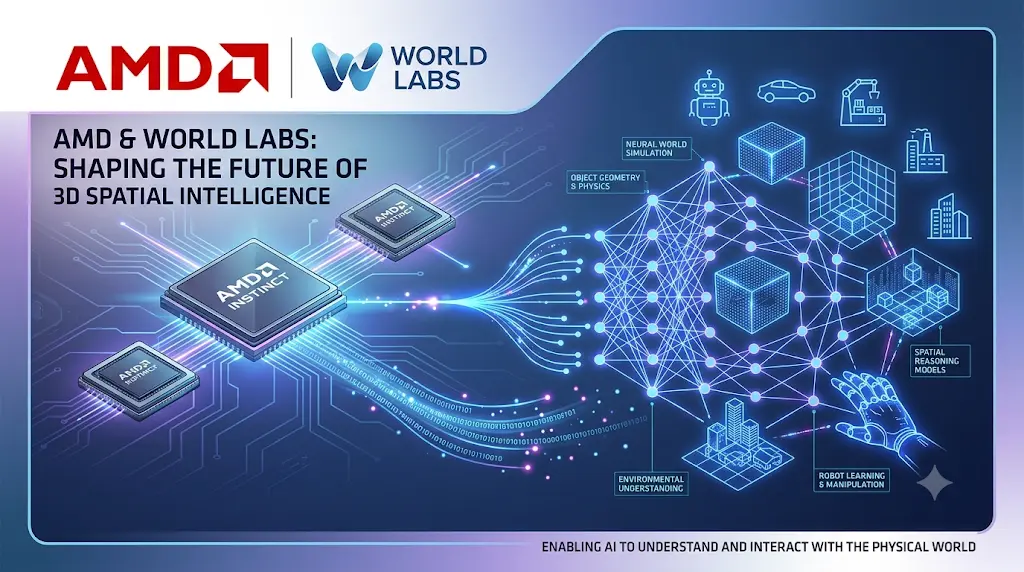
Unlike conventional generative AI models that focus on text (LLMs) or 2D image synthesis, World Labs specializes in spatial intelligence and 3D world models. Its core technology generates persistent, spatially coherent 3D environments and physical representations from text, video, and layout inputs.
[2D Inputs: Images / Video / Text]
│
▼
┌──────────────────┐
│ World Labs 3D │ ────► Spatial Geometry & Physical Constraints
│ World Model │ ────► Real-Time Physics & Object Dynamics
└──────────────────┘
│
▼
[Physical AI: Robotics / Digital Twins / Industrial Automation]
For AMD, acquiring World Labs accelerates its transition from a pure hardware vendor into an end-to-end AI platform provider. Co-designing future Instinct GPU architectures alongside foundational world models gives AMD an operational edge in hardware efficiency for 3D simulation workloads.
Key Highlights of the Acquisition
| Parameter | Acquisition Details |
| Transaction Value | $8.2 Billion |
| Deal Structure | All-stock transaction |
| Target Company | World Labs (San Francisco, CA) |
| Co-Founder & Key Executive | Dr. Fei-Fei Li (Joining AMD as EVP & Chief Scientist) |
| Target Technology Stack | 3D Spatial Intelligence, Physical AI, World Simulation Models |
| Expected Completion | Late 2026 (Subject to regulatory approvals) |
Decoding Spatial Intelligence in AI
Spatial intelligence refers to an AI system’s capability to perceive, reason about, and simulate three-dimensional environments, physical dynamics, geometry, and motion.
┌─────────────────────────────────────────────────────────────┐
│ 3-Step Spatial Perception │
└─────────────────────────────────────────────────────────────┘
│
- Multimodal Parsing ──► Processes video, images & spatial layouts
│
- 3D World Generation ──► Builds geometrically sound 3D representations
│
- Physical Reasoning ──► Simulates motion, collisions & spatial dynamics
Core Applications of Physical AI
- Robotics & Autonomous Systems: Enables robots to navigate complex physical obstacles, estimate weight and momentum, and safely manipulate objects in real-world settings.
- Industrial Automation: Allows manufacturers to test assembly lines, optimize warehouse floor plans, and run high-fidelity simulations before physical deployment.
- Interactive 3D Environments: Powers digital twins, spatial computing applications, and scientific research models that require physical constraints over pure visual rendering.
Strategic Impact on AMD vs. Nvidia Competition
Nvidia has built a strong lead in physical AI through platforms like Omniverse and dedicated synthetic data tools. AMD’s acquisition of World Labs directly answers this ecosystem expansion.
┌─────────────────────────────────────────────────────────────────────────┐
│ AMD’s AI Tech Stack │
├─────────────────────────────────────────────────────────────────────────┤
│ Foundational Models │ World Labs Spatial Intelligence & 3D Models │
│ Software Stack │ ROCm Open Software Ecosystem & Model Libraries │
│ Compute Hardware │ Instinct GPUs, EPYC CPUs, Accelerators │
└─────────────────────────────────────────────────────────────────────────┘
Rather than competing purely on raw floating-point operations per second (FLOPS), AMD is aligning its computing silicon directly with the specific algorithmic demands of 3D spatial intelligence.
Frequently Asked Questions (FAQ)
Who is Dr. Fei-Fei Li?
Dr. Fei-Fei Li is a renowned computer scientist and Stanford professor often called the “Godmother of AI” for co-leading the development of ImageNet, which helped launch modern deep learning.
Is the AMD–World Labs deal completed?
No. The acquisition was announced on September 28, 2026, and is scheduled to close by the end of 2026, pending regulatory approvals and standard closing conditions.
What product does World Labs develop?
World Labs produces 3D spatial foundation models—such as its early spatial system, Marble—that build interactive, persistent 3D worlds from text, images, and visual inputs.
Useful Resources & Links
- Read broader global news and tech coverage on Matribhumi Samachar English.
Disclaimer
This article is for informational purposes only based on the announcement made on September 28, 2026. The acquisition remains subject to customary regulatory reviews and closing conditions. Financial metrics and timelines mentioned reflect forward-looking statements provided at the time of publication.
