
New Delhi.
- What Is the Revamped Khelo India Framework?
- 7 Core Pillars Driving the Expansion
- 1. Unified Pathway: School to Elite Podium
- 2. Emerging Khelo India Athletes (E-KIA) Category
- 3. Connecting Education and Sports
- 4. Olympic-Grade Infrastructure Expansion
- 5. AI, Wearables & Sports Science Integration
- 6. Enhanced Competition Framework
- 7. National Coach Accreditation Board (NCAB)
- Stakeholder Impact Summary
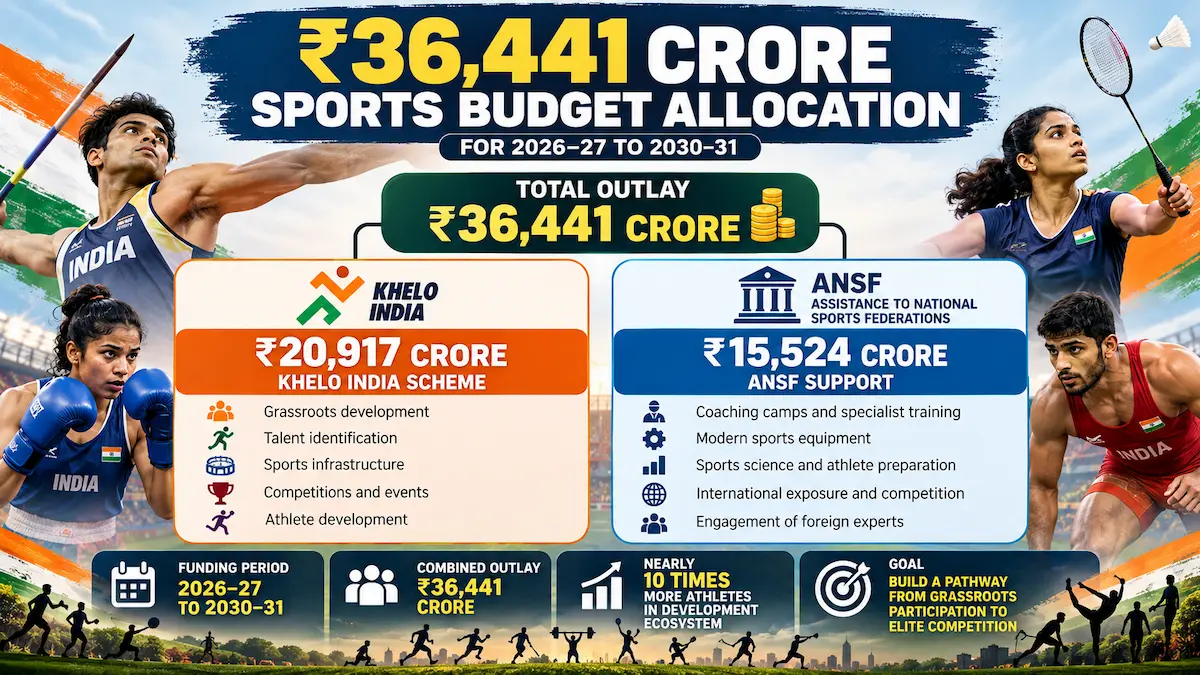
In a landmark step toward transforming the nation into a global sporting powerhouse, the Government of India has launched a major expansion of its sports development ecosystem. Backed by a massive ₹36,441 crore budget outlay over five years (2026–27 to 2030–31), the revamped framework sets out to build an end-to-end athlete pathway—taking young talent from school grounds all the way to Olympic podiums.
For detailed news coverage on regional and national sports initiatives across India, visit Matribhumi Samachar English – Sports Section.
What Is the Revamped Khelo India Framework?
The ₹36,441 crore outlay represents an eightfold increase in capital dedicated to sports development. Crucially, this funding serves a dual purpose:
- Grassroots Development: Expanding the Khelo India Scheme to widen access and infrastructure.
- Federation Support: Enhancing the Assistance to National Sports Federations (ANSF) program to build high-performance camps, secure top foreign coaches, and ensure international competition exposure.
The primary objective is to scale the athlete pipeline, bringing nearly 10 times more athletes into structured development ecosystems nationwide.
7 Core Pillars Driving the Expansion
1. Unified Pathway: School to Elite Podium
The framework creates a connected institutional matrix. Local training grounds will connect directly with:
- Khelo India Centres (KICs)
- Sports Authority of India (SAI) Training Centres
- National Centres of Excellence (NCoE)
This seamless linkage reduces transition gaps, ensuring promising athletes receive high-grade facilities as soon as they are discovered.
2. Emerging Khelo India Athletes (E-KIA) Category
A major addition to the program is the E-KIA classification. Sitting alongside the core Khelo India Athletes program, E-KIA focuses on “tier-two” potential talent—young athletes showing high promise who require professional mentoring, nutrition, and scientific feedback before breaking into national elite squads.
3. Connecting Education and Sports
To make sports an integral component of school life, two dedicated school initiatives have been introduced:
- Khelo India Feeder Schools (KIFS): Local school hubs designed to identify talent early.
- Khelo India Utkrishta Vidyalayas (KIUV): Schools equipped to seamlessly blend academics with high-level sports preparation.
4. Olympic-Grade Infrastructure Expansion
Infrastructure priorities emphasize building facilities tailored to India’s key medal prospects at international events. Key projects focus on modernizing regional complexes, supporting state-level infrastructure development, and establishing regional high-performance hubs to serve rural and remote talent.
5. AI, Wearables & Sports Science Integration
To modernize talent scouting and athletic monitoring, the framework adopts cutting-edge technologies:
- AI & Video Analytics: Automated skill identification and technique corrections.
- Wearable Monitoring: Live tracking of fatigue, bio-metrics, and injury risk.
- Centralized Data Repositories: Digital tracking of athlete progress throughout their developmental journey.
6. Enhanced Competition Framework
The calendar will expand across multi-tier tournaments, including school, university, regional, and national championships. Broadening access remains a priority, with increased participation opportunities for women athletes, para-athletes, and players in indigenous sports.
7. National Coach Accreditation Board (NCAB)
To upgrade training standards, the proposed National Coach Accreditation Board (NCAB) will set standardized coaching qualifications across India. Simultaneously, expanded ANSF funding will enable federations to recruit specialized support staff and foreign technical experts.
Stakeholder Impact Summary
| Group | Key Benefits |
| School Students | Early talent identification via KIFS & KIUV in academic settings |
| Emerging Athletes | E-KIA tier access to scientific training and early mentoring |
| Rural Athletes | Local talent scouting and connectivity to high-performance facilities |
| Women & Para-Athletes | Dedicated leagues, equal access, and expanded tournament slots |
| Elite Athletes | High-performance coaching camps, top equipment, and international exposure |
Frequently Asked Questions (FAQ)
Q1: Is the ₹36,441 crore allocation provided as direct cash assistance to athletes?
No. The budget covers overall ecosystem costs—building infrastructure, organizing competitions, providing sports science support, funding training camps, acquiring foreign coaches, and strengthening National Sports Federations.
Q2: What is the main difference between KIFS and KIUV?
Khelo India Feeder Schools (KIFS) act as initial scouting grounds to catch grassroots talent early. Khelo India Utkrishta Vidyalayas (KIUV) integrate dedicated sports development into regular academic schooling.
Q3: How can young athletes apply for selection under the revamped scheme?
Athletes can enter through state/district sports department trials, official school and university games, or talent identification drives organized at accredited Sports Authority of India (SAI) and Khelo India Centres. Maintaining performance records and fitness metrics is recommended.
Q4: How does the ANSF scheme fit into this budget?
The total ₹36,441 crore figure is a combined outlay covering both the grassroots Khelo India Scheme and the Assistance to National Sports Federations (ANSF). ANSF funding supports national squads, foreign exposure trips, elite coaching camps, and equipment.
Disclaimer
This article is provided for informational and educational purposes based on official announcements from the Ministry of Youth Affairs and Sports and the Union Cabinet. Scheme guidelines, eligibility criteria, and financial disbursements are subject to implementation policies laid down by relevant state authorities, the Sports Authority of India (SAI), and national governing bodies. For official news and regional sports updates, visit Matribhumi Samachar English.
