

New Delhi.
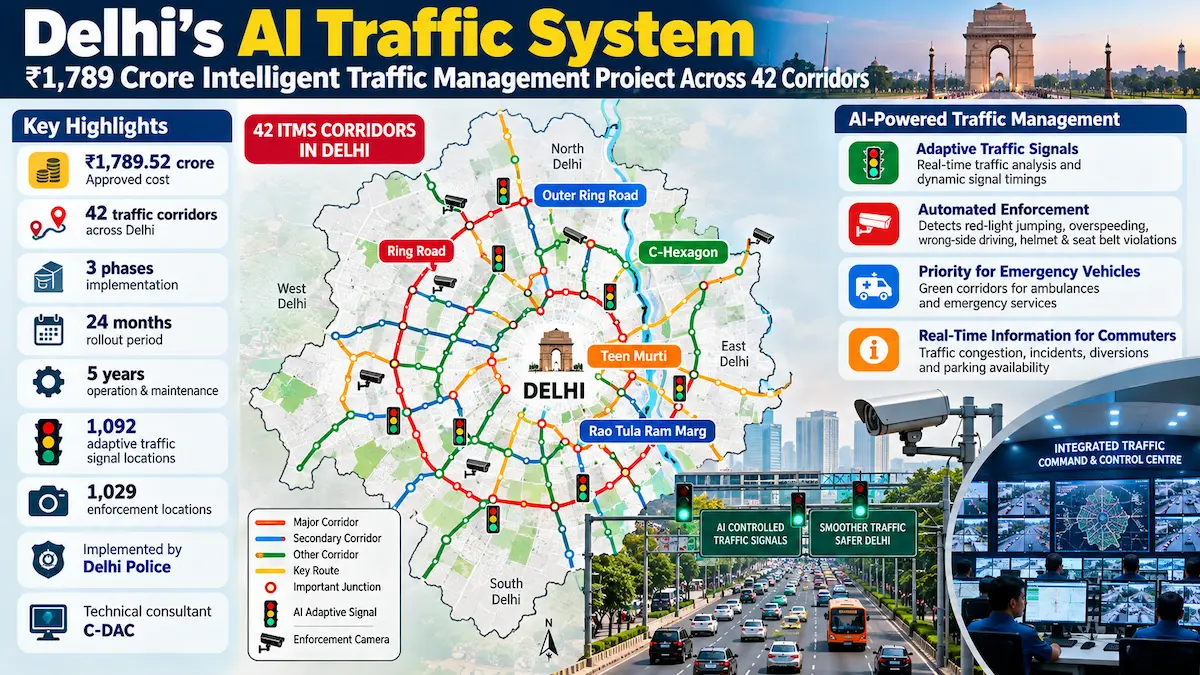
In a major technological leap aimed at resolving urban mobility bottlenecks in the national capital, the Union Cabinet has officially approved the ₹1,789.52 crore Intelligent Traffic Management System (ITMS) for Delhi. Implemented by the Delhi Police with technical consultancy from the Centre for Development of Advanced Computing (C-DAC), this multi-phased project marks a fundamental shift from static, timer-based signal operations to real-time, artificial intelligence-driven traffic governance.
Technical Specifications & Strategic Architecture
Dynamic Signal Optimization
Instead of relying on fixed durations, the system leverages Adaptive Traffic Control Systems (ATCS) across 1,092 locations. AI models evaluate live congestion metrics via real-time camera feeds and dynamically balance signal durations along interconnected corridors, ensuring continuous traffic flow and reducing unnecessary idling.
Comprehensive Automated Enforcement
High-definition AI camera networks at 1,029 key enforcement locations will detect automated traffic violations, including:
- Speeding and red-light jumping
- Stop-line and zebra crossing infringements
- Helmetless riding, seatbelt non-compliance, and mobile phone usage while driving
- Wrong-side driving and illegal roadside parking
- Automated flagging of stolen, blacklisted, or repeat-offender vehicles
Emergency Vehicle Priority (Green Corridors)
The ITMS platform features automated green corridor routing for emergency service vehicles. Real-time signal overrides clear paths for ambulances and fire engines moving through heavy congestion stretches.
Commuter Information & Navigation Integration
Live status updates on congestion, accidents, diversions, and parking space availability will be displayed on Variable Message Signs (VMS) across major roads. Open APIs allow integration with mobile navigation systems to redirect traffic proactively.
Phase Implementation Plan (24-Month Rollout)
The deployment across 42 major corridors will occur in three distinct phases over 24 months, followed by five years of operation and maintenance (O&M):
| Phase | Rollout Scope | Key Corridors Covered |
| Phase 1 | Initial major traffic arteries & core infrastructure | Ring Road, Outer Ring Road, Rao Tula Ram Marg, Teen Murti, and C-Hexagon |
| Phase 2 | Secondary high-density traffic corridors | Expansion to 7 additional identified corridors |
| Phase 3 | Complete network integration across remaining routes | Remaining corridors across Delhi network |
Related Coverage & Links
For further analysis on national infrastructure and technology initiatives, read more on Matribhumi Samachar English:
- Explore latest national technology updates at Matribhumi Samachar National Section.
- Read about regional development and smart city initiatives at Matribhumi Samachar Main Portal.
Frequently Asked Questions (FAQ)
What is the total budget for Delhi’s ITMS project?
The Union Cabinet approved a budget of ₹1,789.52 crore for the implementation of the Intelligent Traffic Management System in Delhi.
Which agency will execute the ITMS project?
The project will be implemented by the Delhi Police through a Master System Integrator, with the Centre for Development of Advanced Computing (C-DAC) acting as the Project Management Consultant.
How does the AI traffic signal system work?
Unlike traditional fixed-timer signals, AI adaptive signals analyze live traffic density using camera feeds and dynamically alter signal light durations to clear congestion efficiently.
How long will the ITMS project take to complete?
Implementation across 42 corridors will take 24 months in three phases, followed by five years of operations and maintenance.
Disclaimer
Disclaimer: The information provided in this article is based on official government cabinet releases and public announcements. Project timelines, corridor allocations, and implementation details are subject to administrative updates by the Delhi Police and ministry officials.
