



Yuxi, China–(Newsfile Corp. – October 17, 2026) – DEEP Robotics is pleased to announce it has deployed its Lynx M20S wheeled-legged robot in the Ailao Mountains. Stretching for hundreds of kilometers along the eastern edge of the Hengduan Mountains in southwestern China, the Ailao Mountains contain extensive subtropical evergreen broadleaf forests and rich biodiversity. Their dense vegetation and relatively undisturbed habitats offer valuable opportunities for ecological research. But the terrain also makes fieldwork difficult: steep slopes, fallen trees, tangled vines and slippery moss can slow progress and increase risks for researchers.
Working alongside researchers, the robot assisted with route reconnaissance, wildlife observation, visual documentation and supply transport. The deployment offered a practical test of how mobile robotics can support biodiversity research in difficult-to-access environments.
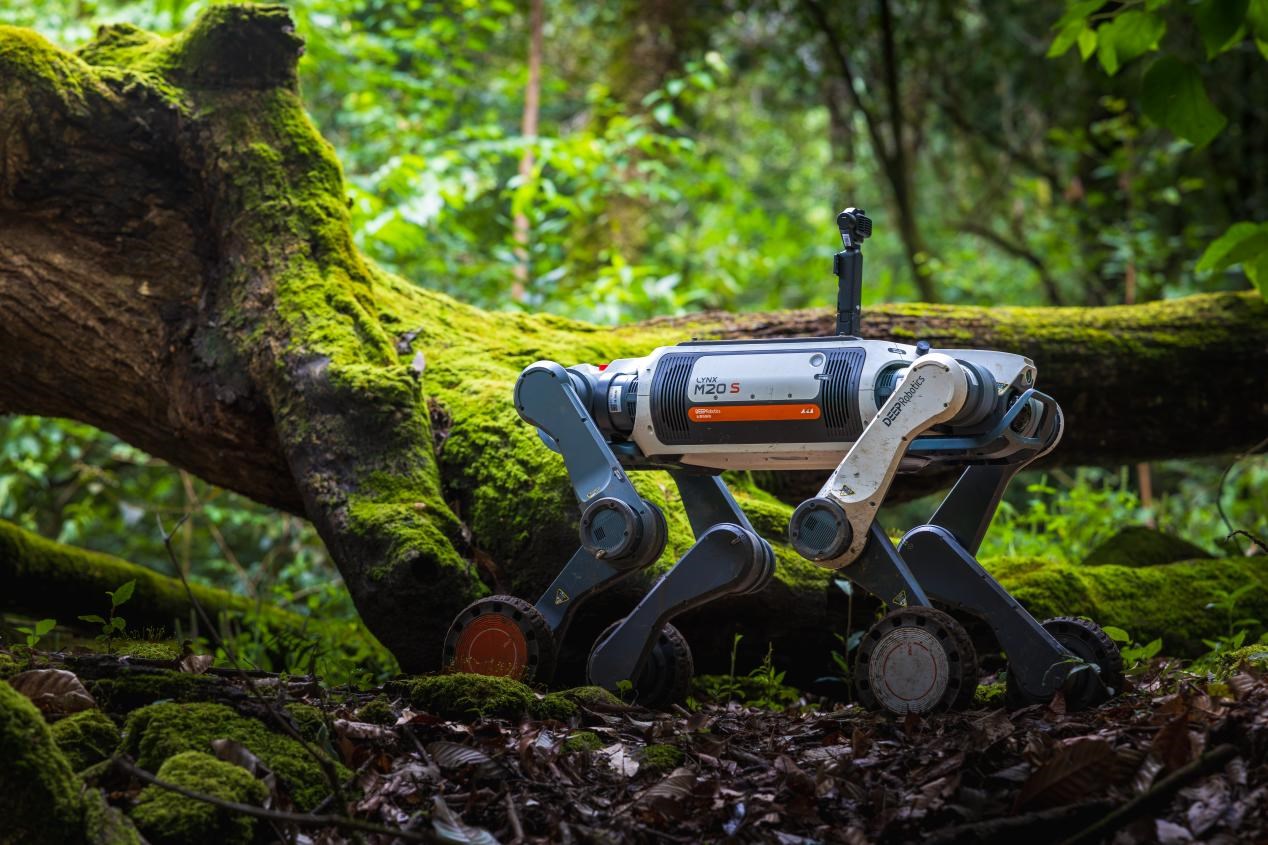
DEEP Robotics’ Lynx M20S navigates mossy fallen logs and leaf litter in the Ailao Mountains.
Navigating Rapid Weather Changes and Dense Forest
Conditions in the Ailao Mountains can change quickly. Rain, fog and thunderstorms may develop with little warning, and temperatures can fall from the mid-20s Celsius to single digits, a change of more than 10°C. For field teams, dependable equipment is essential. The Lynx M20S has an IP67 ingress-protection rating and a specified operating temperature range of −30°C to 55°C. These specifications are designed to support operation in wet conditions and across wide temperature variations, both relevant to fieldwork in the mountain forest.
Deep in the Ailao Mountains, established trails are scarce. Steep slopes, thorny vegetation and fallen trees make route selection a challenge. The robot helped scout unfamiliar sections ahead of the team. Its wheeled-legged design allows it to switch movement modes according to the terrain: wheels support efficient travel along passable forest paths and muddy streambanks, while articulated legs help it negotiate fallen timber and uneven rocky ground. This flexibility can help researchers assess routes before entering potentially hazardous areas.
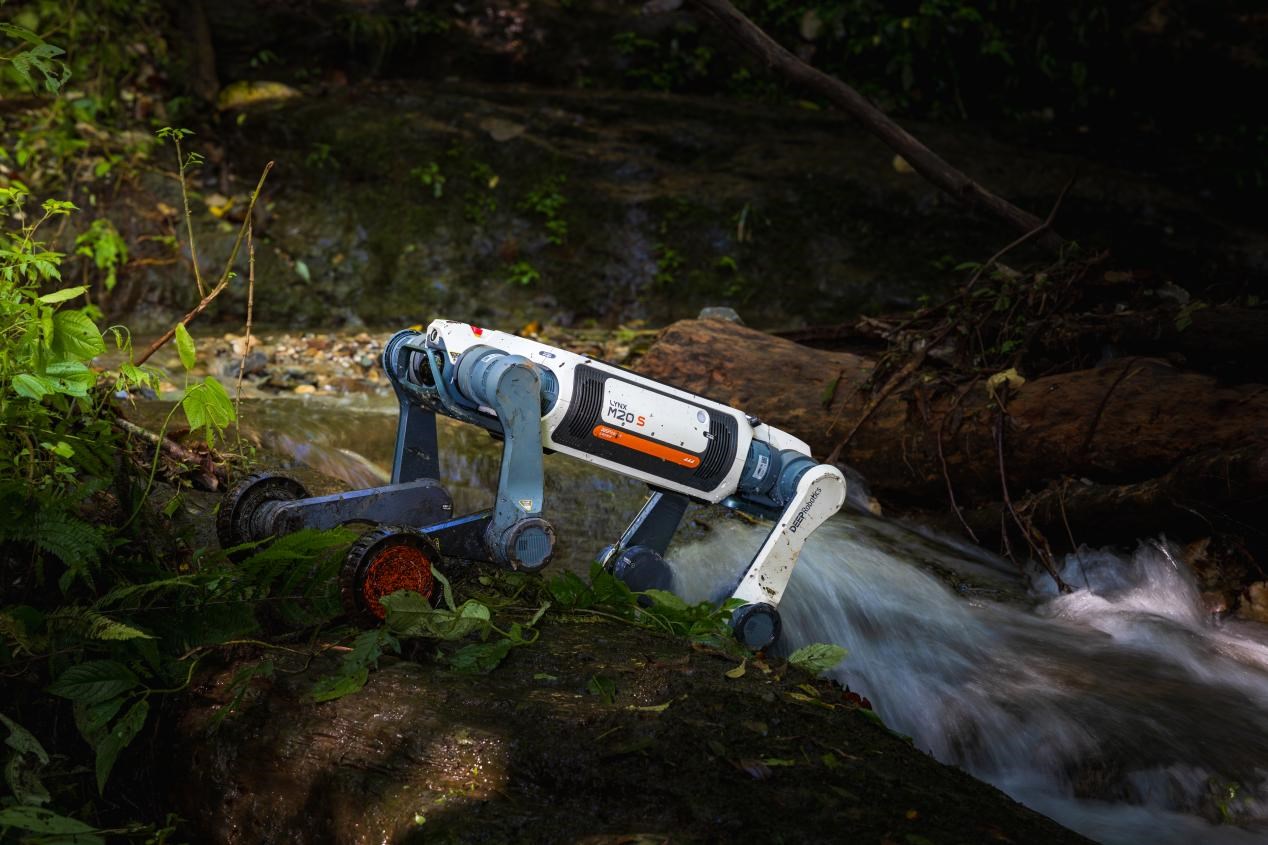
The Lynx M20S crosses slippery rocks and fallen timber beside a stream while scouting the route ahead.
Visibility presents another challenge. Layers of trees, shrubs and undergrowth can block sightlines, while fog may reduce visibility to around 20-30 meters. The robot’s wide-angle camera provided live footage to researchers’ devices, allowing them to inspect obstacles and terrain beyond their immediate view. This scouting-first approach gave the team additional information before moving forward, potentially reducing exposure to unseen hazards.
Observing Wildlife Above and Below the Canopy
The Ailao Mountains provide habitat for species that can be difficult to observe at close range. The western black-crested gibbon (Nomascus concolor), lives in old-growth forests at elevations of approximately 2,200-2,900 meters. These canopy-dwelling primates are sensitive to human activity, so researchers must balance the need for close observation with the risk of disturbing natural behavior.
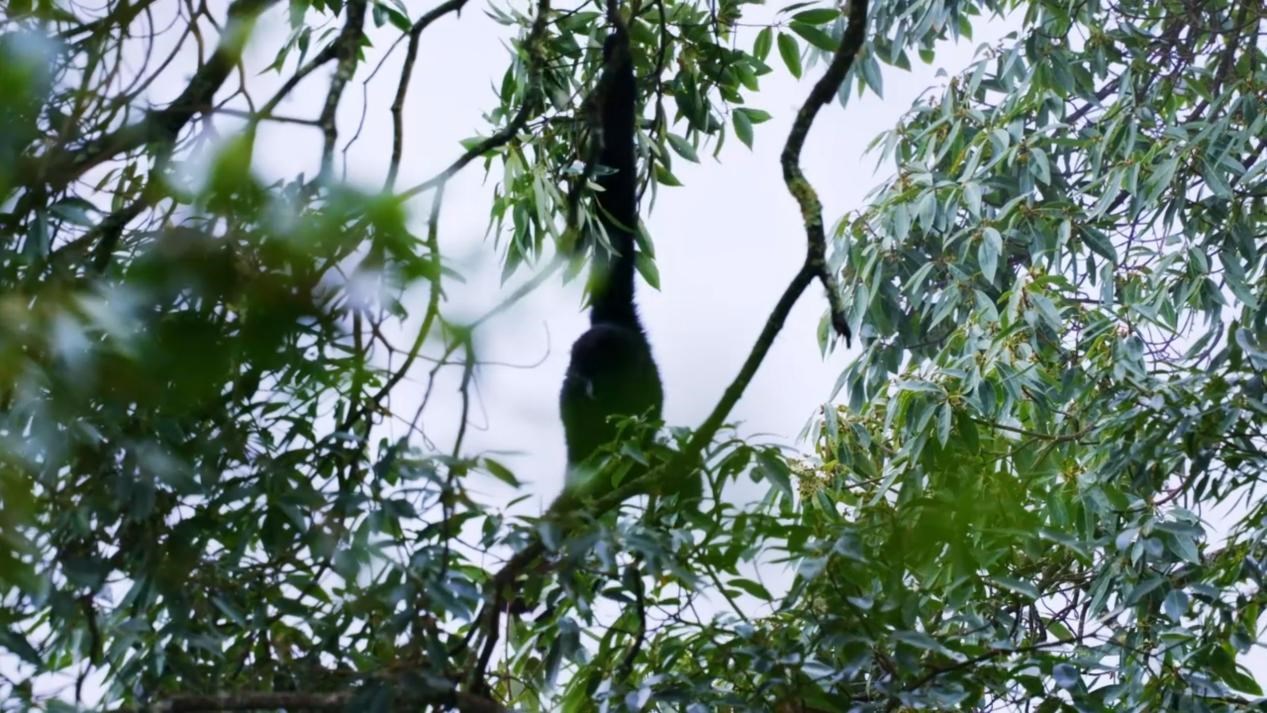
A western black-crested gibbon in the canopy, filmed with limited disturbance by the robot’s imaging payload.
With a relatively compact profile and low operating noise, the robot offered an alternative observation platform to a group of people approaching on foot. Its imaging equipment supported upward and side-angle filming from the forest floor, helping the team document gibbons moving, foraging and calling in the canopy. During the expedition, researchers were able to move an observation point approximately 20 meters closer, obtaining filming angles that had previously been difficult to access. The approach illustrates how remote imaging platforms may help limit disturbance while collecting useful behavioral footage.
The same low viewing angle can be useful for botanical surveys. Dense understory vegetation often conceals plants from researchers standing above it. By moving close to the forest floor, the robot helped document vegetation hidden behind branches and leaves. During the expedition, it captured footage of Monotropa uniflora, commonly called ghost pipe, a mycoheterotrophic plant that can be difficult to spot in the wild. Its aboveground growth is visible for only a limited part of the year-around 40 days, according to the expedition account-making opportunistic observations valuable for subsequent study.

Monotropa uniflora (ghost pipe) captured near the forest floor, where it is visible for only about 40 days a year.
Carrying Equipment on Long, Difficult Routes
Transporting equipment is another persistent challenge in remote field research. Forest covers approximately 85.1% of the Ailao Mountains, according to the expedition account, and vehicles cannot reach many sites. Teams often carry monitoring instruments, cameras and essential supplies over uneven ground. The Lynx M20S has a specified continuous payload capacity of 35 kg and can accompany researchers across mixed terrain while carrying equipment. In practice, this can reduce the load carried by individual team members and leave more time and energy for observation and data collection.
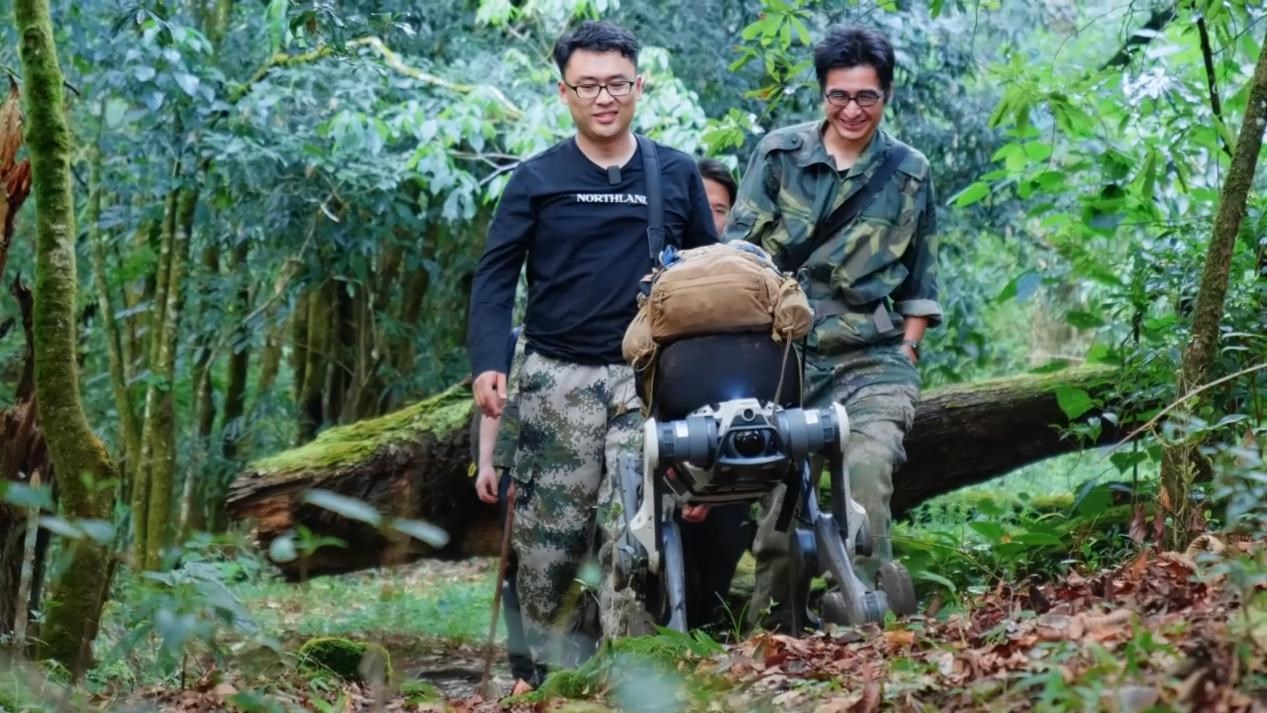
Researchers move through the forest alongside the Lynx M20S, which carries up to 35 kg of equipment.
Reaching remote sites can involve several hours of trekking, making endurance and battery management important. The Lynx M20S offers up to 3.5 hours of operation while carrying a payload, according to its stated specifications, and uses hot-swappable batteries that can be replaced without powering down the robot. During fieldwork, the platform can alternate between assisting with filming at observation sites and carrying equipment as the team moves between locations.
What the Expedition Shows About Field Robotics
The Ailao Mountains expedition brought together three practical applications of mobile robotics: scouting difficult routes, gathering images from hard-to-reach viewpoints and transporting supplies. Together, these functions helped researchers work in terrain where conventional field methods can be physically demanding.
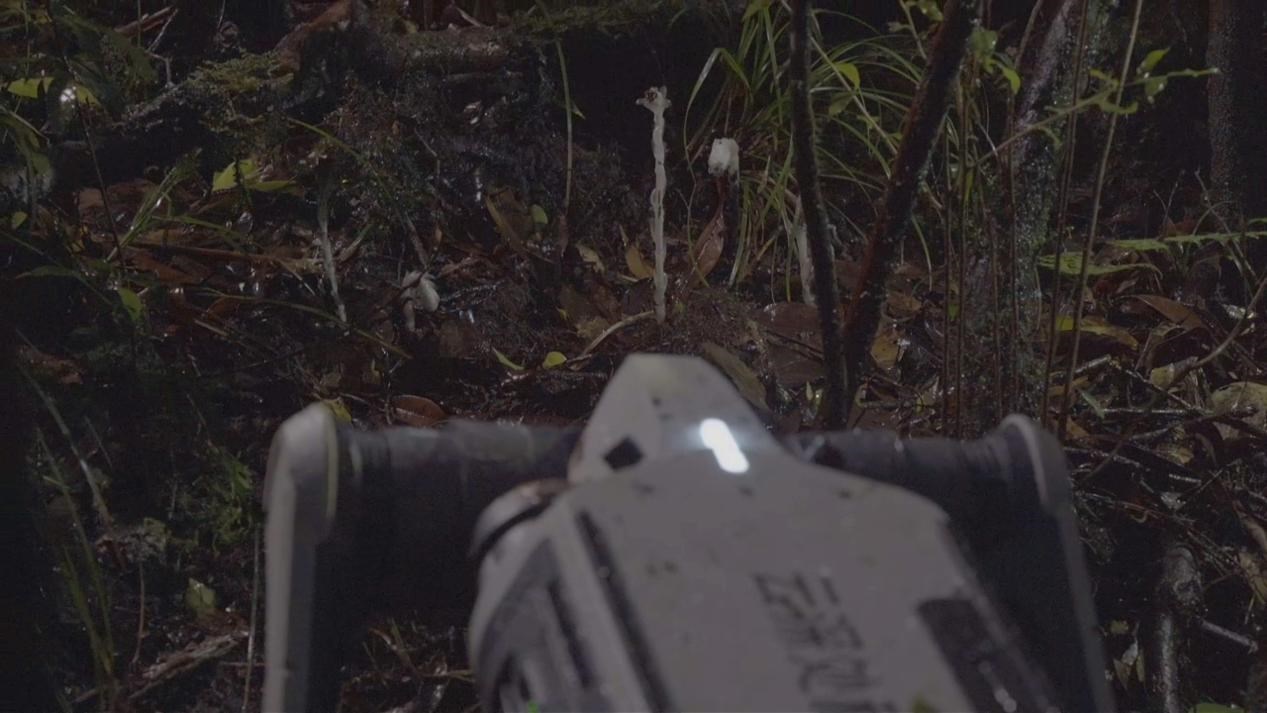
A robot’s-eye view of dense understory vegetation, documenting plants hidden from a standing viewpoint.
The Ailao Mountains deployment is part of DEEP Robotics’ broader exploration of robots for environmental fieldwork. At Zhuonai Lake in Hoh Xil, a robot was used as a “robotic Tibetan antelope” to capture close-range footage with limited disturbance to the herd. A robot also traveled aboard the research vessel Sun Yat-sen University Polar for performance testing on Arctic sea ice. At Serling Tso, robotic filming supported observations of Tibetan antelopes migrating, nursing and foraging.
These deployments span forests, high-altitude grasslands and polar environments, each presenting different mobility and observation challenges. DEEP Robotics founder Zhu Qiuguo described the company’s approach this way: “Our original intention in building robots was not to replace humans, but to enable robots to step forward when people need them!” In the Ailao Mountains, that principle took the form of a machine moving ahead on uncertain trails, carrying research equipment and capturing views that would otherwise be difficult to obtain.
For conservation teams, the significance lies in practical support rather than novelty alone. Mobile robots may help researchers access challenging locations, document sensitive wildlife and reduce some of the physical demands of field expeditions. The Ailao Mountains project offers one example of how embodied AI could complement established research methods while helping scientists observe natural habitats with less direct human intrusion.
Company: DEEP Robotics
Contact: Vivian Chen
Email: [email protected]
Website: https://www.deeprobotics.cn/en
Source: DEEP Robotics
Dateline City: Yuxi, China
To view the source version of this press release, please visit https://www.newsfilecorp.com/release/319333