

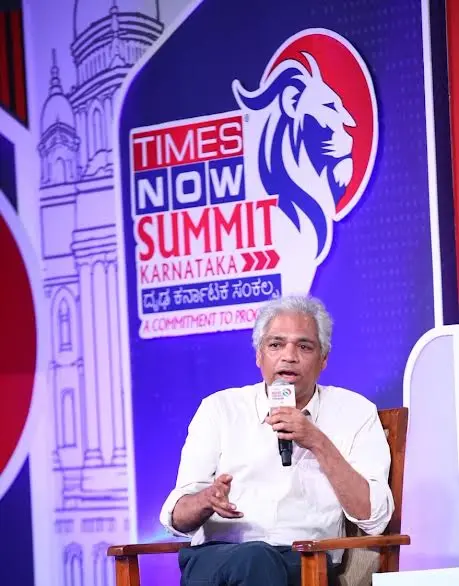
Bengaluru, November 2026: Karnataka CM DK Shivakumar termed the SIR exercise a “criminal conspiracy” and accused the BJP of resorting to electoral manipulation instead of seeking people’s mandate. He added that local workers had admitted receiving instructions from higher-ups.
Speaking at the Times Now Summit Karnataka, he alleged, “The biggest blunder that the BJP did… In every Assembly segment, from their head office, they got the forms printed, and all the names were there. They wanted to delete all the minorities, backward class and weaker sections of the vote, If I had not rushed that day, they would have deleted more than 15,000 to 17,000 voters in each Assembly constituency where the Congress votes were there. So immediately, I had to fight it out.” He further claimed that local party workers were asked to submit their Aadhaar and phone numbers along with Form 7 applications, with a target of removing 10,000 to 15,000 names in every Assembly constituency.
Further speaking about the vote theft, he said, “We were the first to start this fight, Karnataka. We knew what was going on in Mahadevapura. In one small house, 80 voters were there, 40 voters were there,” he said. Claiming that the Congress was among the first parties to raise concerns over alleged electoral irregularities, Shivakumar said he had personally intervened to prevent the deletion of thousands of voters in the state. He claimed that following the meeting, instructions were issued to officials at the lower levels not to act on the disputed Form 7 applications.
“The National Election Commission office has become a political office. It is a BJP office. As a Chief Minister, it is my duty. Whichever party they vote for, we don’t know, but I have to protect the voters. I have gone, I am fighting it. I will go on fighting till justice is given to every voter of this state,” he said.
Questioning the Commission’s conduct, he said the Leader of the Opposition was not being allowed to visit the office and seek answers. He also criticised Chief Election Commissioner Gyanesh Kumar, saying he did not agree with the way the poll body was handling the matter.
Addressing the event, Karnataka Minister for Greater Bengaluru Development Krishna Byre Gowda contextualised Bengaluru’s traffic situation by pointing to the city’s rapid urbanisation and the growing number of vehicles on its roads. He added, “From a population of 30 lakh to 1.5 crore, the rate of urbanisation in Bengaluru has been far more intense. Traffic is at the top of our priority, and our government is absolutely committed to addressing this issue. The number of vehicles in Bengaluru is 1.5 crore, and every day we are adding over 2,000 vehicles to the road.”
Gowda also questioned the disproportionate attention Bengaluru receives over civic infrastructure issues. Recalling a recent visit to Delhi, he said, “Recently I was in Delhi, 20mins rainfall and before I could reach the airport there was traffic jams and water logging in three different locations. Apparently, that does not make news, only Bengaluru makes news around the world.”
He further referred to the international coverage of frothing in one of Bengaluru’s lakes and drew a comparison with the visuals of frothing during Chhath Puja, “A few years ago, news about frothing in one of the lakes in the eastern part of Bengaluru became global. I was watching the visuals of Chhath Puja the other week, there is no river there is only frothing there but that does not make news.”
At the Summit, National Award-winning filmmaker Prakash Belawadi argued that Karnataka’s development agenda should not remain centred around Bengaluru. He expressed concern over the enormous amount of money being spent on the state capital while other districts continued to miss out on comparable investments. He advocated for greater decentralisation of development funds and proposed that districts should have greater control over how funds are spent, with elected representatives deciding local priorities. Highlighting the gap between agriculture’s contribution to the economy and the livelihoods it supports, he described the disparity as cruel and unacceptable.
Featured Article
