 Matribhumi Samachar English


New Delhi. Updated on : Wednesday, 24 June 2026
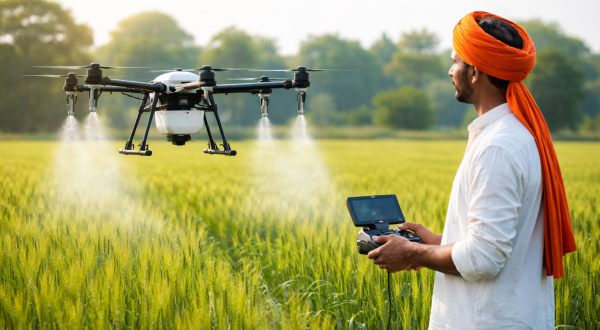
The landscape of Indian agriculture is undergoing a high-tech transformation. Through the visionary “Kisan Drone” initiative, the government is no longer just encouraging modernization—it is actively financing it. In a major move to liberalize airspace, 90% of India’s skies have been designated as a “Green Zone” for drone flights. For the everyday farmer, this presents a golden opportunity to boost crop yields, eliminate severe health hazards linked to manual pesticide spraying, and radically reduce labor costs through generous government subsidies.
Whether you are an individual smallholder, a representative of a Farmer Producer Organization (FPO), or part of a women’s Self-Help Group (SHG), here is everything you need to know about the current 2026 guidelines, financial structures, and the step-by-step application process.
The 2026 Subsidy Breakdown: Who Gets What?
The Sub-Mission on Agricultural Mechanization (SMAM) along with the Namo Drone Didi scheme serve as the primary engines driving this financial rollout. To guarantee that small-scale and marginalized communities benefit most, financial help is structured in tiers:
| Applicant Category | Subsidy Percentage | Maximum Financial Limit |
| Namo Drone Didi (Women SHGs) | 80% | Up to ₹8,00,000 |
| Farmer Producer Organizations (FPOs) | 75% | Evaluated based on total project cost |
| Small, Marginal, SC/ST, & Women Farmers | 50% | Up to ₹5,00,000 |
| General Category Farmers | 40% | Up to ₹4,00,000 |
💡 Upfront Cost Reductions: To lower the entry barrier, the GST on agricultural drones has been slashed to just 5%. For those applying via the Namo Drone Didi scheme, the financial package uniquely covers a 15-day training program, a full 1-year comprehensive insurance policy, and 2 years of annual drone maintenance.
How to Apply: A Step-by-Step Guide
The application process is centralized on a primary federal platform but integrates deeply with progressive state digital portals—such as Agridarshan in Uttar Pradesh or MahaDBT in Maharashtra.
Additionally, if you are applying within states like Uttar Pradesh, remember that state benefits are now linked to your unified digital ID ecosystem. You can check the latest requirements regarding mandatory agrarian frameworks via the UP Farmer ID Rules on Matribhumi Samachar.
2026 Regulatory Updates & Operational Gains
-
No Commercial Pilot License Needed: In a massive relief to rural operators, traditional commercial pilot licenses are no longer required. Operators only need a Remote Pilot Certificate (RPC), achievable through a straightforward 15-day training course at any of the 244 DGCA-approved training institutes.
-
The Efficiency Leap: Manual spraying often leads to dangerous chemical exposure and uneven distribution. Drones use specialized Ultra-Low Volume (ULV) spraying technology, covering 1 acre of land in just 7 to 10 minutes while cutting water usage by 90% and chemical waste by 20%.
Frequently Asked Questions (FAQ)
1. Can an individual small farmer get an 80% drone subsidy?
No, the 80% subsidy (up to ₹8 Lakh) is specifically reserved for women’s Self-Help Groups (SHGs) under the Namo Drone Didi initiative. Individual small, marginal, SC/ST, and women farmers are eligible for a 50% subsidy up to ₹5 Lakh.
2. Is it mandatory to have a commercial pilot license to fly an agri-drone?
No. Under the current relaxed guidelines, traditional commercial pilot licenses are replaced by a Remote Pilot Certificate (RPC), which can be acquired via a 15-day specialized training course.
3. Can I buy any drone from the market and claim the subsidy?
No. The subsidy is strictly applicable to drone models that hold a valid Type Certificate issued by the DGCA and are purchased from authorized dealers with a proper GST invoice.
4. What is the minimum land holding required to apply?
There is no strict minimum land holding specification; however, individual benefits are structured dynamically based on whether you fall into the Small/Marginal farmer category (typically owning less than 2 hectares) or the General farmer category.
Disclaimer
The information provided in this article regarding the Kisan Drone Scheme, subsidy percentages, and civil aviation frameworks is intended for general educational and awareness purposes only. While we make every effort to display highly accurate data reflective of current 2026 policies, government criteria, portal links, and state rules are subject to localized changes. Farmers are advised to check official state agricultural department updates before making financial commitments.