

New Delhi. Updated on : Wednesday, 24 June 2026
As of mid-2026, India has solidified its position as a global organic agriculture superpower. Serving as the celebrated “Country of the Year” at premier international trade fairs like Germany’s BIOFACH, the nation is quickly steering away from unlinked sustainable farming toward multi-billion dollar, high-paying global trade ecosystems.
For Indian farmers, agricultural cooperatives, and agri-entrepreneurs, securing organic farming certification in India 2026 is no longer just an eco-friendly marketing badge. It has transformed into the critical structural passport required to access premium markets across Europe, North America, and the Middle East.
Here is an in-depth breakdown of the massive policy changes, technology upgrades, and tactical pathways driving India’s organic export wave this year.
🚀 The 2026 Landscape: NPOP 8th Edition & TraceNet 2.0
The fundamental catalyst behind this year’s agricultural export boom is the absolute rollout of the 8th Edition of the National Programme for Organic Production (NPOP). Regulated under the Ministry of Commerce, this overhauled legal framework adjusts Indian organic guidelines to match the stringent, updated imports criteria of the European Union and other Western nations.
🛡️ Real-Time Tracking via TraceNet 2.0
Unlike the older, paper-heavy systems that frequently left shipments vulnerable to pesticide-residue rejections at international ports, the 2026 framework operates on TraceNet 2.0. This centralized digital ecosystem acts as a transparent, immutable single source of truth, logging real-time supply chain updates for all export-bound organic goods.
This digital infrastructure keeps Indian agri-exports firmly on track to clear its aggressive $2 billion organic export target well ahead of its initial 2030 timeline. Key commodities spearheading this global push include premium Basmati rice, medicinal herbs, and climate-resilient superfood millets.
🔄 Choosing Your Path: NPOP vs. PGS-India
Deploying the wrong certification framework for your business model can lead to immediate commercial failure, financial losses, or regulatory penalties. In India’s current dual-track ecosystem, farmers must map out their distribution destination clearly:
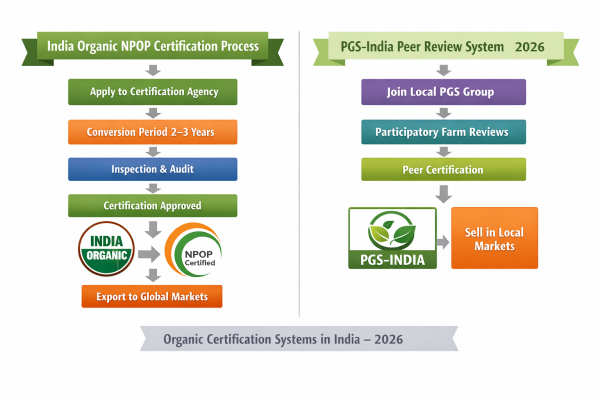
| Feature | NPOP (National Programme for Organic Production) | PGS-India (Participatory Guarantee System) |
| Market Focus | Global Export Markets (Mandatory for cross-border international trade). | Local & Domestic Markets (Ideal for local mandis, state-level retail, and direct consumer sales). |
| Verification Method | Stringent, independent third-party audits performed by accredited bodies (e.g., ECOCERT). | Peer-to-peer verification and review managed entirely by localized farmer groups. |
| Recent 2026 Milestone | Demands a mandatory Transaction Certificate (TC) generated via TraceNet 2.0 for every unique export batch. | Integrated a dedicated “Natural Farming” certification wing as of late 2025. |
⚠️ Critical Compliance Note: Attempting to ship agricultural goods overseas using only a PGS-India certification label is strictly illegal. Doing so will result in immediate shipment seizures, localized border penalties, and potential suspension from export systems.
📈 High-Demand “Gold” Crops for Global Trade
Global health and nutrition trends have pushed the premiums for specific Indian organic staples to all-time highs. Cultivating these verified varieties is yielding top returns this year:
Organic Millets: Driven by international consumer interest in heritage superfoods, organic varieties of bajra (pearl millet) and ragi (finger millet) are commanding 30% higher price premiums across European supermarket shelves.
High-Curcumin Turmeric: Sourced aggressively by global nutraceutical and health-supplement manufacturers seeking pure raw inputs.
Pusa 1121 Basmati Rice: Elite aromatic strains meticulously cultivated to respect the ultra-strict 2026 maximum residue limits (MRLs) set by international health bodies.
🛠️ Step-by-Step Blueprint to Export Readiness
Transitioning a standard commercial farm into an internationally compliant, certified organic operation involves a structured sequence:
🔍 Common Industry Myths vs. Facts
Myth: “Organic farming techniques yield structurally lower net profits.”
Fact: While it is true that yields can experience a temporary reduction during the 2-to-3-year conversion window, by 2026, operational input expenses on certified farms are nearly 40% lower than chemical-reliant properties due to on-farm biological input production. Combined with 20% to 50% higher market price premiums, long-term profit margins are significantly stronger.
Myth: “Any local organic certificate allows me to sample international buyers.”
Fact: Only NPOP-accredited channels satisfy global customs departments for commercial shipments leaving India.
❓ Frequently Asked Questions (FAQ)
1. Where can I track current policy shifts and trading infrastructure updates across India?
To keep close tabs on changing regional frameworks, agricultural guidelines, or digital tracking expansions across major states like Uttar Pradesh, you can read the latest press releases and national economic overviews published directly on Matribhumi Samachar English.
2. Can women-led agricultural self-help groups access technology for organic setups?
Yes. Under the modern Drone Didi sub-scheme frameworks active in 2026, thousands of women self-help group (SHG) members are being actively trained as specialized agricultural drone pilots. These drones are deployed directly to handle smart crop health monitoring, localized biological pest management, and automated spray applications. You can review detailed application eligibility checklists within the Top 7 Government Schemes Empowering Women in India: 2026 Edition.
3. How do modern biological inputs compare to old chemical fertilizers?
Innovative agricultural companies are actively manufacturing mustard-derived biofertility and biological control solutions that protect the native soil microbiome while establishing natural plant defense mechanisms against pathogens. These organic-certified solutions allow commercial farms to hit global import standards without experiencing heavy crop losses.
4. How can I protect my organic enterprise from volatile commodity price shifts?
Staying ahead of macroeconomic trends is vital. Factors such as regional monsoon distribution, direct state procurement limits, and logistics shifts can dramatically sway broader agricultural pricing structures across Northern and Southern markets. For a granular look at the market vectors driving wholesale trends, consult the Agricultural Commodity Market Forecast.
⚖️ Disclaimer
All information, policy data, and agricultural updates provided in this guide are synthesized for educational and general informational purposes based on active 2026 frameworks. Agri-processors, farmers, and traders are strongly advised to run their own independent verification via official ministerial portals (such as APEDA or the Ministry of Commerce & Industry) or consult certified export compliance specialists before executing commercial contracts or investing heavy capital into agricultural transformations. The author and publisher assume no liability for market losses, administrative delays, or certification rejections arising from actions taken based on this content.
