 Matribhumi Samachar English


Lucknow. Wednesday, 29 April 2026
The Kashi Vishwanath Temple, standing on the western bank of the holy river Ganga in Varanasi, is not merely a structure of stone and gold; it is the beating heart of Hindu cosmology. Known as the “City of Light” (Kashi), Varanasi is believed to be the oldest living city in the world, and at its center resides Lord Shiva as Vishwanatha—the Ruler of the Universe.
1. The Radiance of the Jyotirlinga
Kashi Vishwanath is paramount among the 12 Jyotirlingas. In Vedic philosophy, a Jyotirlinga is a “column of light” representing the infinite, formless nature of Shiva. Unlike a traditional idol, the Jyotirlinga signifies that the divine has no beginning and no end.
-
Auspicious Fact: It is believed that a single glimpse (Darshan) of the Kashi Jyotirlinga earns more merit than a lifetime of meditation elsewhere.
2. The Gateway to Moksha (Liberation)
The most profound reason for the temple’s auspiciousness is the concept of Moksha. In Hinduism, the cycle of birth and death (Samsara) is a bond.
-
The Taraka Mantra: It is traditionally believed that Lord Shiva himself whispers the “Taraka Mantra” (the mantra of crossing) into the ears of those who breathe their last in Kashi, ensuring their soul reaches liberation.
-
Purification of Karma: A visit to the temple, preceded by a dip in the sacred Ganga, is said to dissolve “Sanchita Karma”—the accumulated baggage of many past lives.
3. The Power of the Kashi Vishwanath Corridor (Latest Update)
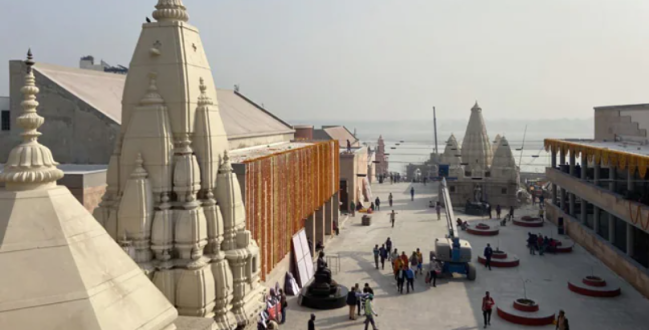
The recent inauguration of the Kashi Vishwanath Dham Corridor has restored the ancient spiritual link between the river and the temple.
-
Seamless Pilgrimage: Previously, devotees had to navigate narrow, congested lanes. Now, a massive 500,000-square-foot pedestrian plaza connects the Manikarnika, Jalasen, and Lalita Ghats directly to the temple.
-
Cultural Restoration: During the corridor’s construction, over 40 ancient temples that had been hidden by modern shops and houses for centuries were rediscovered and preserved, enhancing the spiritual “vibration” of the entire complex.
4. Cosmological Significance: The Trident of Shiva
According to the Puranas, Kashi does not rest on the earth but stands on the tip of Lord Shiva’s Trishul (Trishul). This symbolic representation suggests that the city is a transcendental realm, protected from the “Pralaya” (the eventual dissolution of the universe). This makes any ritual performed here exponentially more powerful.
5. Historical Resilience and Faith
The temple’s history is a testament to the undying faith of devotees. Having been destroyed and rebuilt multiple times—most notably by the Maratha queen Ahilyabai Holkar in 1780—the temple stands as a symbol of the “Sanatana” (eternal) nature of Hindu dharma. The gold used to plate the spires was later donated by Maharaja Ranjit Singh, representing a pan-Indian devotion.
Important Information for Pilgrims
-
Best Time to Visit: The festival of Mahashivratri and the month of Shravan (July-August) are the most auspicious, though they are also the most crowded.
-
Rituals: Attending the Sapta Rishi Aarti (where seven priests perform rituals simultaneously) or the Shringar Aarti provides a deep meditative experience.
Relevant Links for Further Reading
For the most current updates on spiritual circuits and temple news, explore these curated articles:
-
Top 15 Spiritual Landmarks in UP (2026 Guide): Read the Full Guide
-
The 12 Jyotirlingas: 2026 Pilgrimage Updates: Explore the Jyotirlinga Circuit
Final Thought: A journey to Kashi is often described as a “death of the ego.” Whether you are drawn by the history, the architecture, or the search for peace, Kashi Vishwanath offers a glimpse into the timeless continuity of human faith.
Disclaimer
The information provided in this article regarding the Kashi Vishwanath Temple and its auspiciousness is based on traditional Hindu scriptures, historical records, and current administrative updates (as of 2026). While Matribhumi Samachar English strives to ensure historical and factual accuracy, the spiritual benefits, beliefs, and interpretations of “Moksha” and “Karma” mentioned are based on religious faith and cultural tradition. Readers are encouraged to view this content through the lens of spiritual exploration and personal belief.