
Lucknow. Tuesday, 28 April 2026
The Shri Ram Janmabhoomi Teerth Kshetra Trust has launched a massive scientific initiative to preserve India’s intellectual and spiritual heritage. What began as a national call to safeguard ancient texts has now transformed into a global movement, with significant interest pouring in from the United States and various corners of the globe.
The Global Outreach: BAJNA USA Joins the Mission
The campaign has struck a chord with the Indian diaspora. The US-based organization ‘BAJNA’ (an association of the North American Bihari community) has officially contacted Dr. Sanjeev Singh, Director of the International Ram Katha Museum, to offer their support.
Search and Rescue: BAJNA leaders Anurag Kumar and Vinay Kumar Singh have committed to identifying rare Ramayana-related manuscripts within the US and India.
Acquisition: The organization has expressed readiness to purchase rare scrolls or texts from private collectors to donate them to the Ayodhya repository.
The Repository: A Modern Sanctuary for Ancient Wisdom
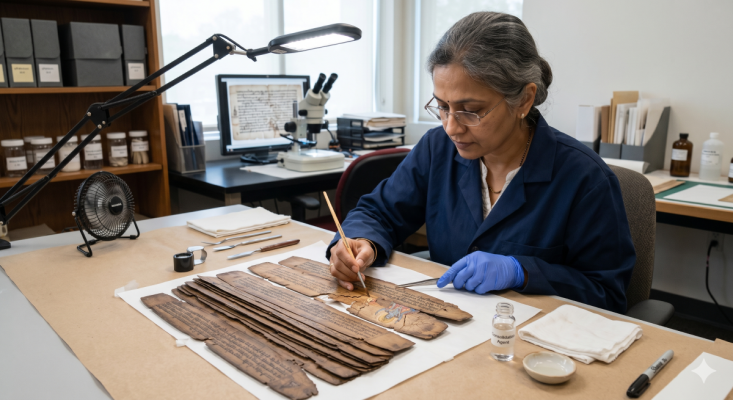
The conservation project is being executed under the umbrella of the Prime Ministers’ Museum and Library (PMML), New Delhi. The collected works will be housed in the specialized Repository Center at the International Ram Katha Museum in Ayodhya.
The Selection Process
As of late April 2026, the Trust has received over 80 inquiries and several formal applications. However, the standards for “rare and valuable” are stringent.
Key Upcoming Milestone: On May 4, 2026, a high-level expert committee meeting will be held in New Delhi. Led by Nripendra Misra (Chairman of the Temple Construction Committee), the panel will finalize the acquisition of three primary candidates:
300-Year-Old Handwritten Manuscript: Sourced from Kumarganj, Uttar Pradesh (Jangjeet Singh).
200-Year-Old Lithography Printed Ramayana: A rare early-print specimen from Ahmedabad.
150-Year-Old Preserved Ramayana: A significant family heirloom from Lucknow.
Clarifying Standards: What Counts as ‘Rare’?
The Trust recently clarified its criteria following an application from Moradabad. An applicant, Ankit Agarwal, submitted copies of the Ramcharitmanas and Sundarkand printed post-1992.
“While these texts are sacred, they do not meet the ‘rare manuscript’ criteria of the Trust, which focuses on centuries-old handwritten or early lithographic works that represent unique historical records,” stated Dr. Sanjeev Singh.
Comparison of Current Major Candidates
| Origin | Document Type | Estimated Age | Key Feature |
| Kumarganj | Handwritten | 300 Years | Original ink on traditional paper |
| Ahmedabad | Lithography Print | 200 Years | Rare early industrial printing |
| Lucknow | Preserved Text | 150 Years | Exceptional state of preservation |
Why This Matters for Ayodhya’s Future
This initiative marks Ayodhya’s transition from a pilgrimage site to a global center for Indology and Vedic research. By digitizing and physically conserving these texts, the Trust ensures that the diverse versions and artistic interpretations of the Ramayana are not lost to time or decay.
For more updates on Ayodhya’s heritage projects, visit:
