 Matribhumi Samachar English


New Delhi. Updated on : Sunday, 9 August 2026
In the rich landscape of Indian spiritual heritage, few symbols evoke as much devotion, respect, and socio-economic relevance as the cow. Far from being considered merely a domesticated farm animal, the cow is revered as Gau Mata (Mother Cow)—a living embodiment of unconditional grace, maternal care, and the earth’s natural bounty.
This timeless tradition is not rooted in arbitrary custom; rather, it represents a sophisticated synthesis of Vedic scripture, ethical philosophy, sustainable ecology, and rural economic logic.
1. Spiritual Foundations: The Divine Mother and Sacred Pantheon
In Sanatan Dharma, the designation Gau Mata acknowledges the cow’s role as an selfless provider. Just as a human mother feeds her child, the cow offers sustenance to all of humanity through her milk and gentle presence, asking for nothing more than grass and simple shelter in return.
Kamadhenu and the Divine Hierarchy
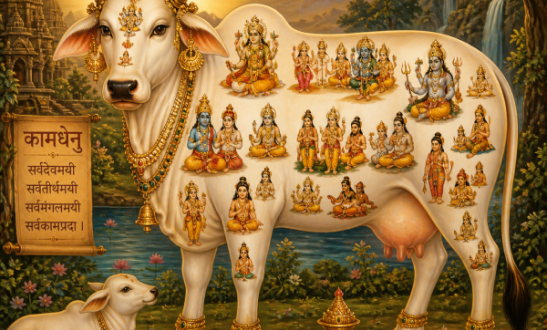
Ancient Puranic texts chronicle Kamadhenu, the celestial wish-fulfilling cow who emerged during the Samudra Manthan (the churning of the cosmic ocean). Iconography depicts her with wings, a maternal divine head, and a body harboring the entire cosmic order. According to tradition, 330 million deities (Devas) reside within various parts of a cow’s body, rendering the act of serving a cow equivalent to honoring the complete divine pantheon.
The Krishna Connection
Lord Krishna, revered as Gopala (protector of cows) and Govinda (one who brings satisfaction to cows), spent his youth in the pastures of Vrindavan tending cattle. His affection for cows emphasizes that true spiritual leadership involves loving guardianship of nature and all quiet, vulnerable life forms.
2. Scriptural Roots: The Vedic Inviolability of Aghnya
The sacred status of the cow is documented in the oldest layers of Vedic literature.
-
The Rigveda: Hymns celebrate cows as bringers of prosperity, equates them with Aditi (mother of the cosmic gods), and connects them to light and life-giving energy.
-
The Atharvaveda & Dharma Shastras: Here, the cow is frequently designated as Aghnya—meaning “that which must not be killed” or “inviolable”. These legal and moral codes positioned the protection of cattle as a fundamental civic duty (Dharma) and used the health of a kingdom’s livestock as a primary indicator of its moral and economic strength.
3. The Wisdom of Panchgavya: Ritual and Ayurvedic Applications
The cow is uniquely recognized in traditional practices for products that hold purifying qualities. The five cow-derived elements, known collectively as Panchgavya, serve as core ingredients in sacred rituals and Ayurvedic remedies:
-
Kshira (Pure Milk): Provides core nutrition and forms the basis for Abhisheka (sacred bathing rites of temple deities).
-
Dahi (Curd): Symbolic of prosperity and used extensively in auspicious offerings.
-
Ghee (Clarified Butter): Serves as the primary fuel for Homa and Yajna (sacred fire rituals), believed to carry prayers upward while purifying the surrounding air.
-
Go-Mutra (Cow Urine): Valued in traditional Ayurveda for its therapeutic, detoxifying, and antifungal properties.
-
Go-Maya (Cow Dung): Utilized as a natural bio-disinfectant, organic fuel, and thermal insulator for rural housing.
4. Ethical Pillar: Living Embodiment of Ahimsa
At its philosophical core, cow reverence is a tangible expression of Ahimsa (non-violence).
The cow is viewed as a Sattvic (pure, peaceful) creature that yields vital nourishment without taking life or demonstrating aggression. By cultivating active compassion toward a peaceful animal, individuals learn to extend empathy, gentle care, and non-aggression to all living beings across the broader ecosystem.
5. Ecological Pragmatism and Economic Cycles
From an agrarian standpoint, elevating the cow to sacred status served as a historical safeguard against short-sighted economic choices.
-
Soil Preservation: Cow dung enhances organic carbon levels, enriches soil microbiota, and sustains agricultural yields without reliance on harsh chemicals.
-
Agricultural Power: Male offspring (bullocks) historically provided reliable draft energy for field plowing, irrigation wheels, and regional transport.
-
Circular Farming: Cattle consume dry crop residue, inedible husk, and wild grass, efficiently converting agricultural bi-products into protein-rich milk and natural fertilizers.
Protecting cattle guaranteed that families retained their long-term farming productivity through droughts or difficult seasonal transitions.
6. Cultural Expressions and Modern Observances
This reverence remains vibrant in daily life and traditional calendar celebrations:
-
Govardhan Puja: Celebrated following Diwali, honoring the connection between cattle, pastures, and natural hill ecosystems.
-
Gopashtami: A designated festival where communities clean, decorate, and feed cattle in gratitude for their contributions to daily sustenance.
-
Gaushala Preservation: Dedicated shelters across urban and rural landscapes continue to offer sanctuary, veterinary care, and feeding to retired or stray cattle.
FREQUENTLY ASKED QUESTIONS (FAQ)
Q1: What does the term “Aghnya” mean in Vedic texts?
A: Aghnya is a Sanskrit word frequently used in the Vedas (such as the Atharvaveda) to describe cows. It translates directly to “that which must not be killed” or “inviolable,” establishing legal and moral protections against harming cattle.
Q2: What are the five products that make up Panchgavya?
A: Panchgavya consists of milk (Kshira), curd (Dahi), clarified butter (Ghee), cow urine (Go-mutra), and cow dung (Go-maya). Together, they are utilized in sacred fire ceremonies, traditional cleaning, and Ayurvedic wellness preparations.
Q3: Why is Lord Krishna closely associated with cows?
A: Lord Krishna spent his childhood in Vrindavan as a cowherd (Gopala). His bond with cattle symbolizes divine love, protection of the innocent, and living in peaceful alignment with the natural environment.
Q4: How did cow protection benefit historical Indian agriculture?
A: By preventing the slaughter of cattle, rural communities protected essential draft energy for farming and ensured a steady supply of natural fertilizer (dung), sustaining organic soil health across generations.
EDITORIAL DISCLAIMER
This informative article is published for cultural, historical, and educational purposes. References to traditional wellness practices or Ayurveda are intended to explain cultural heritage and should not be used as a replacement for professional medical advice.
Related External & Regional Coverage
For broader reporting on Indian heritage, national developments, and cultural traditions, explore Matribhumi Samachar English Edition.