 Matribhumi Samachar English


Mumbai. Friday, 12 June 2026
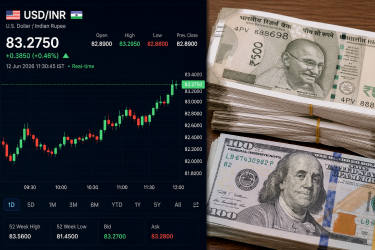
The Indian Rupee (INR) has found itself in the middle of a complex macroeconomic tug-of-war. For anyone tracking personal investments, import-export businesses, or broader economic trends, the currency’s recent fluctuations against the US Dollar (USD) have naturally sparked a lot of conversation.
While headlines often sound minor alarm bells whenever the rupee faces pressure, looking past the immediate market noise reveals a story of remarkable resilience backed by robust domestic fundamentals.
The Core Pressure Points: Oil, Interventions, and Global Capital
To understand where the currency is heading, we have to look at the three major global gears grinding against the domestic economy right now.
1. The Energy Import Multiplier
India’s dependency on imported crude oil remains its primary external vulnerability. India imports more than 80% to 85% of its crude oil requirements. When geopolitical tensions brew in the Middle East, international oil benchmarks like Brent crude quickly react by climbing higher.
Because international oil trade is transacted in US Dollars, Indian oil refining companies must aggressively purchase greenbacks to pay for their shipments. This sudden, concentrated surge in dollar demand shifts the supply-demand balance, naturally exerting downward pressure on the rupee.
2. Foreign Capital Realignment
Foreign Portfolio Investors (FPIs) heavily influence short-term currency movements. When global central banks maintain restrictive monetary policies or when global market uncertainty climbs, international investors frequently pull money out of emerging market equities and bonds. They pivot back toward safer, dollar-denominated assets like US Treasury bonds.
As these foreign funds liquidate their holdings in Indian stock markets, they must convert their rupee proceeds into dollars to repatriate the cash. This capital flight dries up immediate equity liquidity and causes short-term currency depreciation.
[Global Uncertainty Risks Rise]
               │
               ▼
[FPIs Sell Indian Equities/Bonds]
               │
               ▼
[Convert Rupees to USD for Repatriation]
               │
               ▼
[Increased Dollar Demand = Short-term Rupee Pressure]
3. Fact-Checking the “Weakness” Narrative
A vital correction to standard market commentary is distinguishing between a fundamentally weak currency and a globally strong dollar.
When looking at peer emerging market economies, the Indian Rupee has consistently put up a much steadier performance than many of its global counterparts. The current environment is less about structural failures within the Indian economy and more about a globally dominant US Dollar pushing against nearly every major global currency.
How the Reserve Bank of India (RBI) Keeps the Currency Balanced
India’s central bank doesn’t let speculative market forces dictate the rupee’s trajectory unchecked. The RBI employs a sophisticated defense mechanism to smooth out wild intraday drops and maintain orderly market conditions:
-
Strategic Reserves Utilization: India has methodically built one of the world’s largest financial safety nets, with foreign exchange reserves holding strong around the $690–$700 billion mark. The central bank tactically sells dollars directly into the spot market during sharp supply crunches to meet importer demand.
-
Forward Market Management: To avoid draining its cash reserves aggressively, the RBI utilizes forward contracts and dollar-rupee buy/sell swaps, effectively absorbing immediate shocks and pushing delivery expectations to future dates.
-
Speculation Dampening: Strict regulatory boundaries—such as limiting the Net Open Position in Indian Rupee (NOP-INR) for commercial banks—prevent large financial institutions from running massive speculative dollar positions that would otherwise accelerate currency drops.
The Structural Silver Lining: Looking Ahead
While the near-term path for the rupee will inevitably experience bumps determined by crude oil prices and global geopolitical shifts, the long-term horizon remains fundamentally secure.
India’s widening manufacturing base, solid services export sector, and consistent domestic GDP growth continue to act as an anchor for long-term global investment. Temporary foreign portfolio exits do not erode these underlying pillars. With ample import cover resting in the RBI’s vaults, the Indian economy is well-fortified against external shocks, ensuring that currency volatility remains a managed wave rather than a runaway spiral.
Relevant Links & Resources
To read more localized financial insights and regional economic updates, visit the official English portal at Matribhumi Samachar.