 Matribhumi Samachar English


Lucknow. Sudnay, 28 June 2026
Purchasing property is a massive life milestone, but it is also one of the most high-stakes financial decisions you will ever make. Whether you are eyeing a residential plot in Noida, commercial space in Lucknow, or agricultural land in Gorakhpur, verifying official land records in Uttar Pradesh (UP) is an absolute necessity.
Proper due diligence protects you from predatory scams, ownership disputes, pending court litigations, and illegal transfers. Fortunately, the Government of Uttar Pradesh provides robust digital portals like UP Bhulekh and Bhu Naksha to help citizens verify records from the comfort of their homes.
This comprehensive guide walks you through the step-by-step process of UP land record verification, key documents to inspect, and how to spot critical red flags.
Why Land Record Verification is Crucial
Skipping the verification process can trap your hard-earned money in years of frustrating civil court battles. Thorough verification ensures that:
-
True Ownership: The person selling the property is legally recognized as the owner in government registries.
-
Clear Title: The land is free from active family partitions, hypothecations, or financial liabilities.
-
Accurate Dimensions: The physical area on the ground perfectly matches the area registered in revenue records.
-
Zero Litigation: There are no active revenue or civil court disputes tracking the property.
Step-by-Step UP Land Record Verification Pipeline
To ensure absolute safety, execute your property due diligence using this structured, sequential verification pipeline:
Documents to Verify vs. Common Red Flags
Before closing any transaction, maintain a clear picture of what documents you must hold versus the warnings that should make you walk away immediately.
| Critical Documents to Collect | Dangerous Red Flags (Stop Transaction) |
| • Registered Sale Deed & Past Chain Deeds • Active Khatauni (Record of Rights) • Official Bhu Naksha (Land Map) Printout • Formal Mutation Order (Dakhil Kharij) • Government IDs of Seller • Latest Property Tax & Utility Receipts • Bank NOCs (if previously mortgaged) | • Seller’s name differs from official land records. • Property or plot layout is under active litigation. • Land area measurements differ across documents. • Mutation is pending or completely unrecorded. • Visible boundary discrepancies or third-party encroachments. • Unregistered or un-notarized sale documents. |
Understanding a UP Land Record Format
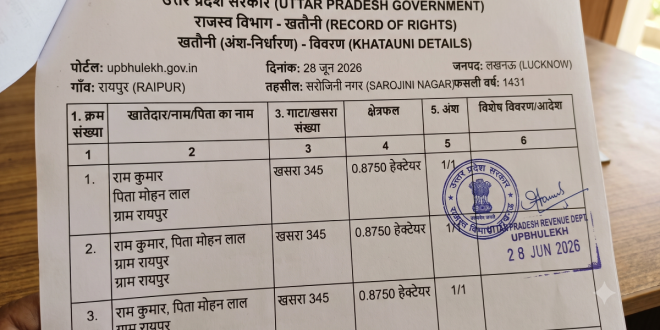
When pulling down records from the UP Bhulekh portal, you will encounter structured documents written in Hindi script that record ownership parameters, unique codes, and plot histories.
When analyzing this document, look closely at Column 2 (the names, parentage, and address of the landholders) and Column 6 (the total area of the Gata in hectares). Any manual changes, mortgages, or pending court orders will typically appear in the remarks column on the right side of the sheet.
Pro Tip: For high-value transactions or complicated ancestral properties, always obtain certified copies directly from the local Sub-Registrar Office (SRO) or Tehsil rather than relying purely on unverified printouts.
Frequently Asked Questions (FAQs)
1. What is the difference between a Khata number and a Khasra number?
A Khasra number (or Gata number) is a unique identification number assigned to a specific parcel of land in a village, similar to a plot survey number. A Khata number is an account number assigned to a family or individual landholder who may own one or multiple Khasra plots.
2. What happens if a property’s mutation (Dakhil Kharij) is not done?
If mutation is not completed, the buyer’s name will not appear in the government’s revenue records. While you may hold a registered sale deed, without mutation, you cannot legally sell the land, secure government subsidies, or clear it easily for formal home loans.
3. Can I verify UP land records entirely online?
You can verify initial ownership details (Khatauni), plot maps (Bhu Naksha), and revenue court statuses online. However, things like physical possession, neighboring boundary line checks, and structural debt checks require physical on-site inspection and legal verification.
Disclaimer
This article is compiled for informational and educational purposes only based on the latest operating frameworks of the Uttar Pradesh Revenue Department. Real estate laws and digital portals are subject to periodic administrative updates. Readers are strongly encouraged to consult a certified property lawyer or visit the local Tehsil office before completing high-value financial investments.
(Note: For real-time state-level media reporting and regional community updates on development, infrastructure, and local administrative mandates across Northern India, you can review the latest English coverage archives via official regional publication platforms like Matribhumi Samachar.)