 Matribhumi Samachar English


New Delhi. Monday, 6 July 2026
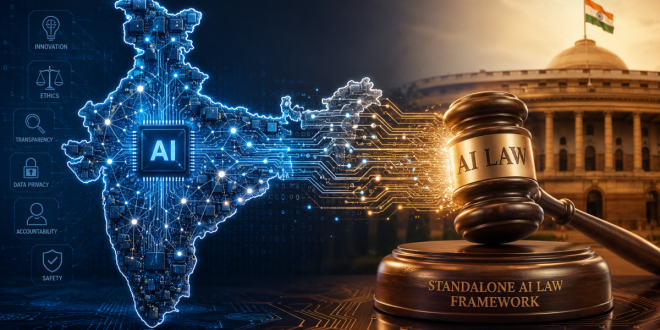
Artificial intelligence has officially transitioned from a corporate luxury into the core digital public infrastructure driving modern economies. In India, deep-tech adoption is scaling rapidly across healthcare, agriculture, and public governance. However, this explosive growth has forced a pivotal shift in policymaking. The Indian government is moving beyond legacy frameworks to construct a comprehensive, standalone AI law designed to regulate advanced models while safeguarding its rapidly expanding digital economy.
As regulatory architectures permanently change worldwide, India’s forthcoming statutory actions aim to establish a clear benchmark for algorithmic transparency, consumer protection, and enterprise accountability.
Why Existing Digital Laws Fall Short
For years, India relied on the Information Technology (IT) Act and the newly enacted Digital Personal Data Protection (DPDP) framework to police the internet. Yet, traditional laws were never engineered to govern autonomous, self-learning systems. Advanced generative AI presents unique risks that traditional data privacy rules cannot adequately mitigate.
The most pressing concerns demanding a dedicated law include:
-
Systemic Structural Risks: Centralized dependency on a handful of global cloud infrastructures leaves entire sectors vulnerable to single-point operational outages.
-
The “Black Box” Dilemma: Advanced machine learning algorithms often lack auditability, meaning developers cannot explicitly trace how a model arrived at a high-stakes decision.
-
Algorithmic Scaling of Threats: Traditional cybersecurity filters fail against hyper-realistic phishing and automated, machine-mutated malware that adapts in real time.
Recognizing these vulnerabilities, India is actively implementing immediate guardrails through subordinate legislation while structuring a robust standalone bill.
Inside the 2026 Regulatory Architecture: The New Rules
India is tackling AI governance through a dual approach: immediate enforcement via executive rules and systemic long-term restructuring through Parliament.
1. The IT Amendment Rules 2026: Cracking Down on Deepfakes
To manage immediate online harms, the government updated its regulatory guidelines by notifying the IT (Intermediary Guidelines and Digital Media Ethics Code) Amendment Rules 2026. This framework introduces strict legal mandates:
-
Synthetically Generated Information (SGI): The law formally defines SGI as any audio, visual, or audio-visual media created or altered via AI to mimic reality.
-
Mandatory Labelling and Provenance: Platforms must prominently label SGI (covering at least 10% of the content) and embed indelible provenance metadata.
-
The 2-Hour Takedown Window: In high-risk scenarios involving identity theft or non-consensual deepfake nudity, digital intermediaries face a strict 2-hour window to remove the offending content or forfeit their “safe harbor” legal immunity.
2. The Artificial Intelligence (Ethics and Accountability) Bill
To build the permanent standalone AI law, the government has introduced The Artificial Intelligence (Ethics and Accountability) Bill in Parliament. Rooted in seven core guiding principles (Sutras)—including Trust, People-First, and Transparency by Design—this landmark bill introduces:
-
A Dedicated AI Ethics Committee: A statutory body tasked with monitoring algorithmic bias and certifying high-risk models before deployment.
-
Substantial Penalties: Financial penalties reaching up to ₹5 crore for compliance failures, establishing severe consequences for negligent developers.
-
Risk-Based Classifications: Stricter oversight for “high-risk” applications like credit scoring, public surveillance, recruitment, and healthcare diagnostics.
Financial Sector Precedents: The RBI Model Risk Management Framework
While the broader standalone AI law moves through Parliament, specific sectors have already deployed rigid governance models. A prime example is the financial landscape. The Reserve Bank of India (RBI) introduced its comprehensive Guidance on Regulatory Principles for Model Risk Management.
This framework forces commercial banks, NBFCs, and credit bureaus to eliminate the “the computer said no” defense. Under these rules, institutions must ensure absolute Explainable AI (XAI), establish board-level accountability frameworks, and build emergency “kill switches” capable of immediately shutting down generative models if they display erratic behavior or suffer a cyberattack.
Transforming Agriculture and Startups
A balanced standalone AI law is critical to protecting India’s unique tech ecosystem, which thrives on public digital goods. Initiatives like the IndiaAI Mission and the creation of AIKosh—a secure, national repository cataloging metadata-standardized public datasets and regional language tokens—democratize access for early-stage agritech startups.
Through voice-first foundational models like BHASHINI, smallholder farmers across India can speak in their native dialects to receive real-time predictive analytics on crop stress and soil moisture. A predictable legal framework ensures that these innovations remain ethically viable, boosting investor confidence while protecting rural citizens from data exploitation.
Frequently Asked Questions (FAQs)
Q1: What is Synthetically Generated Information (SGI) under Indian law?
A: Under the IT Amendment Rules 2026, SGI refers to any digital audio, video, or text content generated or manipulated by AI that appears indistinguishable from authentic, human-created reality.
Q2: How does a standalone AI law protect banking consumers?
A: It mandates algorithmic transparency. According to sector-specific rules like the RBI’s Model Risk Management guidelines, financial entities must explain automated lending decisions and provide a direct path for consumers to opt for human intervention.
Q3: Will the upcoming regulations hurt early-stage AI startups?
A: While compliance costs will naturally rise, a standalone law provides long-term legal certainty. Furthermore, public digital public infrastructures like AIKosh and subsidized compute models under the IndiaAI Mission are specifically designed to ease development burdens for resource-constrained innovators.
Relevant Links for Further Reading
-
To understand the broader systemic vulnerabilities that global and domestic central banks are trying to address, read about The Hidden Threat: Why Global Regulators Are Shifting Focus to Systemic AI Risks.
-
For insights into how financial watchdogs are monitoring technology equity valuations, see The AI Investment Boom: Why Central Banks Are Urging Caution Amid the Market Rally.
-
Explore how automated machine learning models are already being deployed within government frameworks in How Artificial Intelligence is Quietly Revolutionizing India’s GST System.
-
To see how banking architectures are adapting ahead of the overarching legislation, review Beyond Chatbots: How Artificial Intelligence is Rewriting the Rules of Indian Banking.
-
Learn about the intersection of localized language models and public tech platforms in The Digital Precision Agriculture Revolution: How AI Farming is Redefining Indian Agriculture.
-
Discover how sovereign computational strategies are altering regional growth in Leapfrogging to Deep-Tech: How Uttar Pradesh is Positioning Itself as India’s Next Artificial Intelligence Hub.
Disclaimer: The technical, regulatory, and legal information detailed in this article reflects the dynamic state of digital policy and framework updates in 2026. This content is intended purely for educational and informational purposes and does not constitute formal legal or professional compliance advice.