

New Delhi. Thursday, 25 June 2026
Artificial Intelligence (AI) is no longer a luxury confined to software boardrooms and urban technology hubs. In 2026, India’s sprawling farmlands are emerging as one of the fastest-growing frontiers for deep-tech adoption. Faced with volatile weather patterns, fragmented land holdings, and rising input costs, rural communities are trading traditional guesswork for real-time, data-driven precision.
With agriculture supporting millions of livelihoods across the subcontinent, this transformation is reshaping the country’s rural economy. Backed by state initiatives, expanding agritech startups, and cutting-edge remote sensing, smart farming is making scientific, localized recommendations accessible to even small and marginal farmers.
What Is AI Farming and Why Does It Matter for India?
At its core, AI farming represents the integration of machine learning algorithms, satellite imagery, Internet of Things (IoT) field sensors, and automated drone technology into daily cultivation workflows. Rather than applying a single uniform strategy to an entire field, farmers receive hyper-localized, scientific recommendations tailored to the exact requirements of their plots.
For the average Indian farmer, this technology tackles a long list of traditional structural bottlenecks:
Small Land Holdings: Enables microscopic management of small plots to maximize every square foot.
Climate and Monsoon Uncertainty: Replaces old seasonal estimates with predictive, short-range weather intelligence.
Escalating Input Expenses: Eliminates waste by indicating the exact amount of seeds, water, and fertilizers required.
Key Pillars of the Smart Agriculture Overhaul
1. Earth Intelligence and Satellite Analytics
Instead of relying on slow, manual field inspections, Indian agriculture is leveraging a domain known as “Earth Intelligence.” By pairing advanced machine learning models with continuous raw remote sensing data from organizations like the Indian Space Research Organisation (ISRO), digital platforms can automate crop health monitoring. This technology tracks soil moisture variations and produces predictive yield metrics, allowing rural communities to adapt dynamically before a crisis hits.
2. Multi-Dialect Voice Assistants and Language Models
A major historical barrier to digital adoption in rural India was the English-centric nature of early software. In 2026, the ecosystem is successfully bypassing this hurdle by deploying indigenous, voice-first foundational AI models. Utilizing vast multilingual voice datasets, agritech platforms now provide regional-language voice bots. A farmer can speak naturally in their native dialect to receive instant, tailored advice on localized pest infestations, crop illnesses, or market pricing.
3. Precision Drones and Smart Irrigation
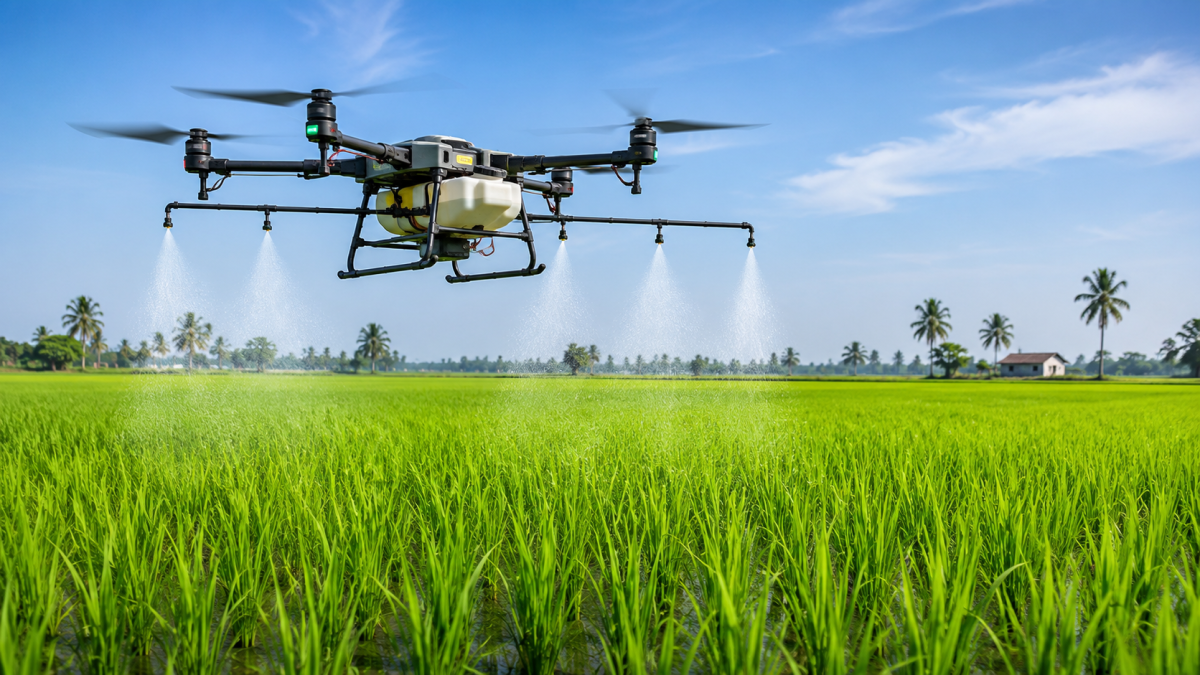
The physical work of farming is seeing an equal tech upgrade. Agricultural drones are increasingly standard for field surveillance and targeted pesticide spraying, which significantly cuts down chemical waste. Concurrently, smart irrigation systems sync real-time soil moisture sensors with local meteorological forecasts. Water is dispensed only when the crop requires it, lowering groundwater draw and dropping electricity consumption across rural power grids.
State Initiatives Driving Digital Infrastructure
The scaling of smart farming across India is anchored by an aggressive public infrastructure push. Under the flagship ₹10,370 crore IndiaAI Mission, the government has established specialized data architectures designed to benefit public utility sectors like agriculture.
A central element of this strategy is AIKosh, a secure, national repository that catalogs metadata-standardized public datasets, geospatial satellite imagery, and localized language tokens. This public digital backbone allows early-stage agritech startups and research groups to pull clean data and deploy scalable agricultural solutions without the millions of dollars in processing costs typically required to build AI from scratch.
To discover how these underlying sovereign computing setups and localized datasets are engineered, read the extensive deep-dive on India’s Sovereign AI Leap.
Navigating the Structural Challenges Ahead
While the economic impact is creating a fresh wave of high-tech rural careers—such as drone pilots, sensor technicians, and precision consultants—the road to total digital transformation still faces real friction:
Digital Literacy and Gaps: Training millions of traditional farmers to interpret data readouts takes time and continuous field extension work.
Hardware Availability: While software is becoming democratized, the high initial cost of smart irrigation valves, IoT sensors, and drone systems remains a bottleneck.
Infrastructure Demands: Processing heavy geospatial maps and training rural AI models strains high-performance physical hardware, a challenge highlighted in the broader discussion on The Sovereign AI Rise and Infrastructure Boom.
To address the hardware pricing issue, rural communities are increasingly utilizing a shared-service approach via Farmer Producer Organizations (FPOs) and regional custom hiring centers, allowing smallholders to lease drone services and sensor networks on a pay-per-use basis.
Frequently Asked Questions (FAQs)
How does AI help small farmers who do not speak English?
Through platforms like BHASHINI and indigenous small language models, agritech applications now feature voice-first interfaces. Farmers can speak into a smartphone in their local language or dialect and receive real-time, audio-based farming guidance.
What is Earth Intelligence in agriculture?
Earth Intelligence combines artificial intelligence with satellite imagery and remote sensing data. It automatically tracks massive geographic areas to identify crop stress, measure soil moisture, and predict pest outbreaks before they spread.
How can a marginal farmer afford drone or sensor technology?
Small and marginal farmers utilize a shared-economy model. Through government-supported digital platforms and local Farmer Producer Organizations (FPOs), individuals can hire agricultural drone operators and precision tools on a temporary, affordable basis without buying the equipment outright.
Disclaimer
The technical layouts, government policy architectures, and agricultural tech implementations discussed in this article are intended for educational and informational purposes only. Agricultural yields, market conditions, and technology performances vary based on hyper-local weather, geographical features, and execution phases. Readers and practitioners should conduct independent field assessments or consult certified agricultural experts before making substantial financial investments in smart farming hardware.
