 Matribhumi Samachar English


Mumbai. Tuesday, 7 July 2026
The global race for artificial intelligence dominance is no longer just a software battle; it is won or lost on hardware. As deep learning models grow increasingly data-heavy and complex, the demand for specialized, high-performance silicon has skyrocketed. For India, achieving true technological sovereignty means building a robust domestic chip ecosystem. By investing billions into localized foundries, packaging plants, and design hubs, India is transforming itself from a consumer of global technology into a primary producer.
Why Semiconductors Matter for AI
Artificial intelligence demands unprecedented levels of computing power. Training a modern large language model (LLM) or running complex computer vision algorithms at the edge requires hardware tailored specifically for parallel processing and heavy data throughput.
Without domestic access to these advanced chips, ecosystems remain vulnerable to high procurement costs, long lead times, and geopolitical supply chain shocks:
-
AI Accelerators & GPUs: The muscle behind major AI model training and hyper-scale data centers.
-
Neural Processing Units (NPUs): Dedicated silicon optimized for accelerating machine learning algorithms on consumer devices.
-
Advanced Memory Chips: High-bandwidth memory necessary to feed massive datasets to processors without lag.
The India Semiconductor Mission (ISM) and the Local Footprint
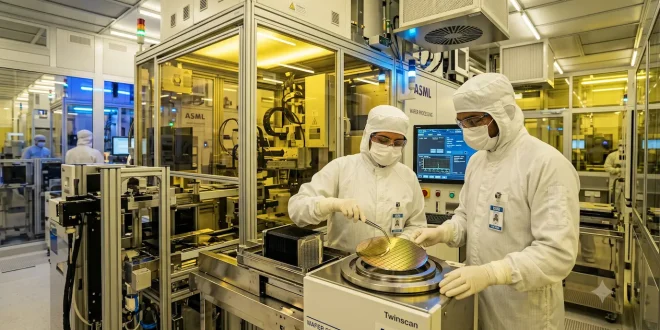
To address these needs, the government launched the India Semiconductor Mission (ISM). Rather than focusing solely on design, the ISM takes a full-stack approach to build a highly integrated domestic ecosystem. This includes constructing commercial semiconductor fabrication plants (fabs), modern Outsourced Semiconductor Assembly and Test (OSAT) units, and comprehensive supply-chain infrastructure.
A primary example of this vision turning into reality is the construction of the landmark Tata Semiconductor Plant in Dholera, Gujarat, which represents a historic shift as the global race for silicon moves directly onto Indian factory floors. Simultaneously, downstream supply chains are being fortified by government initiatives, such as the extended ₹7,280-crore Rare Earth Permanent Magnet (REPM) Manufacturing Scheme, which secures specialized components vital for clean-room robotics and wafer-handling automation.
Supporting India’s AI Ambitions
When localized semiconductor pipelines operate at scale, they unlock massive advantages across the broader tech landscape:
-
Reduced Import Dependence: Shifting production domestic bypasses the “semiconductor bottleneck” that currently leaves high-tech sectors reliant on international silicon foundries.
-
Lower AI Infrastructure Costs: Producing components locally lowers the cost barriers for setting up local data centers, AI servers, and edge devices.
-
Accelerated Innovation: Direct, affordable access to hardware enables local deep-tech startups, research institutions, and universities to build, experiment, and scale AI tools quickly.
-
National Security and Sovereignty: Secure, trusted domestic chip manufacturing underpins crucial national networks, ranging from telecommunications to localized cyber defenses.
AI Sectors Set to Benefit
The convergence of domestic silicon and advanced software algorithms is transforming several core Indian sectors:
-
Sovereign Compute & Agriculture: Under major national initiatives, the country is combining specialized AI chips with satellite arrays to build robust frameworks for precision farming and resource mapping. You can explore how these macro-data frameworks are built in the detailed breakdown of India’s Sovereign AI Leap.
-
Defense & Autonomous Systems: Local hardware is rapidly becoming the core of modern national security systems. The development of indigenous microcontrollers and navigation processors is driving The Rise of Indigenous Defence Drones, allowing automated platforms to process real-time target recognition directly at the edge.
-
Regional AI Infrastructure: Decentralized tech growth is expanding beyond traditional Tier-1 tech capitals. For example, through targeted policy blueprints, states are setting up dedicated AI zones and compute centers, as seen in the multi-crore Uttar Pradesh AI Mission, which leverages Noida’s data center hub to anchor heavy enterprise workloads.
Challenges to Overcome
Building a world-class semiconductor ecosystem from the ground up is an industrial marathon. India faces high upfront fabrication setup costs, intense global competition from established silicon hubs, and massive, uninterrupted requirements for ultra-pure water and electricity. Additionally, global financial watchdogs have urged measured long-term planning; as highlighted by the Reserve Bank of India (RBI), navigating high market valuations and avoiding sudden AI Investment Boom Supply Chain Vulnerabilities requires a steady, sustainable capital flow rather than purely speculative market rushes.
The Road Ahead
India’s strategy goes far beyond simply manufacturing components—it is focused on creating a self-sustaining technology cycle. As local fabrication and packaging plants begin active production, domestically produced silicon will directly power the next generation of sovereign AI applications, cementing India’s role as a major player in the global technology landscape.
Frequently Asked Questions (FAQ)
What is the India Semiconductor Mission (ISM)?
The India Semiconductor Mission (ISM) is a specialized administrative section within the government designed to build a sustainable semiconductor manufacturing, packaging, and design ecosystem using financial incentives and strategic policy support.
Why are GPUs and NPUs important for Artificial Intelligence?
Graphics Processing Units (GPUs) and Neural Processing Units (NPUs) are specialized microchips designed to handle thousands of mathematical operations simultaneously. This makes them significantly more efficient than standard processors for training heavy machine learning models and processing real-time AI workloads.
How does local chip manufacturing help India’s national security?
By producing chips domestically, India secures its critical supply chains against geopolitical trade blockades and ensures that the hardware used in defense, defense drones, telecommunications, and financial networks is free from external malicious tampering.
Disclaimer: This article is prepared for informational and educational purposes only. The industrial projections, policy details, and company initiatives outlined reflect the domestic technological and economic landscapes documented as of mid-2026.