 Matribhumi Samachar English


New Delhi. Tuesday, 7 July 2026
The landscape of innovation is shifting beneath our feet. For decades, India earned its global reputation as a powerhouse for software development and digital IT services. Today, a quieter but far more profound transformation is taking place. The country is rapidly moving beyond consumer apps to build deep technology—innovations firmly rooted in advanced science, rigorous engineering, and cutting-edge laboratory research.
As India aggressively pursues its goal of becoming a fully developed nation (Viksit Bharat) by 2047, deep tech is no longer just an industry buzzword. It is the core engine that will drive industrial productivity, safeguard national security, attract massive venture capital, and generate high-value jobs for the next generation.
What Exactly is Deep Technology?
Unlike a standard software startup that might build an on-demand delivery app or a social media platform, deep-tech companies tackle massive, seemingly unsolvable societal and industrial bottlenecks.
The DNA of a Deep-Tech Innovation:
-
A Scientific Core: Products are born from breakthroughs in physics, biology, or advanced computing.
-
High Barriers to Entry: The technology is incredibly difficult to replicate, requiring heavy initial R&D.
-
Longer Gestation Periods: It can take years—sometimes a decade—of testing and prototyping before a product reaches commercial viability.
-
Intense Intellectual Property (IP): Success relies on patents, proprietary algorithms, and hard-earned trade secrets.
The Key Sectors Driving India’s Transformation
1. Artificial Intelligence (AI) as an Economic Multiplier
From healthcare diagnostics to precision agriculture and financial fraud detection, AI is rewriting the rules of the Indian economy. Thanks to massive data generated by the country’s Digital Public Infrastructure (DPI), local innovators have access to unique, large-scale datasets. Generative AI is also helping Indian small businesses automate complex workflows, code generation, and localized customer support at an unprecedented scale.
2. Semiconductor Independence
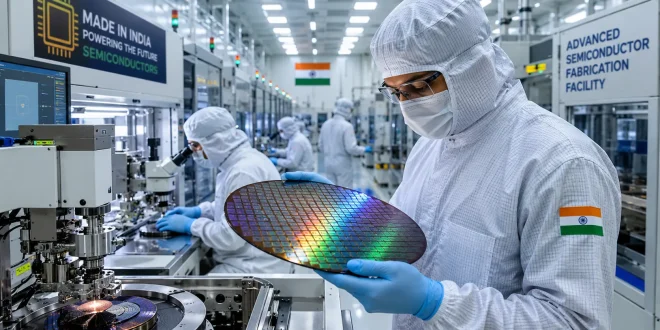
You cannot run a modern economy without silicon chip independence. Semiconductors power everything from the smartphone in your hand to defense systems and electric vehicle (EV) drivetrains. India is heavily investing in local fabrication plants, assembly setups, and advanced chip design ecosystems to decouple its supply chains from volatile global imports.
3. SpaceTech and the New Private Frontier
India’s space sector is no longer exclusively the domain of government missions. A booming private ecosystem is launching indigenous satellites, engineering low-cost launch vehicles, and developing downstream remote sensing software that helps local farmers track soil health and climate patterns from orbit.
4. Biotech and Green Mobility
Biotechnology is evolving rapidly, moving beyond basic pharmaceuticals into bio-manufacturing, gene editing, and synthetic biology. Simultaneously, the push toward clean energy has ignited a race for battery innovation—fueling local research into solid-state batteries, lithium-ion alternatives, and smart EV battery management systems.
Overcoming the Roadblocks to 2047
While the momentum is undeniable, scaling deep tech requires patient endurance. Startups in this space regularly face long research timelines, high initial capital requirements, and a traditional venture capital landscape that often prefers quick consumer returns over patient capital.
Bridging these gaps requires a continuous, deliberate handshake between government policy, private venture funds, and academic research institutions.
For continuous updates on regional developments, industrial policy shifts, and national growth stories, you can follow the latest reporting directly on Matribhumisamachar.
Frequently Asked Questions (FAQs)
What makes deep tech different from regular technology?
Regular tech usually focuses on optimizing business models or user experiences using existing tech frameworks (like e-commerce platforms). Deep tech creates entirely new technologies based on scientific breakthroughs and engineering research.
Why is deep tech critical for India’s 2047 goals?
Deep tech directly addresses structural challenges like energy security, self-reliance in semiconductors, advanced healthcare delivery, and high-tech defense mechanisms, all of which are pillars of a developed economy.
What are the main challenges Indian deep-tech startups face?
The primary hurdles are “patient capital” (funding that understands long R&D timelines before seeing profits), access to highly specialized research laboratories, and navigating complex regulatory frameworks for emerging sciences.
Disclaimer: This article is prepared for informational and educational purposes based on current macroeconomic trends and structural technology overviews. Readers interested in specific financial investments or policy documents should consult independent expert analysis.