 Matribhumi Samachar English


New Delhi. 14 September 2026
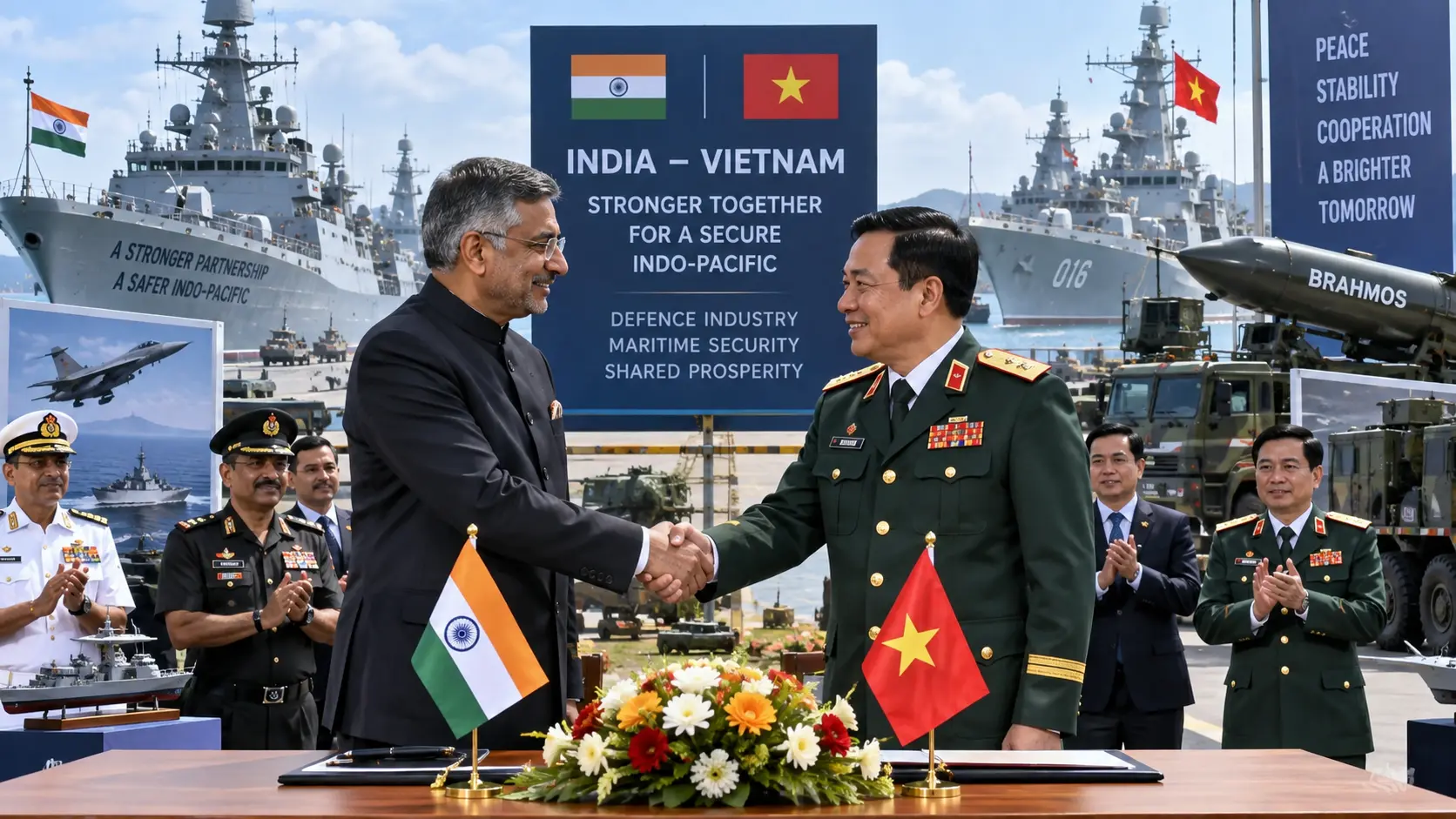
India and Vietnam have officially stepped up efforts to expand their defence and strategic relations, ushering in a new era of bilateral cooperation. The renewed partnership focuses heavily on defence technology transfer, co-development of advanced indigenous platforms, defence-industrial collaboration, and maritime security in the Indo-Pacific region.
This evolution marks a decisive shift away from standard bilateral training exercises and traditional military exchanges toward a high-tech defence industrial alliance built around joint research, artificial intelligence, quantum computing, and deep maritime integration.
Stronger Focus on Defence Technology and Joint Research
A cornerstone of the deepened strategic tie-up is joint research and industrial collaboration in next-generation defence technology. As both nations modernize their armed forces, India and Vietnam are shifting focus toward high-tech indigenous capabilities.
Priority areas targeted for deep collaboration include:
-
Artificial Intelligence (AI): Developing AI-driven autonomous surveillance networks, real-time intelligence analytics, and situational threat detection systems.
-
Quantum Technology: Leveraging quantum research to secure military communications, sensor capabilities, and high-performance computing against cyber threats.
-
Next-Generation Defence Applications: Exploring joint R&D projects between defence research entities, public-sector firms, and private technology startups.
This joint push aims to equip both countries with native technological solutions to handle evolving security dynamics without reliance on external powers.
Expanding Defence Industry & Manufacturing Cooperation
Defence-industrial cooperation has fast become a key operational pillar between New Delhi and Hanoi. Under its Act East Policy, India has positioned itself as a reliable defense manufacturing partner and exporter, promoting domestic industrial initiatives like Make in India.
For Vietnam, aligning with India’s expanding defence-industrial ecosystem provides clear strategic benefits:
-
Access to Advanced Hardware: Building upon major export contracts—such as India’s landmark delivery of BrahMos supersonic cruise missile systems and high-speed guard boats to Vietnam—to boost coastal defence capabilities.
-
Technical Training & Skill Transfer: Upskilling Vietnamese technical personnel and engineers through joint manufacturing programs and routine maintenance setup.
-
Co-Development & Co-Production: Establishing joint ventures between defence enterprises, research facilities, and government agencies to co-produce selected security systems locally.
Maritime Security Takes Centre Stage in the Indo-Pacific
As maritime challenges escalate across critical sea lanes—particularly in the South China Sea and wider Indo-Pacific—maritime security remains central to India–Vietnam relations. Both nations maintain a shared vision of a free, open, inclusive, and rules-based maritime order.
Key operational areas of maritime cooperation include:
-
Operational naval exchanges and routine port calls.
-
Maritime Domain Awareness (MDA) and real-time information sharing.
-
Joint hydrographic surveys and search-and-rescue (SAR) coordination.
-
Coast Guard training and tactical interoperability.
Vietnam’s geographic location along the South China Sea’s vital sea lanes of communication (SLOCs) complements India’s active presence in the Indian Ocean, creating an interconnected security link between Southeast Asia and the Indian Ocean Region.
Related Coverage from Matribhumi Samachar
For further global analysis, regional trade news, and geopolitical policy developments across Asia, explore recent coverage from Matribhumi Samachar English:
-
Read more about regional trade, tourism, and diplomatic ties on the Matribhumi Samachar Official Portal.
-
Explore key updates on economic partnerships via the Matribhumi Samachar News Archive.
Frequently Asked Questions (FAQ)
What are the main pillars of the India–Vietnam defence partnership?
The key pillars include defence technology R&D, industrial co-development and manufacturing, maritime domain awareness, capacity building, joint exercises, and collaboration in emerging tech like AI and quantum computing.
How does this partnership support India’s Act East Policy?
Vietnam is a crucial strategic anchor in Southeast Asia. Deeper military ties with Hanoi allow India to actively support ASEAN-led regional stability, expand defence exports, and reinforce a rules-based Indo-Pacific.
Why is emerging technology like AI and quantum key to this agreement?
Emerging tech enhances military readiness for future threats. AI aids autonomous surveillance and intelligence processing, while quantum technologies safeguard communication channels and sensor networks against sophisticated cyber operations.
Disclaimer
This article is for informational and educational purposes only. The strategic, defense, and geopolitical analyses presented herein are based on official policy updates, defense disclosures, and regional security assessments available as of the published date.