 Matribhumi Samachar English


Mumbai. Tuesday, 31 March 2026
As Indian financial markets navigate a pivotal transition in March 2026, the debate between Fixed Deposits (FDs) and Mutual Funds (MFs) has taken a new turn. With the implementation of the New Income Tax Act 2025 starting April 1, 2026, and interest rates reaching a multi-year plateau, choosing the “safer” option now requires a deeper look at both capital security and purchasing power.
🔐 Fixed Deposits: The “Guaranteed” Fortress in 2026
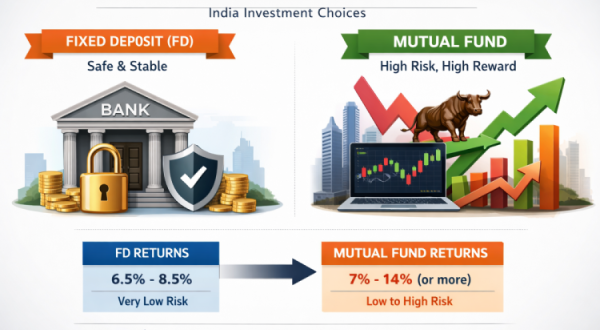
Fixed Deposits remain the bedrock of Indian savings, especially with current interest rates hovering at attractive levels. Major banks like SBI and HDFC are offering up to 7.0% – 7.5% for senior citizens, while certain Small Finance Banks and NBFCs like Shriram Finance are touching the 8.10% – 8.50% mark.
Why FDs are the “Safe Haven”:
-
Zero Market Volatility: Your principal is untouched by market crashes.
-
DICGC Protection: Every depositor is insured up to ₹5 lakh per bank.
-
Predictable Payouts: You can opt for monthly or quarterly interest to manage expenses.
📈 Mutual Funds: Beating Inflation in a Volatile Year
While FDs offer peace of mind, Mutual Funds are the primary engine for wealth creation. In FY26, the market saw extreme divergence; while some sectoral funds delivered over 50% returns, nearly 300 equity funds faced short-term negative fluctuations.
The 2026 Edge:
-
Inflation Hedge: With inflation averaging around 5-6%, an FD’s real return is marginal. Equity MFs aim for 12-15% long-term CAGR.
-
Professional Management: Experts rebalance portfolios to navigate the 2026 economic shifts.
-
Tax Efficiency: Under the latest rules, Long-Term Capital Gains (LTCG) above ₹1.25 lakh are taxed at 12.5%, which is often lower than the tax slab for FD interest.
⚖️ At a Glance: FD vs Mutual Funds (March 2026 Data)
| Feature | Fixed Deposits (FD) | Mutual Funds (Equity/Hybrid) |
| Risk Profile | Extremely Low | Moderate to High |
| Current Returns | 6.5% – 8.5% (Fixed) | 10% – 18% (Variable/Market-linked) |
| Taxation (FY 2025-26) | Taxed as per Income Slab | LTCG: 12.5% |
| Liquidity | Penalty on premature withdrawal | High (T+1 or T+2 settlement) |
| Best Used For | Emergency funds, Senior Citizens | Retirement, Child’s Education |
🛠 2026 Updates
-
Tax Transition: Income earned up to March 31, 2026, follows the old 1961 Act; income from April 1, 2026, falls under the New Income Tax Act 2025.
-
Safety Misconception: While FDs are “safe” from losing money, they are “risky” for long-term goals because they may fail to keep up with the rising cost of living (Inflation Risk).
🏁 Final Verdict: The Hybrid Approach
In 2026, “Safety” isn’t about choosing one. Smart investors are using Fixed Deposits for their immediate 1-3 year needs and Mutual Funds for any goal beyond 5 years. This “Barbell Strategy” ensures you have cash when you need it and wealth when you retire.
Relevant Links: For more local financial updates, visit matribhumisamachar.com/en
Disclaimer: This report is for informational purposes only and is not a recommendation to invest. Interest rates are current as of April 2026 and are subject to change by the banks or the RBI. Past performance does not guarantee future returns. Please verify all “slab-based” interest calculations and safety guidelines (DICGC) directly with the lenders or a certified financial consultant before opening an account