


New Delhi. Wednesday, 15 April 2026
As of mid-April 2026, the Indian economy is displaying a “mature” growth profile. While the post-pandemic surge has stabilized, India remains the fastest-growing major economy globally. However, a “below-normal” monsoon forecast and persistent geopolitical tensions in West Asia have introduced a layer of strategic caution into the mid-year outlook.
📊 Growth Momentum: Sustainable Normalization

The Indian economy has transitioned from recovery-led growth to structural expansion.
GDP Forecast: The Economic Survey 2026 projects a robust 7.4% growth for FY26, while the RBI has set a target of 6.9% for the current fiscal year (FY27).
Key Drivers: Growth is being anchored by a “double engine” of domestic consumption and aggressive infrastructure investment. Private sector capital expenditure (Capex) is finally hitting a multi-year high, signaling business confidence in long-term demand.
📉 Inflation & Monetary Policy: The Neutral Stance
In its April 2026 meeting, the Reserve Bank of India (RBI) maintained a watchful eye on price stability.
Repo Rate: Held steady at 5.25% with a “neutral” stance.
Current Inflation: Retail inflation (CPI) hovered around 3.4% in March 2026, though food inflation remains slightly higher at 3.87%.
Global Headwinds: The ongoing conflict between the US and Iran has disrupted shipping through the Strait of Hormuz, pushing up freight costs and energy prices, which the RBI cited as a primary reason for its “wait-and-watch” approach.
🌧️ The Monsoon Factor: A Critical Risk
The most significant domestic threat to the 2026 outlook is the India Meteorological Department (IMD) forecast.
Below-Normal Rainfall: IMD predicts rainfall at 92% of the Long Period Average (LPA).
El Niño Impact: There is a 61% probability of El Niño conditions developing between May and July, which could weaken the second half of the monsoon (August–September).
Economic Ripple Effect: A weak monsoon directly threatens rural incomes, which are vital for the FMCG, tractor, and automobile sectors. It also risks pushing food inflation higher later in the year.
🏭 Manufacturing: The New Pillar
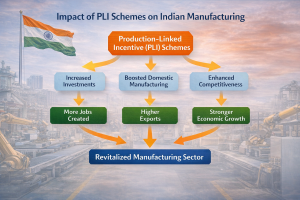
The structural shift toward manufacturing is yielding measurable results through the Production-Linked Incentive (PLI) schemes.
Investment: Over ₹3.2 lakh crore in investments have been attracted across 14 sectors.
Export Milestone: Smartphone exports alone have crossed ₹1.2 lakh crore, turning India into a net exporter in a segment that was previously import-dependent.
Job Creation: The scheme has directly generated over 11.5 lakh jobs by early 2026, strengthening the domestic supply chain ecosystem.
Upskilling for 2026: Why Data Analytics is the Most In-Demand Skill
⚠️ Summary of Risks and Outlook
| Variable | Status | Impact on 2026 |
| Monsoon | ⚠️ Below Normal | High risk to rural demand and food prices. |
| Geopolitics | ⚠️ Volatile | Elevated shipping costs and energy uncertainty. |
| Private Investment | ✅ Improving | Stronger corporate balance sheets driving growth. |
| Policy | ✅ Stable | RBI’s neutral stance provides a predictable environment. |
UGC-Approved Online Degrees 2026: New Equivalence Rules
Disclaimer
The information provided in this report, “India’s 2026 Mid-Year Economic Outlook,” is for informational and educational purposes only. It is intended to provide a snapshot of current economic trends based on data available as of mid-April 2026.
