 Matribhumi Samachar English


Mumbai. Updated on : Tuesday, 23 June 2026
The financial landscape in India has undergone a historic, tectonic shift. The old-school financial myth that “you need big money to make big money” has officially been debunked.
With the seamless integration of AI-driven financial advisory and instant, unified UPI-based wealth interfaces, a single ₹1,000 note—the kind that easily vanishes on a standard weekend brunch—can now become the seed for a multi-lakh rupee financial forest.
The secret weapon for the modern Indian investor isn’t timing the volatile market; it is maximizing your Time in the Market. If you are looking for smart wealth creation in India, here is how you can deploy a small budget effectively.
1. The SIP Revolution: Compounding at Your Fingertips
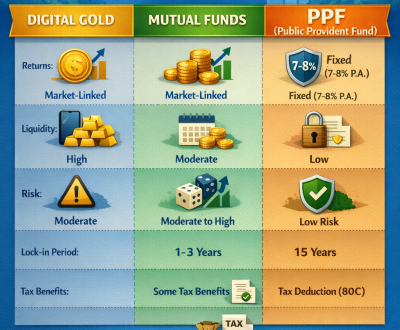
The Systematic Investment Plan (SIP) remains the absolute gold standard for small-scale retail investors. By committing just ₹1,000 every single month to a diversified equity mutual fund, you unlock the power of Rupee Cost Averaging.
This means your money automatically buys more units of a fund when the market drops, and fewer units when it climbs, systematically lowering your average cost price over time. Driven by India’s resilient GDP growth, even a moderate 12% annual return can transform a fixed ₹1,000 monthly investment into:
-
~₹2.3 Lakhs in 10 years
-
~10 Lakhs in 20 years
2. Digital Gold: The Modern Financial Hedge
Gold remains a deep cultural and financial staple across Indian households. However, the days of renting bank lockers to store physical gold coins are rapidly fading.
Digital Gold allows you to buy 24-Karat pure gold for as little as ₹1. This asset class is highly liquid and can be instantly sold or converted into physical jewelry via institutional partner jewelers. Because it eliminates traditional middleman “making charges” and security risks, it stands out as an ideal diversification tool for a tight budget.
3. Public Provident Fund (PPF): The Sovereign Safety Net
For the conservative investor, the Public Provident Fund (PPF) continues to offer an unmatched sovereign guarantee. While its interest rates are reviewed quarterly by the government, the completely tax-free nature of its returns makes it a cornerstone for stress-free retirement planning.
Expert Insight: While many believe PPF accounts are strictly meant for large tax-savers, you can actually open a PPF account with just ₹500. A tiny ₹1,000 monthly contribution ensures you build a disciplined, risk-free retirement corpus.
The Ultimate Growth Multiplier: The ‘Auto Step-Up’
Don’t let your investment remain stagnant. The smartest modern micro-investing platforms offer an Auto Step-Up feature. By opting to increase your monthly SIP contribution by just 10% annually—which means adding a tiny ₹100 extra to your monthly budget each year—look at how your final wealth changes at a 12% rate of return:
| Strategy | 10-Year Value | 20-Year Value |
| Static SIP (Fixed ₹1,000/mo) | ~₹2.32 Lakhs | ~₹9.99 Lakhs |
| Step-Up SIP (10% Annual Rise) | ~₹3.40 Lakhs | ~₹27.20 Lakhs |
Quick FAQ for Beginners
Can I actually start investing with just ₹1,000 a month in India?
Yes. Modern micro-investing apps, index mutual funds, and digital gold platforms allow you to start with amounts as low as ₹100 to ₹500.
Should a beginner buy direct stocks with ₹1,000?
If you are managing a small budget, you should stick to Exchange Traded Funds (ETFs) or Nifty 50 Index funds. This distributes your ₹1,000 across the top 50 companies in India instantly, protecting you from the high risk of a single stock crashing.
What is the minimum amount required to keep a PPF account active?
You only need a minimum deposit of ₹500 per financial year to keep your Public Provident Fund account active and earning tax-free interest.
Disclaimer
Investments in Mutual Funds, the Stock Market, and Digital Gold are subject to market risks. The value of your investments can fluctuate based on market conditions, and past performance is not a guaranteed indicator of future results. Please read all scheme-related documents, terms, and conditions carefully before investing.
External References & Resources
For further updates on national economic policy, trade announcements, or local grassroots updates out of Uttar Pradesh, explore the English news edition at Matribhumi Samachar English.