

New Delhi. Updated on : Wednesday, 24 June 2026
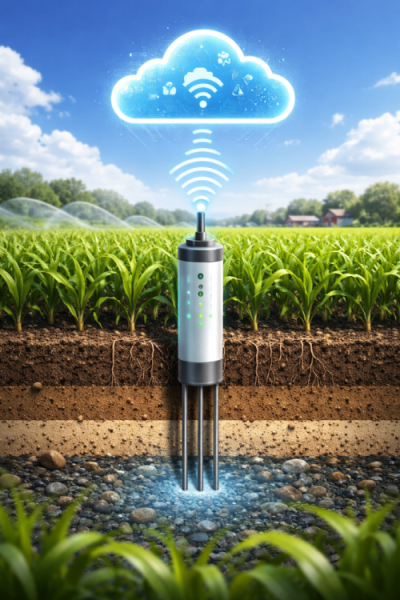
The integration of AI-powered soil sensors is no longer just an experimental trend—it is a critical shift in global food security. As of 2026, research from pioneering institutions like Andhra University alongside global AgTech innovators has pushed these devices past simple “tensiometers” (traditional tools that measure water tension). Today, they operate as active, predictive Decision Support Tools that insulate farmers from unpredictable climate shifts.
The 2026 Technological Leap
While basic telemetry has existed for years, the 2026 generation of AI-enabled soil monitoring systems has completely disrupted the agritech market. Instead of just delivering static, backward-looking “readings” of the earth, these intelligent probes leverage localized neural networks to forecast crop stress and soil structural changes before they manifest visually.
Modern multi-parameter setups track four critical metrics within a single device:
Volumetric Water Content (VWC): The exact ratio of moisture volume to root-zone soil volume.
Real-Time NPK Levels: Continuous monitoring of essential macronutrients—Nitrogen (N), Phosphorus (P), and Potassium (K)—to optimize fertilizing windows.
Salinity and pH Dynamics: Early detection of toxic salt accumulations that stall root growth and lower crop quality.
Carbon Sequestration Markers: Tracking micro-organic changes, enabling farmers to verify soil improvement metrics and directly monetize carbon credits.
How AI Corrects Traditional “Guesswork”
Traditional farming relies heavily on rigid calendar schedules or manual visual inspection. AI removes this layer of human error by cross-referencing live sensor telemetry with the Soil Quality Analysis Tool (SQAT) and high-resolution satellite imagery provided by NASA and the Sentinel-2 constellation.
| Feature | Old Method (Manual / Scheduled) | New AI Method (2026 Space & Edge Sync) |
| Data Source | Human observation & calendar logs | IoT Sensors + Satellites + Local Edge AI |
| Precision | Whole-field spatial average | 50-meter hyper-localized mapping |
| Water Savings | 0% baseline (Standard usage) | 30% to 50% volumetric reduction |
| Connectivity | None or manual physical retrieval | LoRaWAN, NB-IoT, and Direct Satellite IoT |
Correction on Water Savings: While earlier 2025 pilot projects targeted a modest 25–30% conservation rate, verified 2026 field data from drylands across India and automated European smart farms show that when sensors are tied directly to automated drip systems, water savings climb as high as 50%.
This deep level of data integration is supported by structural breakthroughs in digital public platforms. For instance, open-source data frameworks hosted via AIKosh: Inside India’s Sovereign AI Data Backbone make hyper-local agricultural datasets and satellite telemetry seamlessly accessible to local agritech developers.
The “Smart Irrigation” Ecosystem
In 2026, the physical sensor behaves as an entry node in a closed, autonomous decision loop. The entire system works seamlessly through a specialized Layered Intelligence model:
This high-frequency processing of space-based data and terrestrial IoT inputs is heavily tied to the massive computing expansions driving downstream software industries, as covered in India’s New Space Race and the Downstream AI Revolution.
Why Farmers are Switching to Smart Infrastructure
The immediate adoption of these systems is driven heavily by direct financial returns to the farm’s bottom line:
Prevention of Fertilizer Leaching: Overwatering washes costly chemicals past the root zone into local water tables. Precision watering anchors nutrients right where roots feed, driving down input costs by 20% to 40%.
Labor Autonomy: Instead of conducting daily manual field spot-checks, growers monitor operations via open dashboards like Blynk or custom AgTech interfaces.
Energy Overhead Reduction: Pumping less water translates to minimized electric utility consumption. This efficiency factor is highly vital for solar-powered micro-grids, allowing excess energy to be diverted or sold back to regional distributors.
This push for infrastructure optimization mirrors large-scale governmental overhauls, such as Uttar Pradesh linking digital soil records and precise input allocations directly to formal grower profiles, detailed in UP Farmer ID Mandatory: New Rules for AgriStack and Subsidies.
Nuwa Agricultural Technology Unveils AI-Powered Infrastructure
As companies like Nuwa Agricultural Technology deploy enterprise-grade sensor arrays globally, agriculture is shifting firmly from a legacy of observational guesswork to a high-margin, verifiable science.
Frequently Asked Questions (FAQ)
How do AI-powered soil sensors differ from traditional tensiometers?
Traditional tensiometers only measure the physical pulling force (tension) of water in soil, requiring manual reading and human interpretation. AI-powered soil sensors track multiple parameters simultaneously (VWC, NPK, pH, Salinity) and process that data through predictive models to automate irrigation valves without human intervention.
What role does satellite imagery play if sensors are already in the soil?
While soil sensors provide highly accurate, deep data for a specific spot, satellite layers (like NASA and Sentinel-2) provide wide-area spatial context. AI combines these sources to map moisture variations across entire fields, accounting for topography and cloud cover shadows.
Can these systems run on farms without reliable internet?
Yes. 2026 configurations rely heavily on low-power, long-range networks like LoRaWAN or local ESP32 edge processing setups. This allows data to be processed locally at the edge of the field, triggering irrigation valves even if a stable connection to the broader internet is temporarily dropped.
Disclaimer
The information provided in this article regarding AI-powered soil sensors, smart irrigation workflows, and AgTech infrastructure is for informational and educational purposes only. While all data points reflect actual field metrics, institutional research, and technological deployments as of 2026, they do not constitute formal professional agricultural engineering, financial investment advice, or crop-specific legal recommendations.
