

New Delhi. Updated on : Wednesday, 24 June 2026
The ongoing Rabi Marketing Season (RMS) 2025–26 highlights a fascinating contrast in India’s winter crop economy. While state backed initiatives have successfully anchored grains like wheat, a combination of record-breaking local yields and cheap global imports continues to test the price support frameworks for oilseeds like mustard.
As we look deeper into the Indian agriculture market forecast 2026, this distinct price divergence offers a look into how structural government strategies and macro international trade policy directly affect the financial realities of domestic farmers.
Market Dynamics: A Tale of Two Essential Commodities
Wheat: Strong Policy Insulation and Steady Demand
Wheat remains the absolute anchor of stability in the ongoing trading cycle. The central government’s structural floor rate adjustments—setting the wheat Minimum Support Price (MSP) at ₹2,425 per quintal for RMS 2025–26 and aggressively projecting a further hike up to ₹2,585 per quintal for the upcoming RMS 2026–27 season—has heavily fortified agricultural incomes against open market shocks.
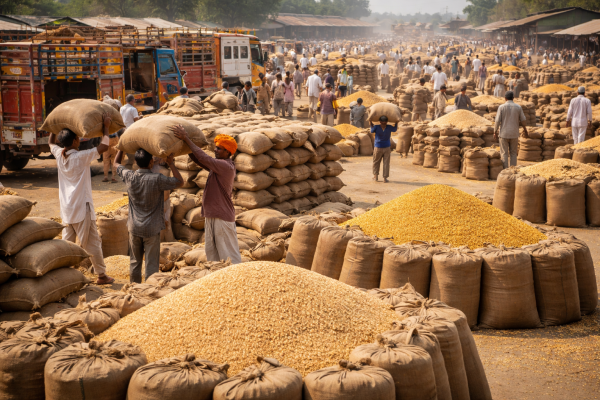
Procurement Buffers: Direct government procurement footprint remains highly active across key agricultural belts like Punjab, Haryana, and Madhya Pradesh. By shifting volume away from open trading blocks into official warehouses, the state has thinned out raw private market availability, allowing wholesale market prices to comfortably track at or slightly above official support rates.
Climate Resiliency: Despite early concerns regarding brief local heatwaves, late post-winter rains and a rapid rollout of late-sown resilient seeds have stabilized yields, ensuring India safely hits a record targeted production boundary close to 120 million tonnes.
Mustard: Compounding Pressures From Gluts and Imports
In sharp contrast, domestic mustard seed farmers are navigating an intensely restrictive selling market. Even though the state established an aggressive base support floor of ₹5,950 per quintal, spot transactions inside major local mandis regularly fluctuate below this baseline.
The Domestic Supply Glut: Ideal localized growing conditions have driven a stellar winter harvest, with total domestic production comfortably surging past 13 million tonnes.
The Global Oil Import Dilemma: Local oil processing and crushing mills have reduced aggressive domestic procurement because international crude palm oil and refined soybean oil imports remain significantly cheaper. Rather than purchasing local mustard at fixed high support floors, industrial mills are optimizing operational margins via cheaper imported substitutes.
Technical Overview: Approved MSP Trends Across Rabi Crops
To counter these systemic market imbalances and insulate farmers from shifting open-market matrices, the Cabinet Committee on Economic Affairs (CCEA) continues to enforce progressive baseline revisions.
The structure below breaks down official price dynamics comparing recent crop cycles alongside projected farmer margins:
| Rabi Crop Category | MSP 2025–26 (₹/Quintal) | Newly Approved MSP 2026–27 (₹/Quintal) | Absolute Increase Vector | Projected Return Over Cost* |
| Wheat | ₹2,425 | ₹2,585 | +₹160 | 109% |
| Rapeseed & Mustard | ₹5,950 | ₹6,200 | +₹250 | 93% |
| Lentil (Masur) | ₹6,700 | ₹7,000 | +₹300 | 89% |
| Gram (Chana) | ₹5,650 | ₹5,875 | +₹225 | 59% |
| Barley | ₹1,980 | ₹2,150 | +₹170 | 58% |
| Safflower | ₹5,940 | ₹6,540 | +₹600 | 50% |
*Note: The calculated return margin directly reflects the All-India weighted average Cost of Production (A2+FL parameters), strictly adhering to the national policy directive of guaranteeing at least a 50% profit margin over base expenses for the farming community.
Modern Structural Reforms: Digitization and AgriStack Integration
Beyond straightforward price modifications, the overarching market ecosystem is being retooled through large-scale administrative digital shifts. A notable example is the mandatory implementation of the Digital Farmer ID (Kisan Pehchan Patra) under the comprehensive national AgriStack platform.
For instance, in primary agricultural centers like Uttar Pradesh—home to nearly 3 crore growers—the state has integrated these digital identities to overhaul systemic benefit pipelines:
Direct Procurement Linkages: Middlemen and unauthorized external brokers are systematically bypassed because direct crop sales at MSP collection centers require pre-verified Digital ID verification.
Subsidy and Resource Tracking: The allocation of essential farm inputs, from subsidized fertilizers distributed through Primary Agricultural Credit Societies (PACS) to specialized machinery under the Krishi Yantra Subsidy Yojana, is now directly managed via digital ledger networks.
While central price support mechanisms like NAFED and the National Cooperative Consumers’ Federation (NCCF) are actively intervening to absorb surplus mustard yields via the Price Support Scheme (PSS), long-term oilseed price recoveries will ultimately rely on adjustments to international import duty margins.
Frequently Asked Questions (FAQ)
Why are wheat prices rising or remaining stable even after the primary harvest concludes?
Wheat prices are well-supported because an extensive volume of the total harvest has been directly absorbed by state procurement programs. This reduction in the open market supply leaves private millers and commercial traders competing for limited remaining stocks, holding prices steady above the base MSP floor.
What is causing mustard prices to trade lower than the government-mandated MSP?
The price drop is caused by a massive domestic yield of over 13 million tonnes combined with low import tariffs on foreign edible oils. Local oil processing mills prefer to buy cheaper imported crude palm and soybean oil rather than paying full price for domestic mustard seeds.
How does the Digital Farmer ID improve grain procurement?
The Digital Farmer ID streamlines transactions by linking land ownership records directly with bank accounts. This ensures that only genuine farmers can sell their produce at designated procurement stations, cutting out unauthorized middlemen and preventing delayed payments.
Relevant Resource Links
For further details and updates on market movements and rural agricultural reforms, please explore the official coverages:
Read the latest analytical market breakdowns on the Matribhumi Samachar English Homepage.
Learn more about the market forecasts for primary crops at Matribhumi Samachar Agricultural Commodity Forecast.
Understand new regional procurement guidelines via Matribhumi Samachar UP Farmer ID Mandatory Rule.
Disclaimer
The informational insights provided throughout this market overview are collated for general educational and awareness purposes only. Agricultural market trends, geopolitical import duty schedules, and government procurement policies are subject to rapid shifts based on real-time bureaucratic amendments and changing international trade values.
