

Mumbai. Updated on : Wednesday, 24 June 2026
Investing in Indian real estate in 2026 offers incredible opportunities for wealth creation, but it comes with a brand-new set of rules. As our cities quickly stretch outward into rural borders and “Gram Panchayat” territories, the legal landscape has shifted.
To help you secure your hard-earned money and protect yourself against total capital loss, we’ve put together a friendly, highly detailed guide covering the latest regulatory shifts, technology-driven mandates, and must-have paperwork for land purchases in 2026.
The Digital Shift: Understanding RERA 2.0 in 2026
The property market is no longer managed through static web pages and physical archives. In 2026, the real estate sector relies on Live Digital Dashboards and high-tech tracking. For instance, the recent New UP Property Registry Rules 2026 have introduced mandatory biometrics and QR codes to entirely wipe out fraudulent land transfers.
When analyzing any plot or project, you must ensure it complies with two non-negotiable updates:
1. The 500/8 Rule
Do not fall for the myth that village or rural properties are exempt from national laws. By law, any project exceeding 500 square meters or containing 8 or more units must be registered under RERA. If a developer relies solely on a local “Gram Panchayat approval” but cannot show you a valid RERA registration number for a project of this size, that plot is legally non-existent for residential sales.
2. The Three-Bank-Account Guardrail
Under RERA 2.0 guidelines active in 2026, developers are legally obligated to split project funds across three separate accounts: Collection, Separate, and Transaction. This ensures that exactly 70% of your money is locked entirely for land acquisition and construction materials, preventing builders from diverting your cash into newer projects.
The “Original Seven” Document Checklist
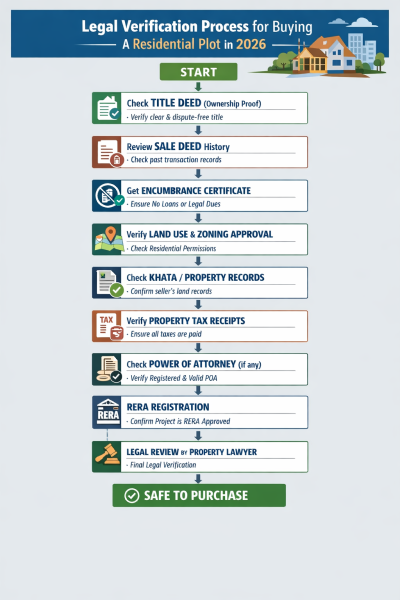
Before handing over token money or signing an advance agreement, make sure you collect and verify the following original documents.
| Document Type | What to Verify in 2026 |
| 1. Title Deed & Chain | Check historical ownership for 13 to 30 years. Look for the newly introduced Uniform Title Guarantees—a state-backed digital ownership certification designed to block “Benami” transactions. |
| 2. Encumbrance Certificate (EC) | Ensure a clear “Nil” status. In 2026, ECs must be cross-verified directly on central state digital registries to ensure physical copies haven’t been falsified. |
| 3. Non-Agricultural (NA) Certificate | Essential for rural outskirts. It proves the Land Use Certificate has been officially converted from agricultural to residential by the District Collector. |
| 4. Layout Approval (DTCP/CMDA) | Check that the layout is formally sanctioned. Unapproved plots risk facing forced demolition and immediate utility disconnection. |
| 5. Khata/Patta Records | Confirm that these revenue listings reflect the current seller’s name inside the digital land revenue system. |
| 6. Possession Certificate | For ready plots, this ensures the actual physical layout and boundaries match the dimensions filed in the legal paperwork. |
| 7. Tax Receipts | Ensure property taxes are paid in full right up to the current financial year so you don’t inherit the seller’s past debt. |
⚠️ High-Risk Mistakes to Avoid This Year
The Gram Panchayat Misconception: Many unvetted developers claim local village permissions override state frameworks. This is false. In 2026, national RERA guidelines strictly supersede village permissions for any developed project.
Power of Attorney (PoA) Deals: Be incredibly careful with PoA property sales. Current 2026 regulations strongly favor direct registrations between the actual owner and the buyer. PoA transactions are frequently used by bad actors to hide family disputes or skip paying proper stamp duties.
Expert Verification Tip: Always utilize the QR codes embedded inside modern project advertisements. In 2026, developers are legally forced to link these codes directly to live RERA dashboards. Scanning it gives you instant, tamper-proof access to auditing histories and construction deadlines.
Whether you are looking into an upcoming area boosted by transit developments—such as the booming Lucknow-Kanpur Rapid Rail Corridor—or exploring premium developments, keeping this checklist handy will ensure your investments remain safe, legal, and profitable.
Frequently Asked Questions (FAQs)
Can I construct a house on agricultural land if I have a Gram Panchayat NOC?
No. An NOC from a Gram Panchayat does not permit residential construction on agricultural land. You must obtain a formal Non-Agricultural (NA) Conversion Order from the District Collector.
What is the “Three-Bank-Account” system under RERA 2.0?
It is a 2026 compliance rule requiring developers to split finances into three separate accounts (Collection, Separate, and Transaction). This effectively locks 70% of the buyer’s money so it can only be used on that specific project’s construction and land expenses.
How do I know if a property advertisement is genuine in 2026?
Look for the mandatory RERA QR Code on the advertisement. Scanning this code must instantly redirect you to the official government RERA portal showing real-time construction and legal audits.
Disclaimer
This article is provided strictly for educational and informational purposes and does not constitute formal legal or financial advice. Real estate regulations and digital portals can vary significantly across individual states. Always consult with a registered property lawyer and certified financial advisor before signing contracts or transferring funds.
