

Mumbai. Updated on : Wednesday, 24 June 2026
Buying a home remains one of the most significant life milestones, but the landscape of protection has completely transformed. In 2026, the introduction of RERA 2.0 and recent Supreme Court rulings have shifted the power balance firmly toward the homebuyer.
If your builder is citing “labor shortages” or “administrative delays” while your possession date slips away, you no longer have to remain a passive bystander. Here is your updated legal roadmap to securing your investment and taking control of your financial future.
What Has Changed in 2026? Stricter Rules for Developers
The real estate ecosystem has moved toward absolute financial discipline and transparent developer accountability. The days of loose paperwork and unchecked fund diversions are gone, replaced by precise structural frameworks:
1. The Three-Bank-Account System
To eliminate the fraudulent diversion of capital, developers are legally required to funnel your payments into three distinctly isolated accounts:
Collection Account: Where 100% of the buyer’s money initially lands.
Separate (Escrow) Account: Where 70% of all collected funds are automatically locked. These funds can only be withdrawn progressively to cover raw construction and land acquisition costs, validated by third-party architecture audits.
Transaction Account: The remaining 30% used for general operational and marketing expenses.
2. Mandatory QR Codes on Advertisements
Transparency is now instantaneous. Every single marketing asset—whether a newspaper print ad, digital flyer, or physical hoarding—must feature an official RERA QR code. Scanning it directs you straight to the project’s live portal, showing real-time construction milestones, financial balance sheets, and any pending litigation.
3. The Supreme Court “Parity” Ruling
A landmark judgment (Parsvnath Developers vs. Others) permanently dismantled the era of one-sided Builder-Buyer Agreements (BBAs). The rule is now absolute parity: if a builder structures a contract to penalize you at an 18% interest rate for delayed payments, they must pay you that identical 18% interest rate for possession delays.
4. Non-Negotiable Occupancy Certificates (OC)
Handing over keys or inviting you to do fit-outs without a permanent, valid Occupancy Certificate issued by local authorities is completely illegal. Any offer of possession without an OC is deemed legally “null” and constitutes an immediate deficiency in service.
When Are You Eligible to File a RERA Complaint?
You are well within your legal rights to initiate formal dispute proceedings if your project exhibits any of the following warning signs:
The officially committed possession date listed in your BBA has lapsed (including any permitted grace periods).
The builder tries to coerce you into accepting possession without presenting a valid, permanent OC.
There is a glaring mismatch between the promised high-end amenities on marketing brochures and actual physical progress on-site.
The developer defaults on uploading their mandatory Quarterly Progress Reports (QPR) on the state’s RERA portal.
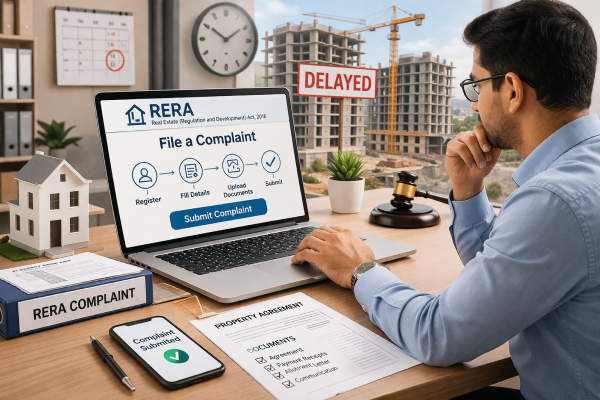
Step-by-Step Guide to Filing a RERA Complaint in 2026
The grievance mechanism has been heavily digitized across states to accelerate resolution times. Follow this sequence to file a valid case:
Busting Common Real Estate Myths
Myth 1: “Gram Panchayat Approval protects my under-construction investment.”
Fact: False. RERA is the overarching legal framework across the country. Any real estate project exceeding 500 square meters or comprising more than 8 distinct units must maintain active RERA registration, regardless of local village or rural permissions.
Myth 2: “I bought this property in resale, so I cannot claim delay compensation.”
Fact: False. The Supreme Court has explicitly established that the right to seek financial delay compensation “travels with the property.” Subsequent buyers inherit the exact same legal protections as the original allottee.
Frequently Asked Questions (FAQs)
What is the resolution timeline for a RERA complaint in 2026?
While state authorities actively target a 60-day resolution window, the timeline depends on attending scheduled virtual hearings and providing clean, indisputable financial evidence. Once an order is passed, it holds the execution weight of a civil court decree.
Can a builder force me to pay extra for delayed construction due to raw material costs?
No. Under RERA 2.0 regulations, a builder cannot arbitrarily hike the property cost unless specifically outlined via escalation clauses within an approved BBA, or if there is a substantial layout modification explicitly agreed upon by two-thirds of the project’s allottees.
What happens if a builder ignores a RERA refund order?
If a developer fails to comply with an execution order, the RERA Authority can direct the local district administration to recover the outstanding dues as arrears of land revenue, which can include sealing properties or attaching the developer’s bank accounts.
Additional Institutional Resources
To stay fully informed on regional updates, regulatory amendments, and complementary real estate legal overhauls happening this year, explore these expert analyses:
- Understand structural overhauls in local ownership tracking and anti-fraud protocols via the Matribhumi Samachar English: New UP Property Registry Rules.
Analyze changing consumer habits and geographical market shifts under RERA 2.0 via the Matribhumi Samachar English: Tier-2 Property Boom Comparison.
Disclaimer
This article is curated strictly for educational and informational awareness. Real estate laws, state portal filing procedures, and litigation fees vary across different state jurisdictions. This information does not constitute formal legal counsel. Homebuyers facing intense disputes are strongly advised to consult a certified legal professional or a registered RERA practitioner to evaluate their specific contractual terms.
