

Mumbai. Updated on : Wednesday, 24 June 2026
The Indian real estate market has received a significant boost following the Reserve Bank of India’s (RBI) latest monetary policy announcement. For home buyers and existing borrowers navigating floating-rate loans, the decision offers a window of predictability in an otherwise volatile global economy.
If you are planning to purchase a property or looking to switch your lender, understanding how this macroeconomic decision impacts your monthly budget is crucial. Let’s dive into the details of the latest rates, bank offers, and strategies to secure the best possible home loan deal in 2026.
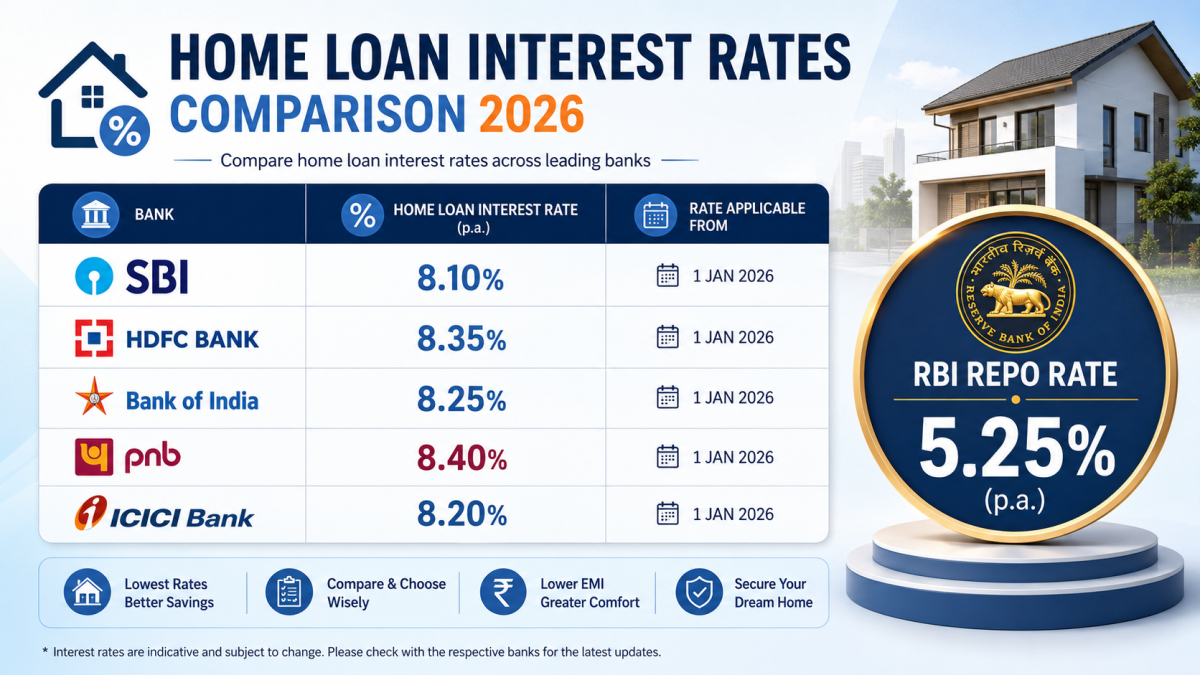
RBI Keeps Repo Rate Unchanged at 5.25%
In its Monetary Policy Committee (MPC) meeting, the RBI decided to maintain the repo rate at 5.25%. Adopting a “neutral” stance, the central bank aims to balance economic growth with retail inflation control.
What is the Repo Rate?
The repo rate is the interest rate at which the RBI lends money to commercial banks. When it stays unchanged,
the External Benchmark Lending Rate (EBLR)—to which most modern home loans are tied—remains stable.
For home loan borrowers, this “pause button” means that floating-rate EMIs will see no immediate hikes. It provides a sigh of relief for households managing tight monthly budgets and gives prospective buyers a clear baseline to plan their finances.
Comprehensive Bank Comparison: Special Home Loan Offers
While the repo rate sets the baseline, individual banks add a risk premium based on their portfolio strategies. Several Public Sector Undertakings (PSUs) and private lenders have introduced special home loan campaigns with competitive entry-level pricing.
Here is a detailed breakdown of the effective ranges and highlights for major Indian banks:
| Bank | Starting Interest Rate (p.a.) | Effective Range | Primary Advantage / Best For |
| Bank of India (BOI) | 7.10% | 7.10% – 10.00% | Lowest entry-level market rate for high-credit borrowers. |
| HDFC Bank | 7.20% | 7.20% – 13.00% | High-speed, seamless digital sanctioning processes. |
| Punjab National Bank (PNB) | 7.20% | 7.20% – 9.10% | Highly economical processing fees (starting at ₹2,500). |
| State Bank of India (SBI) | 7.25% | 7.25% – 8.75% | Transparent PSU terms, trusted sovereign backing, and no hidden costs. |
| ICICI Bank | 7.45% | 8.50% – 9.80% | Instant digital-only pre-approved offers for existing customers. |
Crucial Market Nuances to Keep in Mind
Securing a home loan in 2026 requires looking beyond the bolded “starting rates” advertised on billboards. Lenders have significantly sharpened their risk assessment models this year.
1. The PSU Aggression (The 7.10% Floor)
To capture a larger market share in the early quarters of 2026, smaller public sector giants like the Central Bank of India and Bank of India are actively undercutting private sector lenders. If your priority is purely the lowest interest rate, looking toward PSU banks is currently your best bet.
2. The ICICI Digital vs. Walk-In Variance
ICICI Bank offers a highly competitive rate of 7.45% exclusively for pre-approved customers applying through their digital ecosystem. However, if you are a “walk-in” customer without a prior relationship, standard rates generally begin much higher, around 8.50%. Always check if your existing salary or savings account qualifies you for a digital-first relationship discount.
3. Tightened Credit Score Sensitivity
Banks have significantly tightened their “Risk Premium” protocols. The advertised starting rates (like BOI’s 7.10% or SBI’s 7.25%) are reserved strictly for individuals with pristine credit records.
CIBIL Score of 750 or above: Qualifies for the lowest advertised floor rates.
CIBIL Score below 750: Expect an automatic risk markup ranging from 0.15% to 0.40% above the starting rate.
Strategic Tips for 2026 Home Borrowers
To maximize the benefits of the current stable rate environment, consider executing these three financial strategies:
Leverage Campaign Deadlines: Many banks have extended their financial-year-end special offers. Ensure you submit your official application and secure your rate lock before these promotional windows close.
Optimize Your Loan-to-Value (LTV) Ratio: If you have surplus liquidity, try raising your down payment to cover 30% or more of the property value. By reducing the bank’s risk profile (bringing the LTV below 70%), you gain significant leverage to negotiate a “Preferred Borrower” discount.
Verify Reset Periods: Ensure your loan agreement stipulates a quarterly reset period rather than a half-yearly or annual one. When the RBI eventually enters a rate-cut cycle, a shorter reset period ensures your EMI drops without delay.
Frequently Asked Questions (FAQ)
Q1: Will my home loan EMI decrease immediately because of the RBI pause?
No. An unchanged repo rate means your interest rate will remain stable. Your EMIs will neither increase nor decrease immediately. Decreases will only occur when the RBI actively slashes the repo rate and your bank passes on the benefit during your next scheduled reset date.
Q2: What is the difference between an advertised rate and an effective range?
The starting rate is the minimum interest a bank charges, usually given to salaried individuals with a CIBIL score above 750-800. The effective range shows the absolute minimum and maximum rates a bank can charge based on your employment type, gender, loan amount, and credit risk.
Q3: Can I switch from a private bank to a PSU bank for a lower rate?
Yes, you can opt for a home loan balance transfer. However, calculate the costs involved—such as processing fees, legal valuation charges, and administrative stamp duties with the new lender—to ensure the interest savings outweigh the transfer expenses.
Related Coverage from Matribhumi Samachar
For ongoing updates, detailed regional bank branch listings, and expert opinions on real estate trends, explore the following resources:
For the primary policy announcement details, see RBI Policy Impact on Real Estate.
To read the complete market briefing and upcoming financial predictions, read the Latest Financial News & Analysis.
Disclaimer: Interest rates, processing fees, and loan terms are subject to change at the sole discretion of the respective lending institutions. External Benchmark Lending Rates (EBLR) fluctuate in accordance with RBI directives and market conditions. Borrowers are strictly advised to thoroughly read the official Loan Agreement, Hidden Charges schedule, and Terms & Conditions at their specific local bank branch before signing. All data points listed above reflect market filings correct as of April 2026.
