

New Delhi. Updated : Wednesday, 3 June 2026
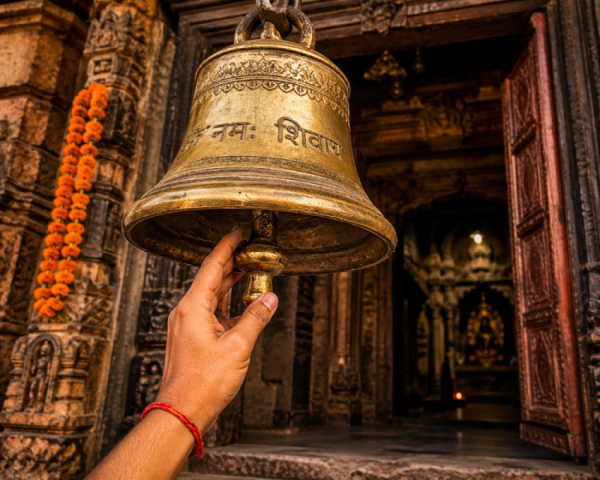
If you have ever stepped onto the cool stone floors of a Hindu temple, the first sensation to greet you—before the aromatic scent of incense or the sight of the deity—is the resonant, metallic chime of the bell. This act, known as ringing the Ghanta, is one of the most recognizable aspects of Sanatan Dharma.
However, ringing the bell is far more than a simple announcement of your arrival. It is a highly sophisticated spiritual and psychological tool designed to harmonize your internal mind with the external universe. Let us dive into the deeper spiritual symbolism, architectural science, and neuroscience behind this age-old practice, including a few necessary scientific corrections to common internet myths.
- Announcing Your Arrival to the Divine
In the philosophy of Bhakti (devotion), a temple is treated as the literal, living home of the deity. Ringing the bell is a gesture of deep humility and respect, serving as a “spiritual knock” at the sacred door.
- Informing the Deity: It is a beautiful way for the devotee to say, “I have arrived, O Lord, to seek your grace and unconditional love.”
- Divine Preparation: It signals the formal beginning of the sacred interaction between the Atman (the individual soul) and the Paramatman (the supreme cosmic soul).
- The Metallurgy of Sound and Vibration
Ancient Indian architects and sages were true masters of acoustics. Traditional temple bells are not made of ordinary scrap metals. They are painstakingly cast from a carefully balanced mixture of metals.
Debunking the Heavy Metal Myth
Many articles online claim that temple bells contain heavy industrial metals such as Cadmium, Lead, Manganese, and Chromium. From both a toxicological and metallurgical standpoint, this is incorrect. Heavy metals like lead and cadmium dampen sound rather than make it resonate, and their dust would pose health hazards to artisans and devotees.
In reality, authentic bell metal is a premium form of bronze—traditionally a balanced alloy consisting of:
- Copper (the base metal, providing strength)
- Tin (the key component that creates a bright, singing resonance)
- Minor additions of Zinc, Iron, and traditional auspicious metals (Panchadhatu) like Gold and Silver.
This specific metallurgical combination produces a sharp, rich, and remarkably long-lasting sound wave when struck.
- The 7-Second “Brain Reset” Button
When a large, well-crafted temple bell is struck, it generates a sustained echo that lasts for approximately 7 seconds.
[Bell Strike] ──> Sharp Auditory Stimulus (Interrupts Chatter)
└──> 7-Second Harmonic Echo ──> Brainwave Synchronization (Calm Alertness)
In traditional spirituality, this 7-second duration is believed to activate and harmonize the seven healing energy centers (Chakras) of the human body.
From a neurological standpoint, this prolonged resonance acts as an immersive acoustic experience. The brain naturally responds to harmonious, repetitive frequencies by encouraging hemispheric synchronization (unity between the left and right hemispheres of the brain). This sudden, clear acoustic wave clears away chaotic mental chatter, creating an immediate state of calm alertness.
- Dispelling Negative Energy and “Tamas”
According to Hindu cosmology, the material world is governed by three Gunas (inherent qualities): Sattva (purity and light), Rajas (passion and activity), and Tamas (darkness, lethargy, and inertia).
- The Sound of Purity: The striking resonance of the bell is believed to shatter Tamasic energies—such as doubt, mental fatigue, and lingering negative vibrations—that a devotee might carry from the stresses of daily life.
- Consecrated Space: The physical sound waves act as a spatial purifier, ensuring that the air surrounding the Garbhagriha (sanctum sanctorum) remains a high-vibrational, spiritually charged space.
- A Gateway to Daily Mindfulness
One of the greatest challenges during worship is a wandering mind. We often walk into a spiritual space while still stressing about work deadlines, family chores, or digital notifications.
- Instant Focus: The sharp, sudden sound of the bell acts as an immediate psychological anchor. It halts the brain’s default mode network and forces the mind to snap directly into the “Now.”
- Sensory Engagement: By engaging the sense of hearing so powerfully, the bell helps the devotee transition from a state of external distraction to Ekagrata (one-pointed concentration), which is essential before beginning prayer or meditation. This is highly comparable to modern mindfulness techniques that use sound bowls or chimes as focal anchors.
- Scriptural Symbolism of the Ghanta
The Agama Shastras (ancient texts detailing temple construction and rituals) provide profound symbolic descriptions for every structural element of the bell:
| Part of the Bell | Symbolic Representation |
| The Body | Represents Ananta (Infinite, boundless Time). |
| The Clapper (Tongue) | Represents Goddess Saraswati, the deity of wisdom, speech, and sound. |
| The Handle | Represents Prana Shakti (the vital life energy), often adorned with figures of Hanuman or Garuda. |
The Echo of “Om”
As the ringing of the bell slowly fades into absolute silence, its acoustic trail beautifully mimics the chanting of the primordial syllable “Om” (Aum). This slow dissolution of sound into stillness perfectly mirrors the ultimate journey of the soul—arising from cosmic vibration and eventually merging back into silent, eternal consciousness.
Related Spiritual and Temple Traditions
If you are interested in exploring how modern technology and ancient traditions continue to merge across Indian temples, discover how tech is modernizing pilgrimages via the Shri Kashi Vishwanath Temple Next-Gen App-Based Darshan System. Alternatively, read about how visual majesty honors these spaces in the feature covering the installation of the Gold-Plated Kalasam at Amawa Ram Mandir in Ayodhya.
