

New Delhi. Tuesday, 28 April 2026
The Bhagavad Gita, spoken by Lord Krishna on the battlefield of Kurukshetra, is often called the “Manual of Life.” While the setting was ancient, the psychological and practical challenges Krishna addressed—anxiety, indecision, burnout, and ego—are more prevalent today than ever. By integrating these teachings into a modern routine, we transform mundane tasks into a path of spiritual and professional growth.
1. The Art of Detached Action (Nishkama Karma)
The cornerstone of Krishna’s philosophy is found in the concept of Nishkama Karma. In a digital age obsessed with “likes,” “KPIs,” and instant gratification, this teaching is a radical act of mental rebellion.
The Deep Wisdom: When your mind is fixed on the outcome (the paycheck, the promotion, the praise), you create a “performance gap” filled with anxiety. This anxiety actually lowers the quality of your work.
Daily Practice: Set your goals clearly, but once the work begins, immerse yourself entirely in the process. Treat the task as an offering to the excellence within you.
2. Emotional Equanimity (Samatvam)
Krishna describes a “Sthitapragya”—a person of steady wisdom—as someone who remains the same in pleasure and pain, victory and defeat.
The Deep Wisdom: Life is a series of dualities (Dwandwas). If your happiness is tied to external validation, you will be on a permanent emotional rollercoaster.
Daily Practice: When you receive a scathing email or a glowing review, take a breath. Acknowledge the emotion, but do not let it define your identity or your next action.
3. Radical Self-Discipline (Atmanigraha)
Success is not an accident; it is a habit. Krishna emphasizes that for one who has conquered the mind, the mind is the best of friends; but for one who has failed to do so, the mind is the greatest enemy.
The Deep Wisdom: Modern distractions are designed to hijack our dopamine systems. Discipline is the only armor that protects our focus.
Daily Practice: Implement “Digital Fasting” or fixed meditation times. By mastering small impulses, you build the willpower necessary for major life pivots.
4. Alignment with Duty (Svadharma)
Krishna famously tells Arjuna, “It is better to perform one’s own duty imperfectly than to master the duty of another.”
The Deep Wisdom: We often chase careers or lifestyles because they look good on others. This leads to “soul-fatigue.” Success is most sustainable when it aligns with your inherent nature (Svabhava).
Daily Practice: Audit your daily tasks. Are you playing to your strengths, or are you trying to be a second-rate version of someone else?
5. Mastery Over the Senses and Negativity
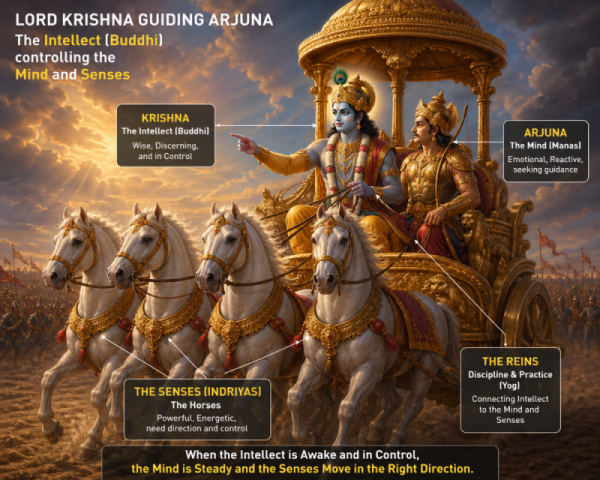
The senses are like wild horses, and the mind is the reins. If the driver (the intellect) is weak, the horses will pull the chariot into a ditch.
The Deep Wisdom: Anger and jealousy act as “clouding agents” for the intellect. Krishna warns that from anger comes delusion, and from delusion comes the loss of memory and reason.
Daily Practice: Use the “Three-Gate Rule” before speaking or reacting: Is it true? Is it necessary? Is it kind?
6. The Pursuit of Lifelong Wisdom (Jnana)
Krishna suggests that there is “nothing as purifying as knowledge.” This isn’t just academic learning, but self-knowledge—understanding the “why” behind the “what.”
The Deep Wisdom: A stagnant mind becomes a breeding ground for ego. Continuous learning keeps the spirit humble and adaptable.
Daily Practice: Dedicate 30 minutes a day to “Deep Reading”—texts that challenge your worldview rather than just confirming your biases.
7. Compassionate Leadership and Service (Seva)
Krishna himself, the Supreme, took the role of a humble charioteer. This teaches us that no work is beneath us and that true leadership is service.
The Deep Wisdom: Success achieved at the cost of others is fragile. Success achieved by lifting others is “Yajna” (a sacred sacrifice).
Daily Practice: Mentor a junior colleague, volunteer your skills, or simply practice active listening. Shift your perspective from “What can I get?” to “How can I contribute?”
Related Resources from Matribhumi Samachar
For more insights on spiritual wisdom and daily living, explore these curated links:
Final Thought:
Success is not a destination but a state of being. By practicing these seven principles, you don’t just achieve your goals; you become a person capable of handling those goals with grace and poise.
Disclaimer
Readers are encouraged to exercise their own judgment and consult with relevant experts before making significant life decisions. Matribhumi Samachar does not claim to provide an exhaustive theological discourse and acknowledges that interpretations of spiritual texts may vary among different scholars and practitioners.
