 Matribhumi Samachar English


New Delhi. Wednesday, 6 May 2026
The Mahabharata is far more than a historical or mythological chronicle; it is a sophisticated treatise on applied ethics (Dharma) and strategic management. In the 21st century, where corporate landscapes are characterized by volatility, uncertainty, complexity, and ambiguity (VUCA), the lessons from the Kurukshetra war provide a timeless framework for navigating modern crises.
Key Leadership Archetypes and Their Corporate Mirrors
While the Pandavas represent the “ideal” path, the epic provides a 360-degree view of human behavior by showcasing the pitfalls of even the most powerful leaders.
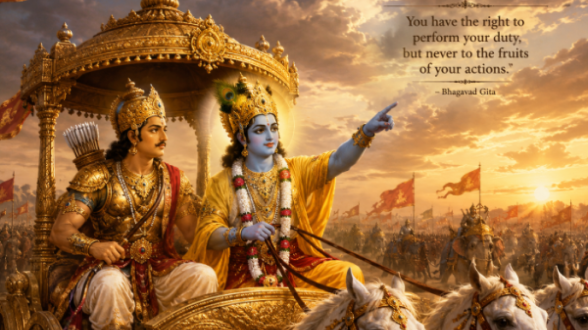
1. The Visionary Mentor: Krishna
Krishna’s role as a non-combatant charioteer is the ultimate example of Strategic Empowerment. He does not fight the war but ensures that the right person is in the right place at the right time.
-
The Lesson: Modern CEOs should move from “doing” to “enabling.” By providing clarity of purpose (as Krishna did for Arjuna during his moment of despair), a leader ensures the team can execute even the most daunting tasks.
2. The Ethical Anchor: Yudhishthira
Yudhishthira’s struggle with truth and duty highlights the difficulty of maintaining a Triple Bottom Line (Profit, People, Planet). His commitment to Dharma, even when it led to personal loss, emphasizes that short-term setbacks are often necessary to maintain long-term brand integrity and public trust.
3. The High-Performance Specialist: Arjuna
Arjuna represents the Subject Matter Expert (SME). However, his initial breakdown on the battlefield shows that even the most skilled professionals can suffer from “burnout” or “moral paralysis.”
-
The Correction: Modern leadership must address mental health and emotional intelligence. Technical skill without emotional resilience is a liability.
4. The Trap of “Vested Interest”: Bhishma & Drona
Both were masters of their craft but were bound by their “salary” (allegiance to the throne). They chose institutional loyalty over moral justice.
-
The Lesson: In corporate governance, this warns against the “Bystander Effect” where senior executives remain silent about unethical practices because of their stock options or seniority benefits.
Core Principles for Modern Decision-Makers
Strategic Agility over Rigid Planning
The Pandavas were outnumbered (7 divisions vs. 11 divisions of the Kauravas). They won because they were agile. They adapted their formation and strategy daily based on the opponent’s moves.
-
Application: In a fast-changing market, a rigid 5-year plan is less effective than a flexible strategy that allows for quick pivots.
The Power of Diversity (The Pandava Synergy)
The five brothers had vastly different temperaments:
-
Bhima: The Disruptor/Executioner.
-
Arjuna: The Technical Master.
-
Sahadeva & Nakula: The Data Scientists/Logisticians (astrology and animal husbandry).
-
Yudhishthira: The Compliance/Ethics Officer.
-
Insight: A leader should not hire “clones.” A diverse team that debates and challenges each other is far more resilient than a group of “Yes-men.”
Communication as a Tool for Conflict Resolution
The war could have been avoided multiple times through better communication. The failure of the peace missions (Sanjay and Krishna’s diplomatic efforts) highlights how ego-driven communication leads to the “Point of No Return.”
-
Application: Transparent internal communication prevents the “silo effect” where departments work against each other rather than toward a common goal.
Conclusion: Beyond the Battlefield
The ultimate message of the Mahabharata is that power is a responsibility, not a privilege. Whether you are a manager at a startup or a policymaker in government, your legacy is not built on the wealth you accumulate, but on the “Dharma” you establish within your organization. Success without values is merely a temporary victory; leadership with character is a timeless legacy.
Related Resources & Further Reading
For more insights into Indian heritage, ethics, and contemporary socio-political analysis, explore these relevant articles:
Disclaimer
The Mahabharata is a complex epic with numerous regional variations and scholarly interpretations. The views expressed in this article are based on widely accepted narratives but do not claim to be the sole or absolute interpretation of the text.