
New Delhi. Wednesday, 6 May 2026
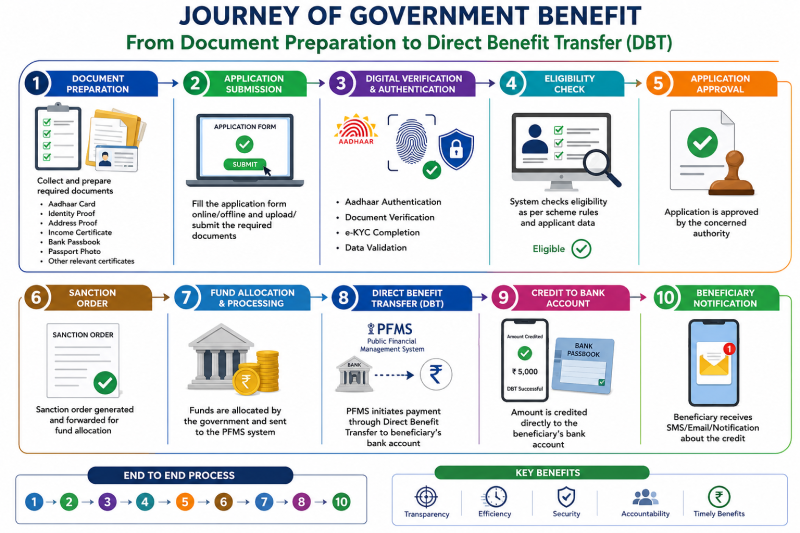
The landscape of social welfare in India has undergone a massive digital transformation. By May 2026, the integration of the India Stack—comprising Aadhaar, UPI, and DigiLocker—has made accessing government benefits more transparent than ever. However, the bedrock of a successful application remains a verified set of documents. Missing a single link between your mobile number and your Aadhaar can lead to “verification pendency,” delaying crucial financial aid.
The Anatomy of Eligibility: Why Documents Matter
Government schemes are generally divided into entitlement-based (where you are automatically eligible based on census data) and application-based (where you must prove your need). In both cases, the government uses a “Trust but Verify” model.
1. Identity & Residency Proofs
Aadhaar Card: The universal identifier. In 2026, ensure your Biometric Update is current (especially for children who have turned 5 or 15) to avoid authentication failures.
Voter ID (EPIC): Essential for state-specific schemes where “Domicile” or “Son of the Soil” requirements are strict.
Family ID (Parivar Pehchan Patra): Now mandatory in states like Haryana and Uttar Pradesh to map household benefits and prevent duplication.
2. Financial & Category Verifications
Income Certificate: This must be issued within the last six months for most scholarships and EWS (Economically Weaker Section) benefits.
Ration Card: Beyond food, it serves as a “Category Certificate” for BPL (Below Poverty Line) or APL families.
Caste Certificate: A one-time document, but must be uploaded to DigiLocker for instant verification by central portals.
3. The Banking Link: Direct Benefit Transfer (DBT)
NPCI Mapping: It is a common misconception that having a bank account is enough. Your account must be linked to the NPCI (National Payments Corporation of India) mapper. This ensures that when the government sends money to your Aadhaar number, it knows exactly which bank account to credit.
Digital Tools for Real-Time Eligibility Checking
The era of standing in long queues at the Tehsildar’s office is fading. Use these digital gateways:
myScheme Portal: This AI-driven platform asks you a series of questions (Age, State, Occupation) and generates a list of schemes you are eligible for across 20+ departments.
UMANG App: Provides a “Life-cycle” approach to governance, from birth certificates to pension applications.
Jan Samarth Portal: Specifically for credit-linked government schemes (loans for business or education).
Latest 2026 Updates
Ayushman Bharat Expansion: Eligibility is no longer strictly tied to the 2011 SECC data. Many states have now expanded this to include all families with an annual income below ₹3 lakh.
Mobile Number Portability: If you change your mobile number, you must update it in the Aadhaar database first, then your bank, and finally the PM-Kisan/PMAY portals.
E-KYC: Most schemes now require a periodic “Face Auth” or OTP-based E-KYC every 6 to 12 months to continue benefits.
Quick Summary Checklist:
Is your Aadhaar linked to your current mobile?
Is your Bank Account NPCI-mapped?
Is your Income Certificate less than 6 months old?
Have you uploaded your documents to DigiLocker?
By keeping this “Digital Toolkit” ready, you ensure that you never miss out on the social safety nets provided by the government.
Important Links & Resources
For the latest news and local updates regarding state-specific implementation of these schemes, you can refer to the following resources:
Latest Welfare News: matribhumisamachar.com/en/category/national
State-specific Notifications: matribhumisamachar.com/en/category/states
Official Discovery Portal: myScheme.gov.in
Direct Benefit Status: pfms.nic.in
Disclaimer
Matribhumi Samachar English is not a government agency. The content herein should not be construed as legal, financial, or professional advice. Applicants are strongly advised to verify all details on official portals such as myScheme.gov.in, India.gov.in, or through the UMANG app before submitting any sensitive documents or applications.
