

New Delhi. Monday, 18 May 2026
Imagine if every time you wanted to turn on a light bulb, you had to buy, build, and maintain a massive diesel generator in your backyard. It sounds absurd, doesn’t it? Instead, we plug our appliances into a wall outlet, use electricity seamlessly, and pay only for what we consume. The power grid handles all the complex machinery, maintenance, and distribution behind the scenes.
Cloud computing applies this exact exact pay-as-you-go, utility-driven model to the digital world. Instead of forcing you to store massive files or run power-hungry software entirely on your local laptop, smartphone, or physical office hardware, cloud computing delivers on-demand technology services over the internet.
Whether you are streaming a 4K movie, checking your email, or looking to build a high-demand career, understanding the architecture of the cloud is no longer optional. Driven by automation, decentralized architectures, and agentic artificial intelligence, the modern landscape has shifted from basic digital usage to deep architectural dependency. To navigate this evolution effectively, professionals must transition from basic digital literacy to true computing literacy.
How Does Cloud Computing Work?
At its core, the “cloud” isn’t an invisible, magical entity floating in the sky. It is a highly sophisticated, physical infrastructure consisting of millions of networked servers housed inside massive, climate-controlled data centers worldwide. These data centers are owned, secured, and meticulously maintained by global technology giants like Amazon, Microsoft, and Google.
When you interact with a cloud-supported application, the data lifecycle follows a structured loop:
The Request: You trigger an action on your local device (e.g., clicking to stream a video or requesting an AI model to process a prompt).
The Transmission: Your command is packaged as data and travels instantly across fiber-optic cables and wireless networks via the internet.
The Processing: A remote server inside a designated data center intercepts your request. It utilizes massive central processing units (CPUs), graphics processing units (GPUs), and memory to execute the request.
The Response: The computed data is beamed back to your local screen in milliseconds, allowing you to access supercomputing capabilities without owning a single piece of heavy hardware.
The Three Primary Cloud Deployment Models
Not all clouds are built or managed the same way. Organizations choose specific deployment strategies depending on their financial models, scalability demands, and legal compliance structures.
1. Public Cloud
In a public cloud environment, the physical infrastructure (hardware, servers, storage, and networking devices) is entirely owned and operated by a third-party cloud service provider. These resources are dynamically partitioned and shared among millions of unrelated users—often referred to as “tenants.”
Key Advantages: Unmatched scalability, zero physical maintenance, and a pure pay-per-use financial model.
Industry Giants: Amazon Web Services (AWS), Microsoft Azure, and Google Cloud Platform (GCP).
Ideal For: Startups, public web applications, and agile organizations that need to scale up or down instantly.
2. Private Cloud
A private cloud consists of infrastructure dedicated exclusively to one single organization. It can be physically hosted inside the company’s on-premise data center or managed off-site by a third-party vendor. Because the resources are isolated from the public internet and other tenants, it offers total control over security and data sovereignty.
Key Advantages: Strict data security, fully customizable architecture, and tight alignment with regulatory laws.
Ideal For: Central banks, defense agencies, healthcare providers, and organizations with strict zero-trust operational protocols.
3. Hybrid Cloud
The hybrid cloud blends public and private environments, allowing applications and data to seamlessly move between them.
By binding these distinct environments together via secure data pipelines, businesses enjoy the ultimate balance of power. For instance, a retail banking enterprise can securely store highly sensitive customer credit profiles inside an isolated private cloud, while simultaneously running its customer-facing mobile banking app on a public cloud to handle millions of concurrent user logins.
Breaking Down the “Cloud Computing Stack” (Service Models)
To truly understand cloud architecture, you must understand the three fundamental pillars of cloud delivery: SaaS, PaaS, and IaaS. Think of this stack as a spectrum of control. On one end, the provider does everything for you; on the other end, you build everything yourself using their raw materials.
+-------------------------------------------------------+
|          SaaS (Software as a Service)                 |  <- End Users (Just use the app)
+-------------------------------------------------------+
|          PaaS (Platform as a Service)                 |  <- Developers (Build & deploy code)
+-------------------------------------------------------+
|        IaaS (Infrastructure as a Service)             |  <- System Admins (Manage virtual hardware)
+-------------------------------------------------------+
Software as a Service (SaaS)
SaaS delivers a complete, fully functional software application over the internet, typically accessible via a standard web browser or mobile app. The cloud provider handles everything—the code, the updates, the server maintenance, data storage, and security. You simply log in and use it.
Everyday Examples: Gmail, Zoom, Microsoft 365, Slack, and Netflix.
Platform as a Service (PaaS)
PaaS provides a cloud-based environment loaded with development tools, operating systems, database management systems, and middleware. It is designed specifically for software developers. Instead of spending weeks configuring servers, operating systems, and network paths, developers can instantly upload their raw code and deploy live applications.
Everyday Examples: Heroku, Google App Engine, and AWS Elastic Beanstalk.
Infrastructure as a Service (IaaS)
IaaS is the foundational layer of the cloud stack. It allows you to bypass physical hardware entirely by renting raw, clean virtual computing blocks over the internet. When you purchase IaaS, you get blank virtual servers (virtual machines), storage space, and advanced networking configurations. You are entirely responsible for installing the operating system, setting up firewalls, managing databases, and deploying software.
Everyday Examples: Amazon EC2 instances, Google Compute Engine, and Azure Virtual Machines.
The Real-World Advantages and Disadvantages
Like any paradigm-shifting technology, cloud computing is an exercise in engineering trade-offs.
The Compelling Benefits
Border Borders Demolished: Data can be accessed securely by remote teams from any geographic location with an active internet link.
Shifting Capital Expenses (CapEx) to Operational Expenses (OpEx): Startups no longer need millions of dollars in upfront venture capital just to purchase hardware; they pay micro-cents per second for virtual infrastructure.
Fluid Elasticity: If a website experiences a sudden traffic spike during a major shopping holiday, the cloud automatically spins up new virtual servers in seconds to prevent crashes, scaling back down when traffic normalizes.
Disaster Resilience: Automated backups and geographically distributed servers guarantee that if a physical disaster strikes a local office, corporate data remains safe, mirrored across multiple alternate nodes.
The Inherent Risks and Challenges
The Offline Bottleneck: If your local fiber line is severed or your internet connection drops, your access to cloud-based corporate assets is instantly cut off.
The Threat Surface: Centralizing data onto third-party servers creates high-value targets for malicious actors. Businesses must adopt strict architectural standards to safeguard distributed cloud assets.
The “Bill Shock” Phenomenon: Because cloud resources scale automatically with demand, unmonitored development environments or unoptimized database queries can run up catastrophic, unexpected long-term costs if financial engineering principles (FinOps) are not actively enforced.
Emerging Horizons: The Cloud in 2026 and Beyond
Cloud computing is no longer just a digital filing cabinet for your photographs; it is the ultimate engine driving the world’s most sophisticated technologies.
The Convergence with Agentic AI
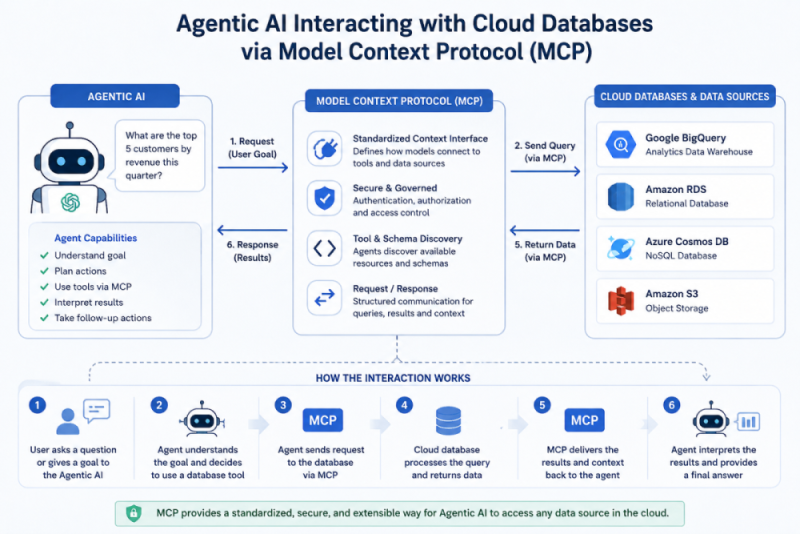
Today’s cloud computing infrastructure is heavily specialized. High-performance computing (HPC) Tier-III data centers are expanding globally to process the extreme resource requirements of next-generation AI models. We are rapidly transitioning past simple conversational chat interfaces into autonomous Agentic AI systems—ecosystems capable of multi-step reasoning and independent execution. These agentic tools rely entirely on cloud-native frameworks to securely link large language models directly to massive enterprise data repositories.
The Rise of Zero-Trust Security & DevSecOps
In a completely decentralized workspace where business data flows freely between hybrid cloud environments, home offices, and external networks, the traditional concept of a “secured corporate network firewall” is dead. Modern infrastructure now relies heavily on a paradigm known as Zero-Trust Architecture, a system governed by a simple rule: never trust, always verify. Modern tech professionals are continually shifting towards integrated DevSecOps pipelines, ensuring that automated security checking and strict cloud posture management are baked directly into the code before it ever hits a public server.
Summary for Beginners
Cloud computing is the invisible foundation of our modern digital lives. It shifts the burden of physical hardware, maintenance, power, and configuration away from individuals and businesses, turning computing into a highly accessible utility. If you store data online, leverage predictive tools, or interact with automated apps, you are standing on the shoulders of cloud engineering.
For deeper insights into navigating today’s rapidly evolving tech landscape and understanding the next wave of high-demand cloud architecture skills, read The Future Workforce: Top In-Demand Digital Skills for 2026 and Beyond on Matribhumi Samachar English. To further explore how these cloud environments protect your sensitive files from modern digital threats, check out The Ultimate Guide to Cyber Security: Protecting Your Digital Life.
Disclaimer
The content of this article does not constitute professional IT consulting, cyber security, architectural engineering, or financial advice (including corporate FinOps or cloud budgeting strategies). Implementation of cloud infrastructures, deployment models (Public, Private, Hybrid), or security frameworks (such as Zero-Trust and DevSecOps) should be done in consultation with certified IT professionals, cloud architects, or system administrators tailored to your specific organizational needs.
