

Washington. Sunday, 24 May 2026
The World Health Organization (WHO) officially declared the intensifying Ebola outbreak in the Democratic Republic of the Congo (DRC) and Uganda a Public Health Emergency of International Concern (PHEIC). Issued under the International Health Regulations (IHR) 2005, the declaration underscores severe anxiety among global health circles regarding rapid cross-border transmission in Central and East Africa.
Simultaneously, the Africa Centres for Disease Control and Prevention (Africa CDC) elevated the crisis status, categorizing this specific outbreak as a Public Health Emergency of Continental Security (PHECS).
In swift response to these international triggers, the Government of India’s Ministry of Health and Family Welfare issued a comprehensive travel advisory urging citizens to avoid all non-essential travel to the Democratic Republic of the Congo, Uganda, and South Sudan.
Why the Bundibugyo Strain Demands Global Alarm
A critical correction to public perception regarding standard Ebola outbreaks must be noted. Most historic countermeasures—including stockpiled medical kits—were designed around the Zaire or Sudan strains of the virus. The Bundibugyo ebolavirus strain introduces entirely distinct biological and logistical roadblocks.
1. No Approved Vaccines Available
The highly successful rVSV-ZEBOV vaccine (Ervebo) deployed in recent years only targets the Zaire strain. It offers zero cross-protection against the Bundibugyo strain. There are currently no approved vaccines ready for public distribution to protect against this variant.
2. Standard Monoclonal Treatments Ineffective
The revolutionary antibody treatments (like Inmazeb and Ebanga) that slashed mortality rates in past DRC outbreaks do not bind to or neutralize the Bundibugyo virus surface proteins. On-ground medical workers are limited strictly to aggressive supportive care, including intensive hydration and symptomatic therapy.
3. High Fatality Viral Hemorrhagic Fever
Classified as a severe viral hemorrhagic fever, the Bundibugyo strain causes multi-organ distress and internal bleeding. Historically, its case-fatality rate has fluctuated between 30% and 50%. However, because the primary epicenters feature heavily damaged or limited healthcare infrastructure, experts fear the actual mortality rates during this wave could surge significantly higher.
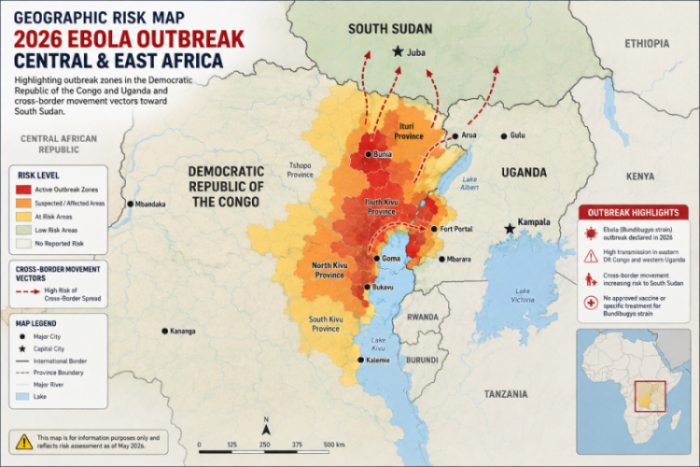
High-Risk Zones & Global Security Map
The WHO issued temporary cross-border guidelines on May 22 to aggressively strengthen entry-point surveillance. Neighboring nations are on high alert due to heavy migration and trade corridors.
| Region / Nation | Risk Assessment & Case Load (May 2026) | Regional Vulnerability Factor |
| Democratic Republic of the Congo | Epicenter: Ituri and Kivu provinces report over 740 suspected cases. | Deep conflict zones limiting humanitarian aid access. |
| Uganda | Active Vectors: Confirmed imported cases tracked into metropolitan Kampala. | High-density urban population hubs. |
| South Sudan | Severe Threat Level: Zero local cases but shares wide, unmonitored border walls with Ituri. | Fragile medical framework and low testing capacity. |
India’s Defensive Measures: Current Status
India’s Ministry of Health and Family Welfare confirmed that no cases of the Bundibugyo strain have been detected in India.
To maintain this firewall, point-of-entry security teams at international airports and maritime ports have initiated strict isolation protocols. Health officers are mandated to identify, clinically evaluate, and quarantine any traveler exhibiting unexplained fever or acute systemic symptoms within 21 days of arriving from the designated African hot zones.
Guidance for Expats and Travelers
For Indian nationals currently located inside or traveling through Central and East Africa, global safety guidelines recommend taking extreme operational precautions:
Avoid Outbreak Facilities: Do not visit local healthcare facilities or clinics in affected provinces unless experiencing a non-Ebola medical emergency.
Bypass Animal Vectors: Strictly avoid handling, cooking, or consuming wild bushmeat. Do not enter caves or rainforest areas populated by fruit bats or non-human primates.
Practice Rigid Hygiene: Maintain strict hand hygiene using soap and water or alcohol-based rubs. Avoid contact with the blood, body fluids, or clothing of any individual showing febrile illness.
Global healthcare networks, including Coalition for Epidemic Preparedness Innovations (CEPI), are actively coordinating with regional authorities to fast-track experimental Bundibugyo candidate vaccines into emergency clinical trials directly within the outbreak zones.
Relevant Regional Press & Health References
For continuous local reporting on health crises, public welfare announcements, and regional Indian developments, check the official English news portal of Matribhumi Samachar at matribhumisamachar.com/en.
