

New Delhi. Sunday, 24 May 2026
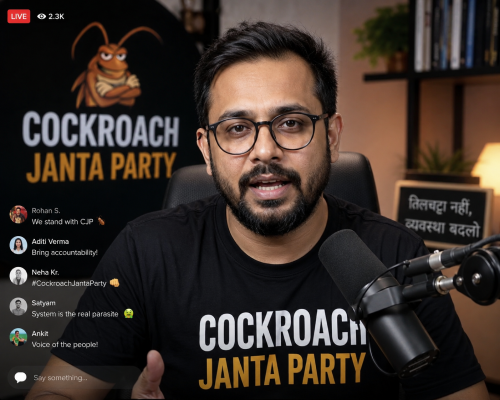
A major political controversy has taken over social media in India following the sudden rise, subsequent account blocking, and serious geopolitical allegations surrounding a satirical youth movement called the Cockroach Janta Party (CJP).
What began as a satirical reaction to a courtroom comment has rapidly escalated into a national debate involving student protests, government crackdowns, and allegations of foreign interference.
The Genesis: From Judicial Comment to Satirical Rebellion
The controversy tracing the rise of the CJP stems from an oral remark made in the Supreme Court of India.
The Catalyst: On May 15, 2026, during a court hearing regarding the designation of senior advocates, Chief Justice of India (CJI) Surya Kant made oral observations comparing certain sections of aggressive, unemployed youth who become social media commentators or RTI activists to “cockroaches” and “parasites of society.”
The Clarification: Though the CJI issued a formal clarification the next day stating he was misquoted and his remarks were strictly limited to individuals manipulating the legal profession with fake or bogus degrees, the damage online was already done.
The Birth of CJP: On May 16, 2026, digital communications strategist Abhijeet Dipke launched the “Cockroach Janta Party” on X (formerly Twitter) and Instagram. Sardonically calling it the “Voice of the Lazy and Unemployed,” the platform invited young Indians who felt insulted by the systemic characterization of youth to join the satirical front.
Explosive Social Media Growth & The NEET-UG Connection
The CJP transitioned with unprecedented speed from a localized internet joke into a massive political force. Within just five days of its launch, the group’s Instagram handle surged past 20 million followers, eclipsing the official accounts of established political heavyweights like the Bharatiya Janata Party (BJP) and the Indian National Congress.
The momentum shifted from mere memes to active political agitation when the CJP launched a digital campaign centering on educational accountability. Tapping into intense student anxiety, the group initiated an online petition demanding the immediate resignation of Union Education Minister Dharmendra Pradhan over alleged systemic failures and paper leaks regarding the NEET-UG 2026 examination. The movement quickly amassed over 5.6 lakh digital signatures, shifting the government’s attention directly toward the page.
The Crackdown: Security Concerns and the Pakistan Allegation
By May 23, 2026, the meteoric rise of the movement faced a sharp institutional halt. The official website of the Cockroach Janta Party was pulled down, and its primary social media handles were suspended or restricted within India under Section 69A of the Information Technology Act, following directives linked to national security concerns.
A fierce political blame game has since erupted over the authenticity of the movement’s massive following:
The BJP Stance: Union Minister and BJP leader Sukanta Majumdar addressed reporters alleging that the group’s sudden traffic explosion was artificial. He claimed data assessments showed that 49 percent of the CJP’s followers originated from Pakistan, while a mere 9 percent were located in India. Senior ministry advisers noted that the scale of harvesting tens of millions of followers in under 72 hours pointed strongly to coordinated foreign bot networks engineered to fan internal dissent.
The Founder’s Rebuttal: Operating from the United States where he is completing post-graduate studies, CJP founder Abhijeet Dipke vehemently denied the foreign proxy allegations. He argued that his internal metrics showed nearly 95 percent of the followership was organically Indian, consisting of students and young citizens tired of high graduate unemployment. Dipke asserted that the “Pakistan link” and subsequent account suspensions were part of a premeditated strategy to silence youth raising questions about the integrity of national examinations.
Political and Social Repercussions
The standoff has deeply divided public and political opinion. Opposition leaders, including Congress MP Shashi Tharoor, defended the movement as an expression of authentic youth grievance regarding unemployment, noting that suppressing a satirical movement is unhealthy for a democracy. Conversely, ruling party leaders have labeled the digital surge a “premeditated conspiracy” aimed at fostering civil anarchy under the guise of humor.
As the digital battle plays out, it continues to highlight the complex modern challenge facing authorities: distinguishing organic, sarcastic citizen dissent from malicious, foreign-backed digital manipulation.
For further background coverage and translated local perspectives on changing national trends, check out the regional breakdowns available on Matribhumi Samachar.
