


Mumbai. Saturday, 6 June 2026
The Indian public sector is witnessing an unprecedented policy shift. In a historic first, the government has served a strict one-year notice to two engineering and industrial titans: Bharat Heavy Electricals Limited (BHEL) and Steel Authority of India Limited (SAIL).
Both companies have been formally warned that their prestigious Maharatna status could be downgraded to Navratna if they fail to aggressively reverse their financial fortunes.
Managed by a high-level committee chaired by Cabinet Secretary T.V. Somanathan, this move signals an end to “permanent privileges” for Central Public Sector Enterprises (CPSEs). Moving forward, financial autonomy will be strictly tethered to continuous performance.
The Profit Problem: Why BHEL and SAIL Fell Short
While both organizations command immense infrastructure footprints, they have faltered against a critical profitability benchmark established to maintain Maharatna standing.
To qualify for and keep Maharatna status, a CPSE must sustain an average annual Profit After Tax (PAT) of more than ₹5,000 crore over a rolling three-year period. Currently, out of India’s 14 elite Maharatna companies, BHEL and SAIL are the only two failing to hit this target.
Maharatna Eligibility Criteria vs. Current Standing:
1. Average Annual Turnover  -> Must exceed ₹25,000 crore
2. Average Net Worth         -> Must exceed ₹15,000 crore
3. Average 3-Year PAT        -> Must exceed ₹5,000 crore (BHEL & SAIL failing here)
4. Global Operations         -> Must possess a significant international presence
SAIL: High Volume, Low Margin
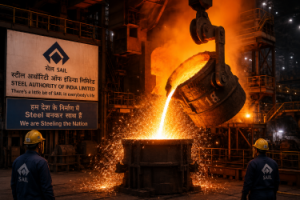
The Steel Ministry highlighted that SAIL remains an absolute giant in scale, boasting an average annual turnover exceeding ₹1 lakh crore and a robust net worth of ₹53,976 crore. However, macro headwinds—including global steel dumping, fluctuating raw material costs, and compressing margins—have severely bruised its bottom-line profits. While external projections show signs of recovery (with a projected PAT of ₹3,233 crore for FY26 up from ₹2,148 crore in FY25), it remains mathematically short of the required three-year average.
BHEL: Execution and Structural Hurdles
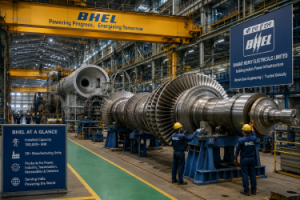
For BHEL, the challenges are structural. NITI Aayog explicitly pinpointed outdated human resource policies as a primary bottleneck stifling organizational agility and project execution speed. The company has historically faced delays in completing large-scale energy and transmission infrastructure projects, directly choking its cash flows and overall profitability.
Maharatna vs. Navratna: What Is at Stake?
A downgrade is not just a nominal demotion; it inflicts a massive blow to a company’s operational independence and boardroom financial muscle.
Under Maharatna Status: Boards can independently greenlight equity investments, mergers, or joint ventures up to ₹5,000 crore (or up to 15% of their net worth on a single project) without seeking Cabinet approval.
Under Navratna Status: This autonomy is drastically slashed. The ceiling for independent capital expenditure plummets to a mere ₹1,000 crore.
For heavy industries requiring immense upfront capital for manufacturing setups, modernization, and global bidding, waiting for ministerial approvals introduces significant bureaucratic delays. A downgrade could severely handicap both firms when competing against nimbler private players.
Systemic Reforms: Toughening the Rules of the Game
This double-warning is part of a broader, systemic overhaul intended to modernize how India’s state-owned enterprises operate.
1. Re-indexing to 2025 Economic Realities
Officials from NITI Aayog pointed out a major regulatory flaw: the current financial thresholds (₹25,000 crore turnover / ₹5,000 crore profit) were codified back in 2010. These metrics have never been adjusted for inflation or evolving market sizes. Consequently, the Department of Public Enterprises (DPE) has been tasked with rewriting the eligibility criteria based on 2025 economic values. Once implemented, all public sector giants will undergo a fresh evaluation under a significantly higher bar.
2. Strict Governance Penalties under the FY27 Framework
The government is also tightening the screws on corporate compliance. Under the upcoming FY27 performance assessment framework, non-financial metrics carry zero-tolerance penalties. If a CPSE fails to meet its mandatory Corporate Social Responsibility (CSR) obligations, delays vital payments to Micro, Small, and Medium Enterprises (MSMEs), or neglects to maintain transparent leadership succession plans, it will lose all allocated marks for those parameters in its annual evaluation.
Turnaround Blueprints: The Path Ahead
The Ministries of Steel and Heavy Industries are actively finalizing aggressive turnaround roadmaps to rescue both corporations.
BHEL’s recovery blueprint includes immediate internal cost-cutting measures, such as capping performance incentives at 16% and freezing the creation of top-tier (E-9 level) executive posts to streamline corporate overheads. SAIL is prioritizing cost optimization across supply chains and trying to stabilize margins against global price volatility.
The next twelve months will decide the operational future of these historic entities. If they cannot restore their profitability to align with the government’s stricter, inflation-adjusted benchmarks, a formal downgrade will signal a new era of absolute accountability in India’s public sector.
